Indigenous people of New Guinea
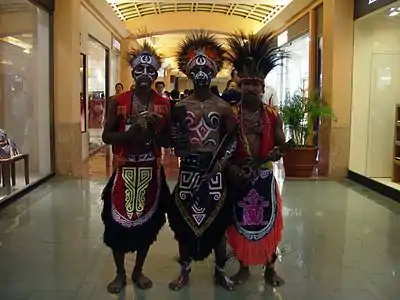
The indigenous peoples of New Guinea, commonly called Papuans,[1] are Australo-Melanesians.
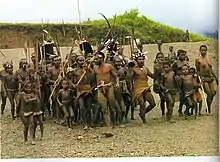
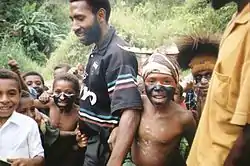
There are two major human population groups in New Guinea and neighboring islands today:
- a first wave from Out-of-Africa migrants, perhaps 60,000 years ago when New Guinea and Australia were a single landmass called Sahul,
- and, much later, a wave of Austronesian people from the north who introduced Austronesian languages and pigs about 4,000 years ago, and who left a small but significant genetic trace in many coastal Papuan peoples.
Linguistically, Papuans speak mostly languages from the Papuan language family, a diverse grouping of related and isolated languages, as well as Austronesian languages along parts of the coast, and recently developed creoles such as Tok Pisin, Unserdeutsch, and Papuan Malay.[2][3][4]
The term "Papuan" is used in a wider sense in linguistics and anthropology. In linguistics, "Papuan languages" is a cover term for the diverse, mutually unrelated, non-Austronesian language families spoken in Melanesia, the Torres Strait Islands, and parts of Wallacea. In anthropology, "Papuan" is often used to denote the highly diverse aboriginal populations of Melanesia and Wallacea prior to the arrival of Austronesian-speakers, and the dominant genetic traces of these populations in the current ethnic groups of these areas.[3]
Languages
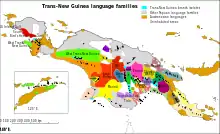
Ethnologue's 14th edition lists 826 languages of Papua New Guinea and 257 languages of Western New Guinea, a total of 1073 languages, with 12 languages overlapping. They can be divided into two groups, the Austronesian languages, and all the others, called Papuan languages for convenience. The term Papuan languages refers to an areal grouping, rather than a linguistic one. So-called Papuan languages comprise hundreds of different languages, most of which are not related.[5]
Papuan ethnic groups
The following indigenous peoples live within the modern borders of Indonesia and Papua New Guinea. Austronesian-speaking (AN) groups are given in italics.
Indonesian West Papua
Here are Papuan ethnic groups / tribes in Indonesian province of West Papua:[6]
|
Indonesian Papua
Here are Papuan ethnic groups / tribes in Indonesian province of Papua.[7]
| Jayapura City |
|
|---|---|
| Jayapura Regency |
|
| Sarmi Regency |
|
| Keeron Regency |
|
| Biak Numfor Regency |
|
| Waropen Regency |
|
| Yapen Regency |
|
| Mamberano Regency | |
| Mimika Regency |
|
| Jayawijaya Regency |
|
| Yahukimo Regency |
|
| Tolikara Regency |
|
| Pegunungan Bintang Regency |
|
| Painai Regency |
|
| Puncak Jaya Regency |
|
| Nabire Regency |
|
| Merauke Regency |
|
| Asmat Regency | |
| Mappi Regency |
|
| Boven Digoel Regency |
Papua New Guinea
Origin and genetics
In a 2005 study of ASPM gene variants, Mekel-Bobrov et al. found that the Papuan people have among the highest rate of the newly evolved ASPM Haplogroup D, at 59.4% occurrence of the approximately 6,000-year-old allele.[8] While it is not yet known exactly what selective advantage is provided by this gene variant, the haplogroup D allele is thought to be positively selected in populations and to confer some substantial advantage that has caused its frequency to rapidly increase.
Main Y-DNA Haplogroups of Papuan people are Haplogroup MS, Haplogroup P and Haplogroup C1b2a; a significant minority belong also to Haplogroup O-M175.[9]

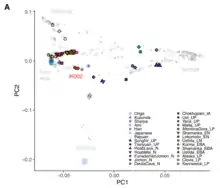
Recent genetic study Carlhoff et al 2021 notes "Demographic models infer a population split between the ancestors of Oceanian and Eurasian groups approximately 58 kya, whereas Papuan and Aboriginal Australian groups separated around 37 kya."[10] A Holocene hunter-gatherer sample (Leang_Panninge) from South Sulawesi "represents a previously unknown divergent human lineage that branched off around the time of the split between these populations approximately 37,000 years ago" and was found to be genetically in between East-Eurasians and Australo-Papuans. The sample could be modeled as ~50% Papuan-related and ~50% Basal-East Asian-related (Andamanese Onge or Tianyuan).[11][12]
Notable people
- Abba Bina, notable businessman
- Frans Kaisiepo, 4th Governor of Papua and National Hero of Indonesia
- Nitya Krishinda Maheswari, Indonesian badminton player and 2014 Asian Games women's doubles gold medalist
- Nowela Auparay, professional singer and the winner of Indonesian Idol
- Peter O'Neill, 7th Prime Minister of Papua New Guinea
- Freddy Numberi, politician and former Indonesian minister
- Raema Lisa Rumbewas, Indonesian weightlifter and silver medalist at 2000 Summer Olympics and 2004 Summer Olympics
- Boaz Solossa, Indonesian professional footballer
- Ricky Kambuaya, Indonesian professional footballer
- Michael Somare, former Prime Minister of Papua New Guinea
- Heather Watson, English female tennis player
See also
- Aboriginal Australians
- Indigenous Australians
- Koteka Tribal Assembly
- List of ethnic groups of West Papua
- Moluccans (to the west of New Guinea)
- Negrito (Southeast Asia)
- Papua conflict
- Proto-Australoid
- Stéphane Breton (filmmaker)
- Torres Strait Islanders between New Guinea and mainland Australia (including the Meriam people, whose language family is otherwise found in New Guinea).
References
- From the Malay word pəpuah 'curly hair'. "Papuan". Oxford English Dictionary (Online ed.). Oxford University Press. (Subscription or participating institution membership required.)
- Encyclopædia Britannica Online
- Friedlaender, Jonathan; Friedlaender, FR; Reed FA; Kidd KK; Kidd JR (2008). "The Genetic Structure of Pacific Islanders". PLOS Genetics. 4 (3): e19. doi:10.1371/journal.pgen.0040019. PMC 2211537. PMID 18208337.
- Jinam, Timothy A.; Phipps, Maude E.; Aghakhanian, Farhang; Majumder, Partha P.; Datar, Francisco; Stoneking, Mark; Sawai, Hiromi; Nishida, Nao; Tokunaga, Katsushi; Kawamura, Shoji; Omoto, Keiichi; Saitou, Naruya (August 2017). "Discerning the Origins of the Negritos, First Sundaland People: Deep Divergence and Archaic Admixture". Genome Biology and Evolution. 9 (8): 2013–2022. doi:10.1093/gbe/evx118. PMC 5597900. PMID 28854687.
- Palmer, Bill (2018). The Languages and Linguistics of the New Guinea Area. Mouton De Gruyter. ISBN 978-3-11-028642-7.
- Ronsumbre, Adolof (2020). Ensiklopedia Suku Bangsa di Provinsi Papua Barat. Yogyakarta: Penerbit Kepel Press. ISBN 978-602-356-318-0.
- "Pemerintah Provinsi Papua". www.papua.go.id. Retrieved 2021-02-16.
- "Ongoing Adaptive Evolution of ASPM, a Brain Size Determinant in Homo sapiens", Science, 9 September 2005: Vol. 309. no. 5741, pp. 1720–1722.
- 崎谷満『DNA・考古・言語の学際研究が示す新・日本列島史』(勉誠出版 2009年)(in Japanese)
- Carlhoff, Selina; Duli, Akin; Nägele, Kathrin; Nur, Muhammad; Skov, Laurits; Sumantri, Iwan; Oktaviana, Adhi Agus; Hakim, Budianto; Burhan, Basran; Syahdar, Fardi Ali; McGahan, David P. (2021). "Genome of a middle Holocene hunter-gatherer from Wallacea". Nature. 596 (7873): 543–547. doi:10.1038/s41586-021-03823-6. ISSN 0028-0836. PMC 8387238. PMID 34433944.
- Genomic insights into the human population history of Australia and New Guinea, University of Cambridge, Bergström et al. 2018
- Carlhoff, Selina; Duli, Akin; Nägele, Kathrin; Nur, Muhammad; Skov, Laurits; Sumantri, Iwan; Oktaviana, Adhi Agus; Hakim, Budianto; Burhan, Basran; Syahdar, Fardi Ali; McGahan, David P. (2021). "Genome of a middle Holocene hunter-gatherer from Wallacea". Nature. 596 (7873): 543–547. doi:10.1038/s41586-021-03823-6. ISSN 0028-0836. PMC 8387238. PMID 34433944.
The qpGraph analysis confirmed this branching pattern, with the Leang Panninge individual branching off from the Near Oceanian clade after the Denisovan gene flow, although with the most supported topology indicating around 50% of a basal East Asian component contributing to the Leang Panninge genome (Fig. 3c, Supplementary Figs. 7–11).
Further reading
- W. G. Lawes (1882), "New Guinea and Its People", Popular Science Monthly
External links
 Media related to People of Papua at Wikimedia Commons
Authority control  | |
|---|---|
| General | |
| National libraries | |