12th arrondissement of Paris
The 12th arrondissement of Paris is one of the 20 arrondissements, or boroughs, of the capital city of France. In spoken French, this arrondissement is referred to as the douzième (the "twelfth"). The arrondissement is situated on the right bank of the River Seine.
12th arrondissement of Paris | |
|---|---|
 The town hall | |
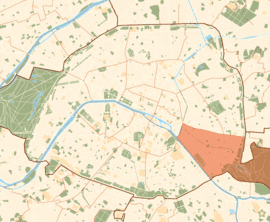 Location within Paris | |
| Coordinates: 48°50′27″N 2°23′17″E | |
| Country | France |
| Region | Île-de-France |
| Department | Paris |
| Commune | Paris |
| Government | |
| • Mayor (2020–2026) | Emmanuelle Pierre-Marie (EELV) |
| Area | 6.38 km2 (2.46 sq mi) |
| Population | 139,665 |
| • Density | 21,891/km2 (56,700/sq mi) |
| INSEE code | 75112 |
History
It is in the 12th arrondissement that some of the oldest traces of human occupation of the territory now occupied by Paris were found. During the construction of Bercy Village in the 1980s, vestiges of a Neolithic village were found (dating from between 4500 and 3800 BC). Subsequent excavations turned up wooden canoes (les pirogues de Bercy), bows and arrows, pottery and bone and stone tools. These are now exhibited in the Carnavalet Museum.
During the Roman era, the area that is now the 12th arrondissement was a largely uninhabited wetlands fed by streams originating in the surrounding hills. The area was crossed by a Roman road that linked Paris to Meaux and Melun.
The Bois and the Château of Vincennes
In the 11th century, the forest that would later become the bois de Vincennes was considered to be non-arable land. When Hugues Capet, King of the Franks, took up residence on the Île de la Cite, he used the bois de Vincennes as his hunting ground. The bois was then reserved for the exclusive use of the kings of France. Under Philippe Auguste it was enclosed by a 12 km wall.

A hunting lodge was built by Louis VII around 1150, which was upgraded to a Manor House by Philippe Auguste, who made it a royal residence that was used over the 1150-1340 period. Legend has it that Louis IX, Saint Louis, administered justice under an oak tree in what is now the bois de Vincennes.
The long process of turning this residence into a fortified castle, the Château de Vincennes, began in about 1337, when Philippe VI de Valois decided to build a dungeon near the Manor House. Progressive upgrades by subsequent kings led to the construction of the fortifications, the Saint Chapelle de Vincennes and several residences within the fortified walls that were designed to cater to royal tastes and standards of living. The last king to use the Chateau extensively as a royal residence was Louis XIV, who later abandoned it in favour of the Chateau de Versailles.
Emergence of a community of artisans
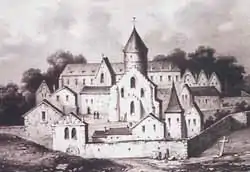
In 1204, a Cistercian abbey, Saint Anthony of the Fields, was founded outside and to the east of the walls of Paris. Its church was dedicated to Saint Antoine, which gave the name, Faubourg Saint Antoine (Saint Anthony’s suburb), to the neighbourhood that grew up around the Abbey. The Abbey was protected by armed soldiers who operated under the direct orders of the Abbesse, who was referred to as the Dame du Faubourg.
The Faubourg developed a specialty in furniture making and, especially, in cabinet making. The development of this specialty was due mainly to the protection and favours accorded by the kings of France to the Abbey, including a dispensation from taxes for artisans working in the territory of the Abbey. Moreover, in 1471, Louis XI authorised these artisans to work freely, without being subject to the control of the guilds. Over the years, the artisans of the Faubourg developed a solid international reputation that attracted skilled craftsmen from all over Europe.[2]:275
Starting in the 17th century, the Royal Mirror Manufacture was established in the Faubourg and further consolidated its reputation. This institution this would later become the multinational enterprise, Saint Gobain.
The distinctive courtyards and narrow passageways that characterise the Faubourg served groups of craftsmen that lived and worked together in the same building. This social organisation of production gradually faded out and had disappeared entirely by the final decades of the 20th century.[2]:277 With the urban redevelopment of the 1980s, the plan was to use the repurposed arches under the railway viaduc of the defunct Paris-Vincennes line to house artisans. The resulting Viaduc des Arts provides workshops for a wide array of specialised crafts. Nevertheless, most traces of the furniture-making activity have disappeared, though the École Boule, a famous school for furniture design located in the 12th arrondissement, continues to bear witness to this ancient artisanal tradition.[3]
The Revolution and 19th century political turmoil
The artisans and workers of the Faubourg played a key role in the French Revolution and the violent political turmoil of the 19th century. Residents of the Faubourg were instrumental in the taking of the Bastille on July 14, 1789. Of the 954 people who received official recognition for being ‘conquerors of the Bastille’, 70% were from the Faubourg Saint Antoine.

The unauthorised demolition of the Bastille began the day after the Bastille was taken when an entrepreneurial business man, Pierre-François Palloy, recruited a team to tear down the fortress. Recovered construction materials were subsequently sold, along with various mementos of the infamous building (keys, paper weights, etc.).[2]:272
The neighbourhood also played a prominent role in the Reign of Terror that followed. In the southern part of what is now Place de la Nation, a guillotine was erected in June 1794. Of the 2,498 people guillotined in Paris during the Revolution, 1,306 were beheaded there. Their bodies were then thrown into two mass graves in what is now the nearby Picpus Cemetery.[3]
After the Revolution, the Faubourg remained a hotbed of revolutionary activity, including during the July Revolution, the 1848 Revolution and the Paris Commune.
Urban development in the 19th century
From 1815 onwards, the neighbourhoods that would later become the 12th arrondissement were the focus of far-reaching urban development projects. These include construction of: the July Column (colonne de Juillet) on the place de la Bastille (1830); the Halle Beauvau (the covered market on rue d’Aligre, 1843); and the construction of the Gare de Lyon (1847) and of the Paris-Vincennes rail line (1855).
Haussmann was also active in this sector, creating arteries that would later take the names of boulevard Diderot (1854), rue Chaligny (1856), avenue Daumesnil (1859) and rue Crozatier (1861). Between 1855 and 1866, the bois de Vincennes was refurbished by order of Napoleon III, who wished it to become a “vast park for the working populations of eastern Paris.”
Creation of the present day arrondissement
From an administrative point of view, the present day 12th arrondissement was created by the law of 16 June 1859, which rearranged Paris into the 20 arrondissements that we know today. The law also extended the arrondissement by absorbing parts of the villages of Bercy and Saint Mandé.[3]
The first town hall, located to the south east of the current town hall, was burned down by the Commune. The current town hall was built in 1876 on avenue Daumesnil, following the plans of the architect, Antoine-Julien Henard.[3]
The bois de Vincennes was given to the City of Paris by Napoleon III in 1860, but was not officially integrated into the 12th arrondissement until 1926.[3]
Gallery — History
_-_WGA13030.jpg.webp) Château et bois de Vincennes, hunting scene from a medieval manuscript.
Château et bois de Vincennes, hunting scene from a medieval manuscript.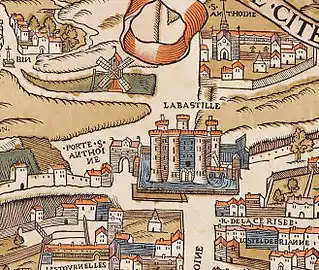 La Bastille and the Saint Antoine Abbey, around 1550.
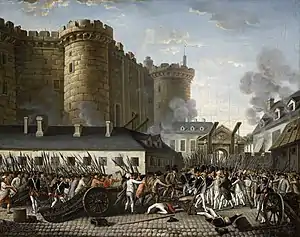 The taking of the Bastille.
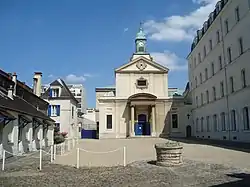 Entry to the Picpus Cemetery, the final resting place of 1306 victims of the local guillotine.
Urban renewal in the 20th century
The district benefited from numerous urban renewal and public works projects, many of them initiated during the 1980s. These include the areas of Cour Saint-Émilion and Bercy, which now contain the French Ministry of Finances, Bercy Village, the Parc de Bercy and the Bercy arena, now renamed Accorhotels Arena.[4] Much of the land these structures now occupy was a depot for wine arriving by river transport from Burgundy and the Loire.[2]:284

The 12th arrondissement also contains the Opéra de la Bastille, the second largest opera house in Paris. It was inaugurated in 1989, on the 200th anniversary of the storming of the Bastille.
The Coulée verte René-Dumont (or Promenade plantée) was developed at the same time as the Opéra de la Bastille. It is a 4.7 km (2.9 mi) elevated linear park built on top of obsolete railway infrastructure. The Viaduc des Arts, also part of this development, is located at the base of the western part of the Coulée verte René-Dumont, which is now a string of workshops for skilled artisans.
Places of interest
Like most neighbourhoods in Paris, the 12th arrondissement offers a rich array of historically important and aesthetically appealing sites. For the 12th, these sites emerged mainly from developments in the 19th century and from the late 20th century urban renewal projects. They include:
- Place de la Bastille (shared by the 4th, 11th and 12th arrondissements)
- Opéra Bastille
- Faubourg Saint-Antoine
- Bois de Vincennes
- Château de Vincennes
- Jardin du Bassin de l'Arsenal
- Cimetière de Picpus
- Musée des Arts Forains
- Palais de la Porte Dorée (Cité nationale de l'histoire de l'immigration)
- Palais Omnisports de Paris-Bercy
- Parc de Bercy
- Paris Zoological Park (also known as Zoo de Vincennes)
- Promenade plantée
- Viaduc des arts.
Gallery — Places of interest
.jpg.webp) The eastern section of the Coulée verte.
The eastern section of the Coulée verte._1.jpg.webp) The Place Félix Éboué.
The Place Félix Éboué.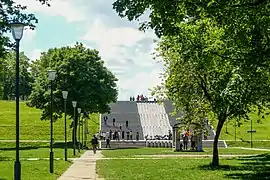 The Parc de Bercy.
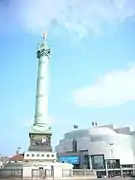 The July Column and the Opera de la Bastille.
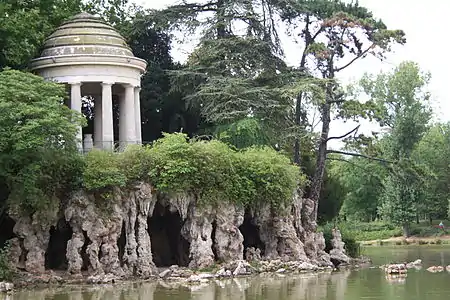 The Bois de Vincennes.
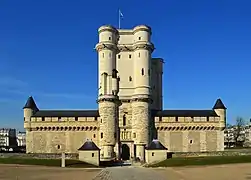 The Château de Vincennes.
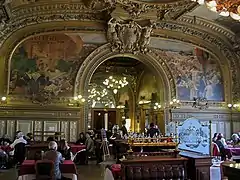 The Train Bleu restaurant, Gare de Lyon.
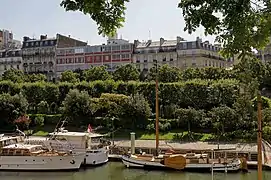 The Bassin de l’ Arsenal.
 Le Viaduc des Arts.
Geography
The land area of this arrondissement is 16.324 km2 (6.303 sq. miles, or 4,034 acres), two-thirds of which consists of the Bois de Vincennes park. Excluding the Bois de Vincennes, its land area is 6.377 km2 (2.462 sq. miles, or 1,576 acres).
Demographics
The peak of population of Paris's 12th arrondissement occurred in 1962 and was followed by three decades of decline. More recently, however, the population has begun to grow again, especially since the urban renewal projects of the 1990s. However, the 2018 census showed a slight decline in population.
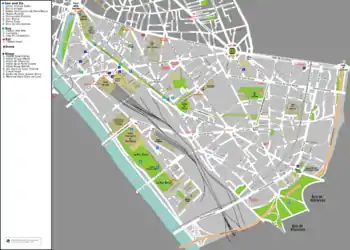
Historical population
| Year (of French censuses) |
Population[5] | Density per km 2 |
|---|---|---|
| 1872 | 87,678 | 13,749 |
| 1954 | 158,437 | 24,845 |
| 1962 (peak of population) | 161,574 | 25,337 |
| 1968 | 155,982 | 24,460 |
| 1975 | 140,900 | 22,095 |
| 1982 | 138,015 | 21,643 |
| 1990 | 130,257 | 20,426 |
| 1999 | 136,591 | 21,419 |
| 2009 | 142,897 | 22,408 |
| 2011 | 144,402 | 22,669 |
| 2017 | 141,287 | 22,180 |
| 2018 | 139,665 | 21,891 |
Immigration
| Born in metropolitan France | Born outside metropolitan France | |||
|---|---|---|---|---|
| 81.2% | 18.8% | |||
| Born in overseas France |
Born in foreign countries with French citizenship at birth1 | EU-15 immigrants2 | Non-EU-15 immigrants | |
| 1.2% | 4.1% | 3.2% | 10.3% | |
| 1 This group is made up largely of former French settlers, such as Pieds-Noirs in Northwest Africa, followed by former colonial citizens who had French citizenship at birth (such as was often the case for the native elite in French colonies), as well as to a lesser extent foreign-born children of French expatriates. Note that a foreign country is understood as a country not part of France in 1999, so a person born for example in 1950 in Algeria, when Algeria was an integral part of France, is nonetheless listed as a person born in a foreign country in French statistics. 2 An immigrant is a person born in a foreign country not having French citizenship at birth. Note that an immigrant may have acquired French citizenship since moving to France, but is still considered an immigrant in French statistics. On the other hand, persons born in France with foreign citizenship (the children of immigrants) are not listed as immigrants. | ||||
References and footnotes
- "Populations légales 2018". The National Institute of Statistics and Economic Studies. 28 December 2020.
- Chadych, Danielle; Leborgne, Dominique (2006). Paris pour le Nuls (in French). Paris: Éditions Générales First. ISBN 2-75400-168-9.
- "Histoire du 12e". mairie12.paris.fr (in French). Retrieved 2021-12-12.
- "Bercy district in Paris. Palais Omnisports". Paris Digest. 2018. Retrieved 2018-11-20.
- "Populations légales 2017 − Ces données sont disponibles sur toutes les communes de France hors Mayotte | Insee". www.insee.fr. Retrieved 2021-12-09.
External links
 |
Wikimedia Commons has media related to Paris 12e arrondissement. |
 12th arrondissement travel guide from Wikivoyage
- Mairie 12 website (in French)
 | ||
