Palais de Justice, Paris
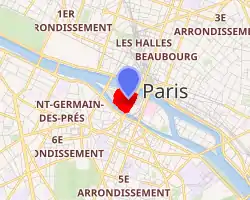
The Palais de Justice (French pronunciation: [palɛ də ʒystis]; '"Palace of Justice"), is a courthouse in Paris, located on the Île de la Cité. It contains the Court of Appeal of Paris, the busiest appellate court in France, and France's highest court for ordinary cases, the Court of Cassation. It is located on the site of the medieval Palais de la Cité, the royal palace of the Kings of France, and is next to the Sainte Chapelle, the royal chapel. The current building was largely constructed under Louis XIV (The May Courtyard), and later, from 1851 to 1914, under Napoleon III and his successors, by the architects Joseph-Louis Duc, Honoré Daumet and A. Tournaire.[1]
| Palais de Justice | |
|---|---|
_June_2010.jpg.webp) Palais de Justice – gates of the cour d'honneur. | |
| |
| General information | |
| Location | Paris, France |
The Tribunal de grande instance de Paris, previously located in the Palais de Justice, was moved in 2020 to a new building in new Judicial center of Paris in Batignolles in 2020.
History
The governors of the Gallo-Roman city of Lutetia built a fortress on the Ile de la Cité, approximately where the courthouse is today, along a temple at the other end, where the cathedral of Notre Dame de Paris is presently located. In the Middle Ages, the island was the religious, political and judicial capital of France. It was the home of the cathedral, of the Palais de la Cité, the royal palace. From the sixteenth century to the French Revolution the palace was the seat of the Parlement de Paris, an assembly of nobles and the highest royal court. Prior to the construction of the Palais de Justice, the Parlement met and heard cases in the Grand Chamber of the Palace, on the upper floor of the Conciergerie, between the Tower of Silver and Caesar Tower. The old palace was damaged by fires in 1618, 1737, and 1776, requiring major restoration. [2]
In March 1793, The Grand Chamber, where the Parlement of Paris had met, became the courtroom of the Revolutionary Tribunal, which rapidly tried and sentenced those accused of opposing the Revolution. Those convicted were usually taken to guillotine the same day. In 718 days, up until 31 May 1795, the Tribunal sent 2,780 persons to the guillotine. Among the last to be executed was the Chief Prosecutor, Fouquier-Tinville, bringing the Great Terror to a close.[3]
Under Emperor Napoleon III, the Palais building was reconstructed between 1857 and 1868 by architects Joseph-Louis Duc and Honoré Daumet.[4] The exterior includes sculptural work by Jean-Marie Bonnassieux. It was opened in October 1868 by Baron Haussmann, prefect of the Seine. It was awarded the Grand Prix de l'Empereur as the greatest work of art produced in France in the decade.[5]
In 1871, in the final days of the Paris Commune, the Communards set the inside of the building on fire, causing major damage. The building was not fully restored until just before the First World War. The final section to be finished was the Tribunal Correctionelle, or criminal court.[6]
 Session of the Parlement of Paris, attended by Louis XVI, in the Grand Chamber (19 November 1787)
'_(11068160775)_(2).jpg.webp) Courtyard and new facade of the Palace of Justice (1860)
Courtyard and new facade of the Palace of Justice (1860)_p321_Palais_de_Justice.jpg.webp) Salle des Pas Perdus, or main hallway, in the new Palace of Justice (1871)
Salle des Pas Perdus, or main hallway, in the new Palace of Justice (1871)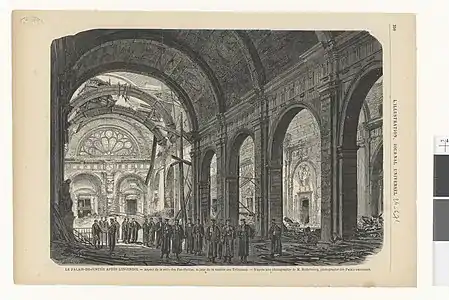 Main hallway after the fire set by Paris Commune
Architecture and decoration
Facade and Cour du Mai
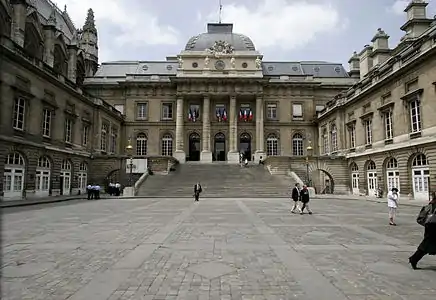 The facade and the Cour du Mai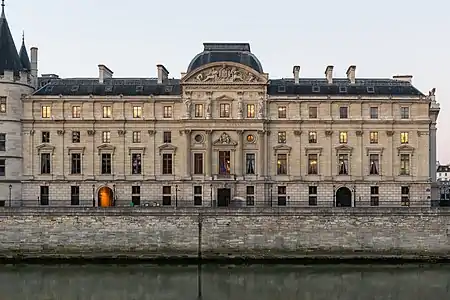
 South facade on the Quai des Orfevres
Interior of the Palace of Justice
_(PA00085991)_(2).jpg.webp) Hall of the "Pas Perdus"
Hall of the "Pas Perdus".jpg.webp) The Salle Voltaire of the Court d'Assises
The Salle Voltaire of the Court d'Assises Hearing chamber for criminal cases in the Cour de Cassation
 First civil hearing chamber of the Cour de Cassation
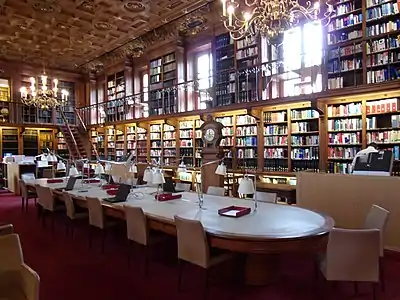 Library of the Cour de Cassation
Art and Decoration
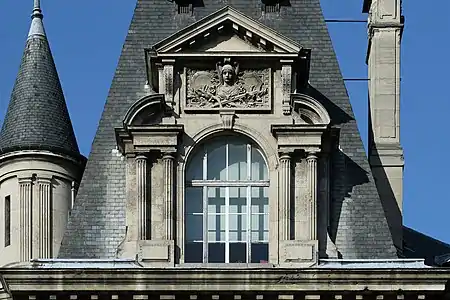 Corner decoration at Quai d'Orfèvres and Boulevard du Palais
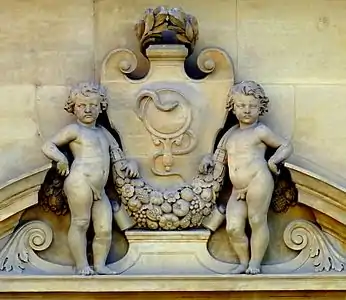 Decoration of facade of Cour de Cassation
 Gallery of Saint Louis (Louis IX) in the Cour de Cassation
 Decoration in Commercial Chamber of the Cour de Cassation
References
- Le Guide du Patrimoine en France, Editions du Patrimoine, Centre des Monuments Nationaux (2002), p. 297
- , "Guide du Patrimoine en France", "Palais de Justice", p. 297
- Delon 2000, p. 33.
- Ayers 2004, p. 22. Daumet is sometimes spelled Dommey.
- Van Zanten, David (1994). Building Paris: Architectural Institutions and the Transformation of the French Capital, 1830–1870. Cambridge, Massachusetts: Cambridge University Press. p. 211. ISBN 0-521-39421-X.
- Delon 2000, p. 65.
Bibliography
- Ayers, Andrew (2004). The Architecture of Paris. Stuttgart; London: Edition Axel Menges. ISBN 978-3-930698-96-7.
- Delon, Monique (2000). La Conciergerie - Palais de la Cité (in French). Paris: Editions du Patrimoine- Centre des monuments nationaux. ISBN 978-2-85822-298-8.
- Fierro, Alfred (1996). Histoire et dictionnaire de Paris (in French). Robert Laffont. ISBN 2-221--07862-4.
- de Parseval, Béatrice; Mazeau, Guillaume (2019). The Conciergerie - Palais de la Cité (in English). Paris: Editions du Patrimoine- Centre des monuments nationaux. ISBN 978-2-7577-0667-1.
External links
 |
Wikimedia Commons has media related to Palais de Justice. |
- A visit of the Hall of Justice (official site of the Paris Court of Appeal)
- Palais de Justice at lartnouveau.com
Authority control  | |
|---|---|
| General | |
| National libraries | |