Parmelia (fungus)
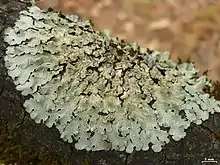
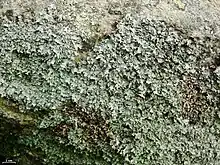
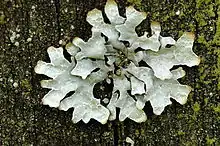
Parmelia is a genus of medium to large foliose lichens.[2]: 78 The ends of the leaf-like lobes are often squarish-tipped.[2]: 78 The upper surface is pale bluish-gray to light brown in direct sunlight, with a network web-like ridges and depressions.: 78 The lower surface is black and has rhizines anchoring it to the substrate.[2]: 78
| Parmelia | |
|---|---|
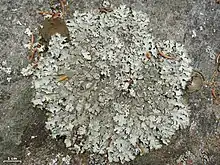 | |
| Parmelia saxatilis | |
Scientific classification  | |
| Kingdom: | Fungi |
| Division: | Ascomycota |
| Class: | Lecanoromycetes |
| Order: | Lecanorales |
| Family: | Parmeliaceae |
| Genus: | Parmelia Ach. (1803) |
| Type species | |
| Parmelia saxatilis | |
| Synonyms[1] | |
It has a global distribution, extending from the Arctic[3] to the Antarctic continent[4][5] but concentrated in temperate regions.[6] There are about 40 species in Parmelia.[7] It is a foliaceous lichen, resembling a leaf in shape. In recent years, the genus Parmelia has been divided into a number of smaller genera according to thallus morphology.
Taxonomy
Parmelia was circumscribed by Swedish lichenologist Erik Acharius in 1803.[8] His idea of the genus, which included foliose species with lecanorine apothecia, was quite broad and included species that are now dispersed in many different genera and families, such as the Lobariaceae (Lobaria), the Pannariaceae (Pannaria, Parmeliella), the Physciaceae (Physcia, Heterodermia, Physconia), the Teloschistaceae (Xanthoria), as well as the Parmeliaceae (Cetraria, Hypogymnia, and Parmeliopsis). Its broad circumscription meant that almost every lichen with a thalline apothecial rim was included by 19th-century authors.[9]
In an attempt to create more homogenous groups of taxa, lichenologists created new segregate genera for species once in Parmelia. These included Menegazzia (1854), Parmotrema (1860), Anzia (1861), Parmeliopsis (1869), Hypogymnia (1896), Pseudevernia (1903), Pannoparmelia (1912), and Pseudoparmelia (1914).[9] In the 1970s and 1980s, electron microscopy was used to help divide several Parmelia species groups into different genera based on the structure of their cortex. These include Arctoparmelia,[10] Bulbothrix, Canoparmelia, Cetrariastrum, Concamerella, Everniastrum, Flavoparmelia, Hypotrachyna, Neofuscelia, Paraparmelia, Parmelina, Parmotrema, Pseudoparmelia, Relicina, Relicinopsis, Xanthomaculina, and Xanthoparmelia. Another group of species was segregated on the basis of the presence of pseudocyphellae: Punctelia, Flavopunctelia, and Melanelia. In Mason Hale's 1987 monograph on Parmelia, he commented: "The group has been further subdivided ... now leaving in Parmelia a small, apparently irreducible assemblage of species typified by P. saxatilis".[9] In 2016, however, sixteen mostly Australasian species were moved to the new genus Notoparmelia; these species had been shown by molecular phylogenetic analysis to form a monophyletic lineage in Parmelia.[11]
Description and ecology
In general, Parmelia have a dark lower side with rhizines ('rootlets') that attach the lichen to its substrate. The upper side may be several colours - grey, yellow, brown - and may have reproductive organs on it. These may be apothecia (spore producing bodies), isidia or soralia (both vegetative structures). In between these two layers is the medulla which contains the algal component of the lichen.
Parmelia lichens are food for the caterpillars of certain Lepidoptera, such as the bagworm moth Taleporia tubulosa.
Conservation
Two species of Parmelia have been assessed by the International Union for Conservation of Nature for the global IUCN Red List. Both Parmelia saxatilis and P. sulcata are considered species of least concern due to their widespread distribution, abundance, and stable populations.[12][13]
Species
- Parmelia adaugescens Nyl. (1890)
- Parmelia ambra Poinar, E.B.Peterson & Platt (2000)[14]
- Parmelia asiatica A.Crespo & Divakar (2011)[15]
- Parmelia barrenoae Divakar, M.C.Molina & A.Crespo (2005)[16]
- Parmelia cochleata Zahlbr. (1927)
- Parmelia discordans Nyl. (1886)[17]
- Parmelia encryptata A.Crespo, Divakar & M.C.Molina (2011)[18]
- Parmelia ernstiae Feuerer & A.Thell (2002)[19] – Europe
- Parmelia fertilis Müll.Arg. (1887)[20]
- Parmelia fraudans (Nyl.) Nyl. (1861)
- Parmelia hygrophila Goward & Ahti (1983)[21]
- Parmelia hygrophiloides Divakar, Upreti & Elix (2003)[22] – India
- Parmelia imbricaria Goward, Divakar, M.C.Molina & A.Crespo (2017)[23]
- Parmelia isidiiveteris Poinar, E.B.Peterson & Platt (2000)[14]
- Parmelia lambii Øvstedal (2009)[24]
- Parmelia marmariza Nyl. (1890)[25]
- Parmelia mayi Divakar, A.Crespo & M.C.Molina (2011)[18]
- Parmelia meiophora Nyl. (1889)
- Parmelia neocaledonica Nyl. (1885)[26]
- Parmelia neodiscordans Hale (1987)[27]
- Parmelia niitakana Asahina (1951)
- Parmelia omphalodes (L.) Ach. (1803)
- Parmelia protosignifera Elix & J.Johnst. (1988)[28] – Australia
- Parmelia pseudoshinanoana Asahina (1951)
- Parmelia rojoi A.Crespo, V.J.Rico & Divakar (2020)[29] – Europe
- Parmelia saxatilis (L.) Ach. (1803)
- Parmelia sectilis Hale (1968)
- Parmelia serrana A.Crespo, M.C.Molina & D.Hawksw. (2004)[30]
- Parmelia shinanoana Zahlbr. (1927)
- Parmelia skultii Hale (1987)[31]
- Parmelia squarrosa Hale (1971)[32]
- Parmelia submontana Nádv. (1957)
- Parmelia submutata Hue (1899)
- Parmelia sulcata Taylor (1836)[33]
- Parmelia sulymae Goward, Divakar, M.C.Molina & A.Crespo (2017)[23]
References
- "Synonymy: Parmelia Ach., Methodus, Sectio post. (Stockholmiæ): xxxiii, 153 (1803)". Species Fungorum. Retrieved 29 October 2021.
- Field Guide to California Lichens, Stephen Sharnoff, Yale University Press, 2014, ISBN 978-0-300-19500-2
- Skult H (1985) A New Subspecies of Parmelia omphalodes Ascomycetes Described from the Arctic. Annales Botanici Fennici 22, 201-6.
- D.C. Lindsay (1973) Notes on Antarctic lichens: IV. The genera Cetraria Hoffm., Hypogymnia (Nyl.) Nyl., Menegazzia Massal, Parmelia Ach. and Platismatia Culb. et Culb. British Antarctic Survey Bulletin 36, 105-114.
- J. Hooker (1847) The Botany of the Antarctic voyage. Vol. 1. Flora Antarctica. Part 2 Botany of Fuegia, the Falklands, Kerguelens land, etc. Reeve Bros., London.
- Bisby, Guy Richard; Ainsworth, G. C.; Kirk, P. M.; Aptroot, André (2001). Ainsworth & Bisby's Dictionary of the fungi / by P. M. Kirk... [et al.]; with the assistance of A. Aptroot... [et al.] Oxon: CAB International. p. 378. ISBN 978-0-85199-377-5.
- Ossowska, Emilia; Guzow-Krzemińska, Beata; Kolanowska, Marta; Szczepańska, Katarzyna; Kukwa, Martin (2019). "Morphology and secondary chemistry in species recognition of Parmelia omphalodes group – evidence from molecular data with notes on the ecological niche modelling and genetic variability of photobionts". MycoKeys. 61: 39–74. doi:10.3897/mycokeys.61.38175.
- Acharius, E. (1803). Methodus qua Omnes Detectos Lichenes Secundum Organa Carpomorpha ad Genera, Species et Varietates Redigere atque Observationibus Illustrare Tentavit Erik Acharius (in Latin). Stockholm: Impensis F.D.D. Ulrich. p. 153.
- Hale 1987, p. 1.
- Hale ME. (1986). "Arctoparmelia, a new lichen genus in the Parmeliaceae". Mycotaxon. 25 (1): 251–254.
- Ferencova, Zuzana; Cubas, Paloma; Divakar, Pradeep Kumar; Molina, M. Carmen; Crespo, Ana (2014). "Notoparmelia, a new genus of Parmeliaceae (Ascomycota) based on overlooked reproductive anatomical features, phylogeny and distribution pattern". Lichenologist. 46 (1): 51–67. doi:10.1017/S0024282913000649.
- Yahr, R.; Allen, J.; Lymbery, C.; Batallas-Molina, R.; Bungartz, F.; Dal Forno, M.; Howe, N.; Lendemer, J.; McMullin, T.; Mertens, A.; Paquette, H.; Petix, M.; Reese Næsborg, R.; Roberts, F.; Sharrett, S.; Villella, J. (18 May 2021). "Parmelia saxatilis". The IUCN Red List of Threatened Species 2021. 18 May 2021. Retrieved 29 October 2021.
- Yahr, R.; Allen, J.; Lymbery, C.; Batallas-Molina, R.; Dal Forno, M.; Howe, N.; Lendemer, J.; McMullin, T.; Mertens, A.; Petix, M.; Reese Næsborg, R.; Roberts, F.; Sharrett, S.; Villella, J. (25 May 2021). "Bottle Brush Shield Lichen". IUCN Red List of Threatened Species. 25 May 2021. Retrieved 29 October 2021.
- Poinar, G. O.; Peterson, E. B.; Platt, J. L. (2000). "Fossil Parmelia in new world amber". The Lichenologist. 32 (3): 263–269. doi:10.1006/lich.1999.0258.
- Lumbsch, H.T.; Ahti, T.; Altermann, S.; De Paz, G.A.; Aptroot, A.; Arup, U.; et al. (2011). "One hundred new species of lichenized fungi: a signature of undiscovered global diversity". Phytotaxa. 18 (1): 1–127. doi:10.11646/phytotaxa.18.1.1.
- Divakar, Pradeep K.; Molina, M. Carmen; Lumbsch, H. Thorsten; Crespo, Ana (2005). "Parmelia barrenoae, a new lichen species related to Parmelia sulcata (Parmeliaceae) based on molecular and morphological data". The Lichenologist. 37 (1): 37–46. doi:10.1017/S0024282904014641.
- Brenner, M. (1886). "Bidrag till kännedom af Finska vikens övegetation. IV. Hoglands lafvar". Meddelanden af Societas pro Fauna et Flora Fennica (in Latin). 13: 40.
- Molina, Maria del Carmen; Divakar, Pradeep K.; Millanes, Ana M.; Sánchez, Edinson; Del-Prado, Ruth; Hawksworth, David L.; Crespo, Ana (2011). "Parmelia sulcata (Ascomycota: Parmeliaceae), a sympatric monophyletic species complex". The Lichenologist. 43 (6): 585–601. doi:10.1017/S0024282911000521.
- Feuerer, T.; Thell, A. (2002). "Parmelia ernstiae Feuerer & Thell – a new macrolichen from Germany". Mitteilungen aus dem Institut für Allgemeine Botanik Hamburg (in German). 30–32: 49–60.
- Müller, J. (1887). "Lichenologische Beiträge XXVI". Flora (Regensburg) (in German). 70 (20): 316–322.
- Goward, T.; Ahti, T. (1983). "Parmelia hygrophila, a new lichen species from the Pacific Northwest of North America". Annales Botanici Fennici. 20 (1): 9–13.
- Divakar, Pradeep K.; Upreti, D.K.; Sinha, G.P.; Elix, John A. (2003). "New species and records in the lichen family Parmeliaceae (Ascomycota) from India". Mycotaxon. 88: 149–154.
- Molina, M. Carmen; Divakar, Pradeep K.; Goward, Trevor; Millanes, Ana M.; Lumbsch, H. Thorsten; Crespo, Ana (2016). "Neogene diversification in the temperate lichen-forming fungal genus Parmelia (Parmeliaceae, Ascomycota)". Systematics and Biodiversity. 15 (2): 166–181. doi:10.1080/14772000.2016.1226977.
- Øvstedal, D.O.; Lewis Smith, R.I. (2009). "Further additions to the lichen flora of Antarctica and South Georgia". Nova Hedwigia. 88 (1–2): 157–168.
- Nylander, W. (1890). "Lichenes Japoniae. Accedunt Observationibus Lichenes Insulae Labuan" (in Latin): 28. Cite journal requires
|journal=(help) - Nylander, W. (1885). "Parmeliae exoticae novae". Flora (Regensburg) (in Latin). 68: 605–615.
- Hale 1987, p. 30.
- Elix, John A.; Johnston, Jen (1988). "New species in the lichen family Parmeliaceae (Ascomycotina) from the southern hemisphere". Mycotaxon. 31 (2): 491–510.
- Crespo, Ana; Rico, Víctor J.; Garrido, Elisa; Lumbsch, H. Thorsten; Divakar, Pradeep K. (2020). "A revision of species of the Parmelia saxatilis complex in the Iberian Peninsula with the description of P. rojoi, a new potentially relict species". The Lichenologist. 52 (5): 365–376. doi:10.1017/S0024282920000341.
- Molina, María del Carmen; Crespo, Ana; Blanco, Oscar; Lumbsch, H. Thorsten; Hawksworth, David L. (2004). "Phylogenetic relationships and species concepts in Parmelia s. str. (Parmeliaceae) inferred from nuclear ITS rDNA and β-tubulin sequences". The Lichenologist. 36 (1): 37–54. doi:10.1017/S0024282904013933.
- Hale 1987, p. 43.
- Hale, M.E. (1971). "Parmelia squarrosa, a new species in section Parmelia". Phytologia. 22 (1): 29.
- Mackay, J.T. (1836). "Flora Hibernica". 2: 145. Cite journal requires
|journal=(help)
Cited literature
- Hale, Mason E. (1987). A Monograph of the Lichen Genus Parmelia Acharius sensu stricto (Ascomycotina: Parmeliaceae). Smithsonian Contributions to Botany. 66. Washington, D.C.: Smithsonian Institution Press.