Paul von Kneussl
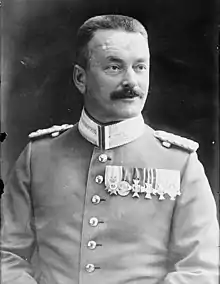
Paul von Kneußl was a German infantry general and an honorary citizen of his hometown. He was most notable for his service in the Romanian Campaign.
Paul von Kneußl | |
|---|---|
 | |
| Born | June 27, 1862 Lindau, Kingdom of Bavaria |
| Died | February 16, 1928 (aged 65) Munich, Bavaria, Germany[1] |
| Allegiance | .svg.png.webp) German Empire German Empire |
| Branch |  Imperial German Army Imperial German Army |
| Years of service | 1880 — 1919 |
| Rank | General of the Infantry |
| Battles/wars | World War I |
Biography
Origins
Paul was born in Lindau as the son of the district administrator Johann Baptist Kneussl and his wife Klara, née Vigl.[2]
Military Career
After visiting the commercial and industrial school he went to the two-year technical college and entered 1880 as a one-year volunteer in the 4th Field Artillery Regiment "King" of the Bavarian Army one. He was then taken over as a capitulator in the 3rd Infantry Regiment "Prince Karl of Bavaria" and appointed portepée ensign. On December 22, 1883, he was promoted to Second Lieutenant with the highest commendation .
As a prime lieutenant (since June 13, 1892) he became a regimental adjutant in 1889 and graduated from the military academy from 1892 to 1895 , which gave him the qualification for the general staff, the higher adjutantage and the subject (tactics).[3] Following this, Kneußl took over a company in the 2nd Jäger Battalion on March 17, 1897 while being promoted to captain . In 1899 he was transferred to the General Staff of the II Royal Bavarian Corps and in 1900 to the III Royal Bavarian Corps. He was promoted to major on September 21, 1904 and on October 17, 1905 he was appointed battalion commander in the Infantry Body Regiment . Then he was transferred to the Central Staff of the General Staff on December 12, 1906 and promoted to Lieutenant Colonel on September 11, 1907 . On December 30, 1907, Kneußl was appointed director of the Bavarian War Academy for two years and on December 19, 1909 he was appointed chief of the General Staff of the III. Army Corps in Nuremberg. After his promotion to colonel , he took over the 3rd Infantry Regiment on October 15, 1910. At the beginning of 1912 he was transferred as head of department in the War Ministry and appointed to the Ordinary Council of State.
After his promotion to major general on January 23, 1913, Kneußl received the Knight's Cross of the Order of Merit of the Bavarian Crown from the hands of his king . Associated with this was the elevation into the personal nobility and from this point on he was allowed to call himself "Knight of Kneussl".
He took over the 8th Infantry Brigade in Metz and at the outbreak of the First World War he was given command of the 1st Reserve Infantry Brigade, with which he was deployed in northern France.[2][4] Then, from March 25, 1915, Kneußl was entrusted with the leadership of the newly established 11th Division and promoted to Lieutenant General on May 19, 1915 . At the beginning of June 1915, the 11th Division under his command played a key role in the Siege of Przemyśl. For this achievement, Colonel General Kneußl was awarded the Order of the Iron Crown together with Hugo Martiny von Malastów, 1st class awarded with war decorations.[2]
From March to May 1916 his division was used in the Battle of Verdun, then between July and October 1916 in the Brusilov Offensive in the Kovel area.[1] His troops proved themselves in the mountain war in the Romanian theater of war and intervened in the Battle of the Argeș on the advance to Bucharest.[5][2] In April 1917, Kneussl's division fought in the defense against French attacks in the Second Battle of the Aisne and was then in the final phase of the Battle of Passchendaele.[1] Still standing in Flanders in the last year of the war, his troops were involved in the attack on Kemmelberg in April 1918 . Shortly before the end of the war, in August 1918, he was appointed Commanding General of the XV Royal Bavarian Reserve Corps, which he returned to his homeland after the Armistice of 11 November 1918.[4]
Kneussl was retired from the army on August 18, 1919 while at the same time being promoted to General of the Infantry.[1]
The University of Erlangen awarded him an honorary doctorate on May 20, 1925. In 1937 a Wehrmacht barracks in Augsburg was named after him, the General Kneussl or New Infantry Barracks.[2]
Awards
- Order of Saint Michael
- Iron Cross, 2nd and 1st class (1914)
- Pour le Mérite with oak leaves[4]
- Pour le Mérite on June 3, 1915
- Oak leaves on January 11, 1917
- Order of the Red Eagle, II class with swords on June 12, 1915
- Military Order of Max Joseph (June 3, 1915)
- Military Order of Max Joseph, Commander's Cross (October 8, 1915)
- Military Merit Order 2nd class with crown and swords (August 4, 1918)
- Friedrich Order, First class (April 5, 1917)
References
- Paul von Kneussl na stranici Prussianmachine.com
- Paul von Kneussl na stranici Field commanders of Austria-Hungary
- Othmar Hackl: The Bavarian War Academy (1867-1914). CH Beck'sche Verlagsbuchhandlung, Munich 1989, ISBN 3-406-10490-8, p. 493.
- Paul von Kneussl na stranici Deutschland14-18.de
- Alexandru Ioanițiu (Lt.-Colonel), Războiul României: 1916-1918 , vol. 1, Tipografia Geniului, București, 1929
Bibliography
- Rudolf von Kramer, Otto Freiherr von Waldenfels: VIRTUTI PRO PATRIA. The Royal Bavarian Military Max Joseph Order. Acts of War and Book of Honor 1914–1918. Self-published by the Royal Bavarian Military Max Joseph Order, Munich 1966, pp. 335–338.
- Ioanițiu, Alexandru (lt.col.), Războiului României, 1916-1918 , vol. I, Tipografia Geniului, București, 1929
- Romania in the World War 1916-1919, vol. I-IV, Official Gazette and State Printing Offices, Bucharest, 1934-1936
