Pedro José Folque de Bragança
Dom Pedro José, Duke of Loulé (Pedro José Folque de Mendoça Rolim de Moura Barreto Bragança e Bourbon; born in Lisbon on the 30th April 1958) is a claimant to the defunct Portuguese throne, as the head of the House of Braganza and Duke of Loulé.[1]
| Pedro José | |||||
|---|---|---|---|---|---|
| Duke of Loulé | |||||
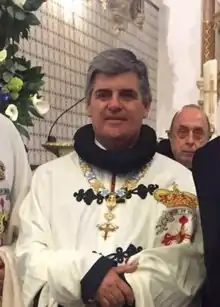 Dom Pedro José in robes of the Sovereign and Grand Master of the Order of Saint Michael of the Wing | |||||
| Duke of Loulé | |||||
| Tenure | 2003 | ||||
| Predecessor | Alberto Nuno Carlos | ||||
| Born | 30 April 1958 | ||||
| |||||
| House | Braganza | ||||
| Religion | Roman Catholicism | ||||
Personal life
Born in Lisabon in 1958, he is married to Maria João Correia Sequeira Franco in 1997 with whom he has a child.
Claims to the throne
With the fall of the Kingdom of Portugal in 1910 and the death of the King Manuel II of Portugal the Dukes of Loulé became senior pretenders and claimants to the throne of Portugal and headship of the House of Braganza.[2] This began the dispute with the Miguelist Braganzas which are currently headed by Duarte Pio, but whose claim is invalid. In 1951[3] This is due to the fact that the whole Miguelist line was disinherited by the law of 1834. On 27 May 1950, the Portuguese National Assembly revoked both the laws of exile from 19 December 1834, which banned the Miguelist Braganzas, and the laws of exile from 15 October 1910, which banned the Legitimist Braganzas. Duarte Pio's claim is now valid.[4] After the death of Alberto Nuno Carlos in 2003, Dom Pedro José headed the title of the Duke of Loulé as pretence on the headship of the Royal House of Portugal.
Honours
Foreign orders
Sovereign and Grand Master
- Real Ordem dos Cavaleiros de Nosso Senhor Jesus Cristo[5]
- Real Orden de San Benito de Avís, Ordem de São Bento de Avis[6]
- Real Orden Militar de Santiago de la Espada[7]
- Real Orden de Nuestra Señora de la Concepción de Villaviciosa[8]
- Ordem Real de Santa Isabel[9]
- Real y Militar Orden de San Miguel del Ala[10]
- Real Orden Dinástica San Nuno de Santa Maria[11]
References
- Borella, Andrea (2017). La successione e le leggi dinastiche della real casa del Portogallo (The succession and dynastic laws of the royal house of Portugal). Rome: Societas Internationalis Studiorum Dynasticorum. pp. 24–30.
- Borella, Andrea (2017). La successione e le leggi dinastiche della real casa del Portogallo (The succession and dynastic laws of the royal house of Portugal). Rome: Societas Internationalis Studiorum Dynasticorum. pp. 24–30.
- Pereira, Nuno da Câmara: O Usurpador-o poder sem pudor, Lisboa : Livros d'Hoje, 2008
- Borella, Andrea (2017). La successione e le leggi dinastiche della real casa del Portogallo (The succession and dynastic laws of the royal house of Portugal). Rome: Societas Internationalis Studiorum Dynasticorum. pp. 15–16.
- Borella, Andrea (2017). La successione e le leggi dinastiche della real casa del Portogallo (The succession and dynastic laws of the royal house of Portugal). Rome: Societas Internationalis Studiorum Dynasticorum. p. 257.
- Borella, Andrea (2017). La successione e le leggi dinastiche della real casa del Portogallo (The succession and dynastic laws of the royal house of Portugal). Rome: Societas Internationalis Studiorum Dynasticorum. p. 272.
- Borella, Andrea (2017). La successione e le leggi dinastiche della real casa del Portogallo (The succession and dynastic laws of the royal house of Portugal). Rome: Societas Internationalis Studiorum Dynasticorum. p. 280.
- Borella, Andrea (2017). La successione e le leggi dinastiche della real casa del Portogallo (The succession and dynastic laws of the royal house of Portugal). Rome: Societas Internationalis Studiorum Dynasticorum. p. 280.
- Borella, Andrea (2017). La successione e le leggi dinastiche della real casa del Portogallo (The succession and dynastic laws of the royal house of Portugal). Rome: Societas Internationalis Studiorum Dynasticorum. p. 287.
- Borella, Andrea (2017). La successione e le leggi dinastiche della real casa del Portogallo (The succession and dynastic laws of the royal house of Portugal). Rome: Societas Internationalis Studiorum Dynasticorum. p. 288.
- Borella, Andrea (2017). La successione e le leggi dinastiche della real casa del Portogallo (The succession and dynastic laws of the royal house of Portugal). Rome: Societas Internationalis Studiorum Dynasticorum. p. 294.
Pretenders to the Portuguese throne | ||
|---|---|---|
| Burgundian line |
| .png.webp) |
| Aviz line |
| |
| Deposed monarchs |
| |
| Miguelist line |
| |
| Other line |
| |