Pelletron
A Pelletron is a type of electrostatic generator, structurally similar to a Van de Graaff generator. Pelletrons have been built in many sizes, from small units producing voltages up to 500 kilovolts (kV) and beam energies up to 1 megaelectronvolt (MeV) of kinetic energy, to the largest system, which has reached a DC voltage of over 25 megavolts and produced ion beams with energies over 900 MeV.
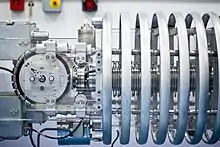
Generating electric charge is done by a mechanical transportation system made of a chain of pellets (short conductive tubes connected by links made of insulating material), that is used to build up high voltages on the Pelletron terminal. The system is enclosed by a pressure vessel filled with insulating gas, such as SF6 (sulfur hexafluoride), and an evacuated beamline. The potential difference between the terminal and ground is used to accelerate several kinds of particles, such as positrons, electrons, and negative and positive ions.
Compared to the Van de Graaff generator, the pellet chain can operate at a higher velocity than a rubber belt, and produce higher voltages and larger currents. The chain is charged more uniformly than the belt of a Van de Graaff, so the stability of the terminal voltage and the particle energy is also higher.
Pelletron particle accelerators are used in many fields, including materials analysis, nuclear physics, semiconductor development and production, pharmaceutical research, and in ultra-sensitive mass spectrometers for carbon dating and measurement of other rare isotopes.
External links
- Pelletron operation animation at pelletron.com
- The Pelletron — Max Planck Institute for Metals Research, Stuttgart, Germany (archived link)
- Pelletron.com — National Electrostatics Corp