Pero Čingrija
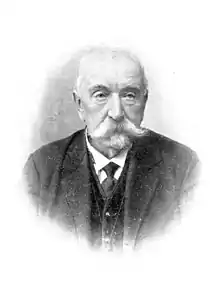
Pero Čingrija (August 24, 1837, Dubrovnik – July 13, 1921, Dubrovnik)[1] was a Croatian politician. Along with Frano Supilo, he was one of the most prominent Dubrovnik and Dalmatian politician from the early 1860s until the collapse of the Habsburg Monarchy.
Pero Čingrija | |
|---|---|
 | |
| Mayor of Dubrovnik | |
| In office 1878–1882 | |
| Preceded by | Rafael Pucić |
| Succeeded by | Rafael Pucić |
| In office 1899–1911 | |
| Preceded by | Frano Getaldić-Gundulić |
| Succeeded by | Melko Čingrija |
| Personal details | |
| Born | August 24, 1837 Dubrovnik, Dalmatia, Austrian Empire (now Croatia) |
| Died | July 13, 1921 (aged 84) Dubrovnik, Kingdom of Yugoslavia (now Croatia) |
| Nationality | Croatian |
| Occupation | Politician |
He was the mayor of Dubrovnik from 1878 to 1882, and continuously from 1899 to 1911.[1] He was the longest-serving mayor in Dubrovnik's history. He was highly esteemed as a civic intellectual, a lawyer, and above all as a devoted member and leader of the People's Party. Pero's son Melko was also a politician.[2]
Biography
After the deaths of Miho Klaić (1896) and Gajo Bulat (1900), he became the leader of the People's Party at the level of Dalmatia. He advocated for the cooperation of Dubrovnik populists and moderate right-wingers.[1] He transferred the fruits of Dubrovnik's cooperation to the level of Dalmatia when, on April 26, 1905, it was through his efforts that Dalmatian populists and moderate rightists merged into the Croatian Party, of which he immediately became president.[1]
He was one of the founders of the policy of the "new course",[1] which proposed cooperation between Serbs and Croats against Austria-Hungary. As president of the Croatian Club in the Dalmatian Parliament in early October 1905, he chaired a conference in Rijeka at which the Rijeka resolution was adopted, marking the victory of the new course policy, and then a member of the Croatian committee to negotiate with the Hungarian opposition on the implementation of the Rijeka resolution.[1]
When the pro-Austrian mood prevailed in the leadership of the Dalmatian Croatian Party, and when the austrophile Vicko Mihaljević was elected its president on September 14, 1908, under Čingrija's influence, representatives from Dubrovnik and Korčula resigned. On September 20, in Dubrovnik, the Independent Organization of the Croatian Party was founded and headed by Čingrija. However, in 1910 he returned to the Croatian Party.[1] The collapse of the Habsburg Monarchy and dissolution of Austria-Hungary following World War I was welcomed by Čingrija. Although he advocated the creation of a Yugoslav state, he soon became disillusioned with its organization and the relations that prevailed in it.[1]
References
- Hrvatska enciklopedija, Pero Čingrija
- Seton-Watson, Robert William (1911). The Southern Slav Question and the Habsburg Monarchy. Constable & Company. p. 293. ISBN 9780722223284.
Dr. Melko Čingrija, a prominent Dalmatian lawyer and politician, and son of the veteran Mayor of Ragusa Ďr. Pero Čingrija..