Perovo Solar Park
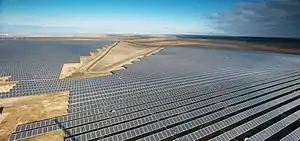
The Perovo Solar Park is a 100 MWp photovoltaic power station located at Perovo, Simferopol Raion, Crimea, Ukraine. As of July 2012 it is the world's fourth-largest solar farm, and is made up of 440,000 solar panels. It is owned by Activ Solar, and the final 20 MW stage was completed on December 29, 2011.
| Perovo Solar Park | |
|---|---|
 | |
| |
| Country | Disputed: |
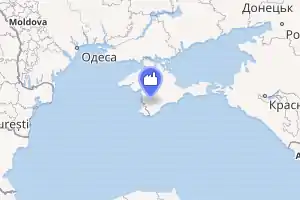
| Location | Perovo, Crimea, Ukraine |
| Coordinates | 44°54′N 33°56′E |
| Status | Operational |
| Solar farm | |
| Type | Flat-panel PV |
| Site area | 200 ha (494 acres) 200 ha (2 km2) |
| Power generation | |
| Units operational | 440,000 |
| Nameplate capacity | 100 MW |
| Annual net output | 132.5 GWh[1] |
In 2009, Ukraine established a feed-in tariff of €0.46 per kilowatt hour until 2030, one of the highest.[2]
As of January 2012 was the most powerful solar power plant in the world. In addition, the Canadian Sunny Power Plant "Sarnia" (97 MW) was occupied by power (97 MW), the second - Italian Montalto Di O (84.2 MW), and the third - German Finsterwalde (80.7 MW).
Power plants near the liver consists of 440 000 crystalline solar photovoltaic modules, connected 1 500 km of cable and installed on more than 200 hectares of the area (covers approximately 259 football fields).
The station allows you to reduce the emissions of carbon dioxide by 105 thousand tons per year.
Electricity that produces this power plant is quite sufficient to meet the needs of the city of Simferopol. The total capacity of all solar power plants, built on the territory of the Crimea: "Perova", "Ohcastrotnikov", "Mitaine" and "Rodnikov", now equal to 227.26 MW, which is over 15 percent of the total energy needs of all Crimea, which is equal to 1200 MW.
The new power station closes the world five largest photovoltaic parks. Another Activ Solar Project in Crimea - 82,65-Megawant "Okhotnikovo", installed by Developer also this year in the Saksky district of the peninsula. Park Okhotnyk is currently most powerful in Central and Eastern Europe. Park Perova was built in record terms - in seven months. The power plants used solar panels of Asian manufacturers and inverters of European companies.
Occupation
At the time of occupation, the substation was integrated into the energy system of Ukraine, after occupation, the station remained not integrated into a single energy system of Russia, with the supply of energy only to the peninsula. Project stations, like a number of other Activ Solar projects received loans from a group of banks that hoped to make a profit from investment through a special "green tariff" that was established by the Ukrainian Government. Surrounding a cheap electricity from Russia, Austrian stations are unprofitable. Now only part of their power is used, the strategic fate is not clear, and the station tried to get a green tariff in the Russian Federation.[3][4]
References
- World’s Largest Solar Park in Ukraine
- Europe’s Biggest Solar Park Completed With Russian Bank Debt
- Sorokina, Anna (2017-09-11). "Russia among top 3 global leaders in solar module production". www.rbth.com. Retrieved 2021-03-31.
- "СМИ узнали о планах солнечных электростанций в Крыму получить льготы". РБК (in Russian). Retrieved 2021-03-31.