Politics of Peru
The politics of the Republic of Peru takes place in a framework of a unitary semi-presidential representative democratic republic,[1][2] whereby the President of Peru is both head of state and head of government, and of a pluriform multi-party system. Executive power is exercised by the President and the Government. Legislative power is vested in both the Government and the Congress. The Judiciary is independent of the executive and the legislature. The Economist Intelligence Unit rated Peru a "flawed democracy" in 2019.[3] Support for traditional political parties have thoroughly collapsed in Peru since 2000, paving the way for the rise of personalist leaderships.[4] The political parties in the congress of Peru are, according to political scientist Lucia Dammert, "agglomerations of individual and group interests more than solid and representative parties".[4]
 |
|---|
|
|
 Peru portal Peru portal |

The historian Antonio Zapata describes Peru as a "right-wing country", the only left-wing government in contemporary history until the election of Pedro Castillo in 2021 being that of Juan Velasco Alvarado (1968-1975), author of an agrarian reform and the nationalization of strategic sectors. Currently, almost all major media and political parties in the country are in favour of economic liberalism.[5] Those opposed to the neoliberal status quo or involved in left-wing politics are often targeted with fear mongering attacks called terruqueos, where individuals or groups are associated with terrorists involved with the internal conflict in Peru.[6][7]
History
In 1924, from Mexico, university reform leaders in Peru who had been forced into exile by the government founded the American People's Revolutionary Alliance, which had a major influence on the country's political life. APRA is thus largely a political expression of the university reform and workers' struggles of the years 1918–1920. The movement draws its influences from the Mexican revolution and its 1917 Constitution, particularly on issues of agrarianism and indigenism, and to a lesser extent from the Russian revolution. Close to Marxism (its leader, Haya de la Torre, declares that "APRA is the Marxist interpretation of the American reality"), it nevertheless moves away from it on the question of class struggle and on the importance given to the struggle for the political unity of Latin America.[8]
In 1928, the Peruvian Socialist Party was founded, notably under the leadership of José Carlos Mariátegui, himself an spectator of the European socialist movements, who maintained relantionships with the Communist Party of Italy and the leadership of Palmiro Togliatti and Antonio Gramsci. Shortly afterwards, in 1929, the party created the General Confederation of Workers.
During the government of Fujimori the 1979 Constitution was changed after the Fujimori's self-coup where the president dissolved the Congress and established the new 1993 Constitution. One of the changes to the 1979 Constitution was the possibility of the president's immediate reelection (112 article) which made possible the reelection of Fujimori in the next years. After the Fujimori era and Fujimori's resignation, the transition government of Valentín Paniagua changed the article 112 and called new elections in 2001 where Alejandro Toledo was elected. After that, Peru has had all presidents democratically elected.
On 28 July 2021, left-wing candidate Pedro Castillo was sworn in as the new President of Peru after a narrow win in a tightly contested run-off election.[9] The new Peruvian president Castillo appointed Guido Bellido, a member of Marxist-Leninist Free Peru party, as prime minister.[10]
Allegations of corruption in politics
Exceptionally many Presidents of Peru have been ousted from office or imprisoned on allegations of corruption over the past three decades. Alberto Fujimori is serving a 25-year sentence in prison for commanding death squads that killed civilians in a counterinsurgency campaign during his tenure (1990-2000). He was later also found guilty of corruption. Former president Alan García (1985-1990 and 2006-2011) committed suicide in April 2019 when Peruvian police arrived to arrest him over allegations he participated in Odebrecht bribery scheme. Former president Alejandro Toledo is accused of allegedly receiving bribe from Brazilian construction firm Odebrecht during his government (2001-2006). Former president Ollanta Humala (2011-2016) is also under investigation for allegedly receiving bribe from Odebrecht during his presidential election campaign. Humala's successor Pedro Pablo Kuczynski (2016-2018) remains under house arrest while prosecutors investigate him for favoring contracts with Odebrecht. Former president Martín Vizcarra (2018-2020) was ousted by Congress after media reports alleged he had received bribes while he was a regional governor years earlier.[11] [12]
Executive branch
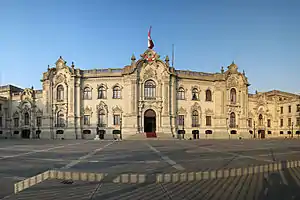
| Office | Name | Party | Since |
|---|---|---|---|
| Acting President | Pedro Castillo | Free Peru | 28 July 2021 |
| First Vice President | Dina Boluarte | Free Peru | 28 July 2021 |
| Second Vice President | Vacant | 7 May 2020 | |
| Prime Minister | Guido Bellido | Free Peru | 29 July 2021 |
Under the current constitution, the President is the head of state and government; he or she is elected for a five-year term and may not immediately be re-elected.[13] All citizens above the age of eighteen are entitled and in fact compelled to vote. The first and second vice presidents also are popularly elected but have no constitutional functions unless the president is unable to discharge his duties.
The President appoints the Prime Minister (Primer Ministro) and the Council of Ministers (Consejo de Ministros, or Cabinet), which is individually and collectively responsible both to the president and the legislature.[1][2] All presidential decree laws or draft bills sent to Congress must be approved by the Council of Ministers.
Legislative branch
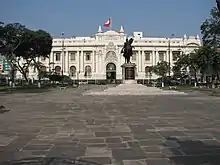
The legislative branch consists of a unicameral Congress (Congreso) of 130 members. elected for a five-year term by proportional representation In addition to passing laws, Congress ratifies treaties, authorizes government loans, and approves the government budget. The president has the power to block legislation with which the executive branch does not agree.
Political parties and elections
Presidential election
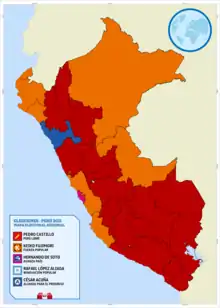
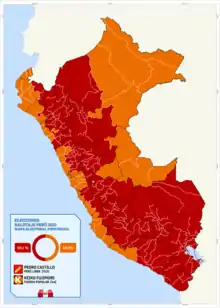
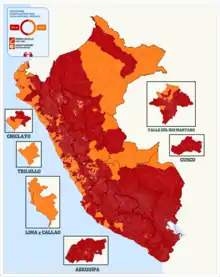
The first round was held on 11 April.[14][15] The first exit polls published indicated that underdog nominee Pedro Castillo of Free Peru had placed first in the first round of voting with approximately 16.1% of the vote, with Hernando de Soto and Keiko Fujimori tying with 11.9% each.[15] Yonhy Lescano, Rafael López Aliaga, Verónika Mendoza, and George Forsyth followed, with each receiving 11.0%, 10.5%, 8.8%, and 6.4%, respectively.[15] César Acuña and Daniel Urresti received 5.8% and 5.0%, respectively, while the rest of the nominees attained less than 3% of the popular vote.[16][17]
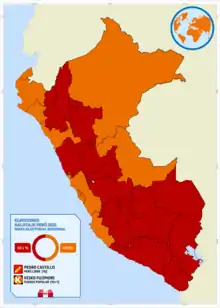
In the second round, Castillo defeated Fujimori by just 44,263 votes, winning by 50.13% to 49.87%. Castillo was officially designated as president-elect of Peru on 19 July 2021, a little over a week before he was to be inaugurated.[18]
| Candidate | Party | First round | Second round | |||
|---|---|---|---|---|---|---|
| Votes | % | Votes | % | |||
| Pedro Castillo | Free Peru | 2,724,752 | 18.92 | 8,836,380 | 50.13 | |
| Keiko Fujimori | Popular Force | 1,930,762 | 13.41 | 8,792,117 | 49.87 | |
| Rafael López Aliaga | Popular Renewal | 1,692,279 | 11.75 | |||
| Hernando de Soto | Go on Country – Social Integration Party | 1,674,201 | 11.63 | |||
| Yonhy Lescano | Popular Action | 1,306,288 | 9.07 | |||
| Verónika Mendoza | Together for Peru | 1,132,577 | 7.86 | |||
| César Acuña | Alliance for Progress | 867,025 | 6.02 | |||
| George Forsyth | National Victory | 814,516 | 5.66 | |||
| Daniel Urresti | Podemos Perú | 812,721 | 5.64 | |||
| Julio Guzmán | Purple Party | 325,608 | 2.26 | |||
| Alberto Beingolea | Christian People's Party | 286,447 | 1.99 | |||
| Daniel Salaverry | We Are Peru | 240,234 | 1.67 | |||
| Ollanta Humala | Peruvian Nationalist Party | 230,831 | 1.60 | |||
| José Vega | Union for Peru | 101,267 | 0.70 | |||
| Ciro Gálvez | National United Renaissance | 89,376 | 0.62 | |||
| Marco Arana | Broad Front | 65,300 | 0.45 | |||
| Rafael Santos | Peru Secure Homeland | 55,644 | 0.39 | |||
| Andrés Alcántara | Direct Democracy | 50,802 | 0.35 | |||
| Total | 14,400,630 | 100.00 | 17,628,497 | 100.00 | ||
| Valid votes | 14,400,630 | 81.30 | 17,628,497 | 93.49 | ||
| Invalid/blank votes | 3,313,086 | 18.70 | 1,228,305 | 6.51 | ||
| Total votes | 17,713,716 | 100.00 | 18,856,802 | 100.00 | ||
| Registered voters/turnout | 25,287,954 | 70.05 | 25,287,954 | 74.57 | ||
| Source: ONPE, ONPE | ||||||
By department
| Department | Castillo Free Peru | Fujimori Popular Force | López Aliaga Popular Renewal | De Soto Go on Country | Lescano Popular Action | Mendoza Together for Peru | Other candidates | Valid votes | Turnout | |||||||
|---|---|---|---|---|---|---|---|---|---|---|---|---|---|---|---|---|
| Votes | % | Votes | % | Votes | % | Votes | % | Votes | % | Votes | % | Votes | % | |||
| Amazonas | 34,411 | 26.1% | 17,805 | 13.5% | 8,269 | 6.3% | 4,433 | 3.4% | 12,698 | 9.6% | 8,887 | 6.7% | 45,557 | 34.5% | 132,060 | 60.1% |
| Ancash | 110,620 | 23.4% | 67,394 | 14.3% | 42,312 | 9.0% | 34,562 | 7.3% | 38,911 | 8.2% | 39,786 | 8.4% | 138,200 | 29.3% | 471,785 | 69.3% |
| Apurimac | 88,812 | 53.4% | 10,879 | 6.5% | 7,768 | 4.7% | 6,531 | 3.9% | 15,649 | 9.4% | 15,368 | 9.2% | 21,179 | 12.7% | 166,186 | 69.4% |
| Arequipa | 256,224 | 32.2% | 40,216 | 5.1% | 71,053 | 8.9% | 148,793 | 18.7% | 88,708 | 11.1% | 55,269 | 6.9% | 135,448 | 17.0% | 795,711 | 78.8% |
| Ayacucho | 130,224 | 52.0% | 17,751 | 7.1% | 11,490 | 4.6% | 8,995 | 3.6% | 20,315 | 8.1% | 24,506 | 9.8% | 37,269 | 14.9% | 250,550 | 68.6% |
| Cajamarca | 232,418 | 44.9% | 54,962 | 10.6% | 31,129 | 6.0% | 25,156 | 4.9% | 38,677 | 7.5% | 29,746 | 5.7% | 105,374 | 20.4% | 517,462 | 62.6% |
| Callao | 33,750 | 6.4% | 79,699 | 15.2% | 78,066 | 14.9% | 78,920 | 15.0% | 34,965 | 6.7% | 38,233 | 7.3% | 181,634 | 34.6% | 525,267 | 75.2% |
| Cusco | 232,178 | 38.2% | 27,132 | 4.5% | 29,618 | 4.9% | 40,423 | 6.6% | 60,659 | 10.0% | 123,397 | 20.3% | 94,626 | 15.6% | 608,033 | 73.5% |
| Huancavelica | 79,895 | 54.2% | 8,449 | 5.7% | 5,060 | 3.4% | 4,591 | 3.1% | 16,727 | 11.3% | 10,091 | 6.8% | 22,574 | 15.3% | 147,387 | 67.6% |
| Huanuco | 110,978 | 37.6% | 32,827 | 11.1% | 33,787 | 11.4% | 15,822 | 5.4% | 22,565 | 7.6% | 15,556 | 5.3% | 63,688 | 21.6% | 295,223 | 68.3% |
| Ica | 56,597 | 14.0% | 62,055 | 15.3% | 46,098 | 11.4% | 39,929 | 9.8% | 39,461 | 9.7% | 30,602 | 7.5% | 130,887 | 32.3% | 405,629 | 76.0% |
| Junin | 131,438 | 22.9% | 80,057 | 13.9% | 52,599 | 9.2% | 54,124 | 9.4% | 66,214 | 11.5% | 52,270 | 9.1% | 137,396 | 23.9% | 574,098 | 71.9% |
| La Libertad | 90,078 | 11.5% | 131,441 | 16.8% | 95,765 | 12.2% | 84,444 | 10.8% | 47,218 | 6.0% | 37,372 | 4.8% | 296,598 | 37.9% | 782,916 | 68.9% |
| Lambayeque | 73,279 | 12.9% | 121,263 | 21.4% | 86,126 | 15.2% | 50,087 | 8.8% | 51,467 | 9.1% | 28,866 | 5.1% | 155,480 | 27.4% | 566,568 | 71.4% |
| Lima | 416,537 | 7.8% | 753,785 | 14.2% | 869,950 | 16.4% | 870,582 | 16.4% | 362,668 | 6.8% | 431,425 | 8.1% | 1,602,623 | 30.2% | 5,307,570 | 74.6% |
| Loreto | 15,432 | 4.9% | 51,900 | 16.6% | 16,378 | 5.3% | 18,816 | 6.0% | 34,773 | 11.2% | 19,502 | 6.3% | 155,025 | 49.7% | 311,826 | 61.0% |
| Madre de Dios | 23,945 | 37.1% | 7,278 | 11.3% | 4,041 | 6.3% | 3,996 | 6.2% | 6,601 | 10.2% | 4,372 | 6.8% | 14,341 | 22.2% | 64,574 | 71.1% |
| Moquegua | 33,665 | 34.4% | 4,617 | 4.7% | 6,832 | 7.0% | 10,183 | 10.4% | 15,412 | 15.7% | 7,190 | 7.3% | 20,027 | 20.5% | 97,926 | 77.2% |
| Pasco | 34,187 | 34.2% | 12,607 | 12.6% | 8,009 | 8.0% | 5,102 | 5.1% | 11,871 | 11.9% | 6,896 | 6.9% | 21,324 | 21.3% | 99,996 | 63.6% |
| Piura | 70,968 | 10.1% | 173,891 | 24.8% | 68,316 | 9.8% | 63,842 | 9.1% | 51,223 | 7.3% | 44,576 | 6.4% | 227,714 | 32.5% | 700,530 | 66.8% |
| Puno | 292,218 | 47.5% | 17,514 | 2.8% | 15,918 | 2.6% | 21,665 | 3.5% | 175,712 | 28.5% | 35,484 | 5.8% | 57,010 | 9.3% | 615,521 | 81.9% |
| San Martin | 67,000 | 21.4% | 46,699 | 14.9% | 26,561 | 8.5% | 21,825 | 7.0% | 31,498 | 10.0% | 17,122 | 5.5% | 102,765 | 32.8% | 313,470 | 69.2% |
| Tacna | 64,521 | 33.2% | 9,363 | 4.8% | 17,842 | 9.2% | 21,000 | 10.8% | 28,696 | 14.8% | 14,068 | 7.2% | 38,779 | 20.0% | 194,269 | 77.8% |
| Tumbes | 7,613 | 7.7% | 36,403 | 37.1% | 8,799 | 9.0% | 7,123 | 7.3% | 7,046 | 7.2% | 5,242 | 5.3% | 26,015 | 26.5% | 98,241 | 74.6% |
| Ucayali | 26,339 | 14.0% | 40,510 | 21.5% | 14,981 | 8.0% | 11,124 | 5.9% | 14,359 | 7.6% | 15,092 | 8.0% | 65,965 | 35.0% | 188,370 | 66.3% |
| Peruvians Abroad | 10,602 | 6.6% | 22,887 | 14.1% | 34,767 | 21.5% | 21,552 | 13.3% | 11,617 | 7.2% | 21,185 | 13.1% | 39,146 | 24.2% | 161,756 | 22.8% |
| Total | 2,723,929 | 18.9% | 1,929,384 | 13.4% | 1,691,534 | 11.8% | 1,673,620 | 11.6% | 1,305,710 | 9.1% | 1,132,103 | 7.9% | 3,936,644 | 27.4% | 14,392,924 | 70.0% |
| Source: ONPE (100% counted) | ||||||||||||||||
Parliamentary elections
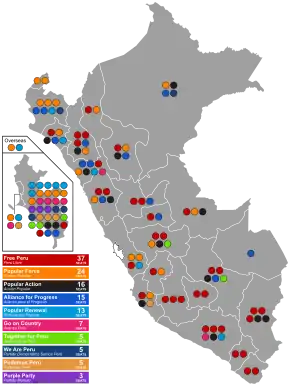
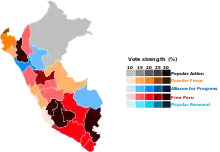
The Popular Action, the largest party in the previous legislature, lost some of its seats, and previous parliamentary parties like Union for Peru (UPP) and the Broad Front (FA) had their worst results ever while attaining no representation.[19] The Peruvian Nationalist Party of former President Ollanta Humala and National Victory of George Forsyth (who led polling for the presidential election earlier in the year) failed to win seats as well.[19] New or previously minor parties such as Free Peru, Go on Country and Together for Peru and Popular Renewal, the successor of National Solidarity, had good results, with Free Peru becoming the largest party in Congress.[19] Contigo, the successor to former president Pedro Pablo Kuczynski's Peruvians for Change party, failed to win a seat once again and received less than 1% of the vote.[19] On 26 July, two days before Castillo was sworn in as Peru's President, an opposition alliance led by Popular Action member María del Carmen Alva successfully negotiated an agreement to gain control of Peru's Congress.[20]
 | |||||
| Party | Votes | % | Seats | +/– | |
|---|---|---|---|---|---|
| Free Peru | 1,724,354 | 13.41 | 37 | +37 | |
| Popular Force | 1,457,694 | 11.34 | 24 | +9 | |
| Popular Renewal | 1,199,705 | 9.33 | 13 | +13 | |
| Popular Action | 1,159,734 | 9.02 | 16 | −9 | |
| Alliance for Progress | 969,726 | 7.54 | 15 | −7 | |
| Go on Country – Social Integration Party | 969,092 | 7.54 | 7 | +7 | |
| Together for Peru | 847,596 | 6.59 | 5 | +5 | |
| We Are Peru | 788,522 | 6.13 | 5 | −6 | |
| Podemos Perú | 750,262 | 5.83 | 5 | −6 | |
| Purple Party | 697,307 | 5.42 | 3 | −6 | |
| National Victory | 638,289 | 4.96 | 0 | New | |
| Agricultural People's Front of Peru | 589,018 | 4.58 | 0 | −15 | |
| Union for Peru | 266,349 | 2.07 | 0 | −13 | |
| Christian People's Party | 212,820 | 1.65 | 0 | 0 | |
| Peruvian Nationalist Party | 195,538 | 1.52 | 0 | New | |
| Broad Front | 135,104 | 1.05 | 0 | −9 | |
| Direct Democracy | 100,033 | 0.78 | 0 | 0 | |
| National United Renaissance | 97,540 | 0.76 | 0 | 0 | |
| Peru Secure Homeland | 54,859 | 0.43 | 0 | 0 | |
| Contigo | 5,787 | 0.05 | 0 | 0 | |
| Total | 12,859,329 | 100.00 | 130 | 0 | |
| Valid votes | 12,859,329 | 72.56 | |||
| Invalid/blank votes | 4,863,287 | 27.44 | |||
| Total votes | 17,722,616 | 100.00 | |||
| Registered voters/turnout | 25,287,954 | 70.08 | |||
| Source: ONPE, Ojo Público | |||||
Judicial branch
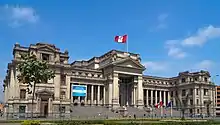
The judicial branch of government is headed by a 16-member Supreme Court seated in Lima. The National Council of the Judiciary appoints judges to this court.
The Constitutional Court (Tribunal Constitucional) interprets the constitution on matters of individual rights. Superior courts in regional capitals review appeals from decisions by lower courts. Courts of first instance are located in provincial capitals and are divided into civil, penal, and special chambers. The judiciary has created several temporary specialized courts in an attempt to reduce the large backlog of cases pending final court action.
Peru's legal system is based on civil law system. Peru has not accepted compulsory ICJ jurisdiction. In 1996 a human rights ombudsman's office (defensor del pueblo) was created to address human rights issues.
Administrative divisions
Peru's territory, according to the Regionalization Law which was passed on 18 November 2002, is divided into 25 regions (regiones). These regions are subdivided into provinces, which are composed of districts. There are a total of 180 provinces and 1747 districts in Peru.
Lima Province is not part of any political region.
Organizations
Armed groups
Leftist guerrilla groups include Shining Path, the Túpac Amaru Revolutionary Movement (MRTA). Both Shining Path and MRTA are considered terrorist organizations.
Regional groups
Regional groups representing peasant and indigenous groups exist in the outlying provinces, often working to promote autonomy.[21] Groups promoting autonomy agreements with larger states possibly existed since the Inca Empire and such sentiments of independence have continued among local communities to current times.[21]
Non-governmental organizations (NGOs)
In the early 1970s and 1980s many grass-roots organizations emerged in Peru. They were concerned with problems of local people and poverty reduction. Solaris Peru, Traperos de Emus San Agustin, APRODE PERU, Cáritas del Perú, and the American organisation CARE, with their Peruvian location, fight to address poverty in their communities with different approaches, depending on the organisation. In 2000 they played an important role in the decentralisation process. Their hope was that power would be divided clearly between national and local governments and the latter would be able to address social justice and the concerns of local people better than the national government could. Some NGO-members even became part of local governments. There is debate extent to which this engagement in politics contributes to the attainment of their original goals.[22]
International policy
Peru or Peruvian organizations participate in the following international organizations:
- Asia-Pacific Economic Cooperation (APEC)
- Andean Community of Nations (CAN)
- Food and Agriculture Organization (FAO)
- Group of Fifteen (G-15)
- Group of Twenty-Four (G-24)
- Group of 77 (G-77)
- Inter-American Development Bank (IADB)
- International Atomic Energy Agency (IAEA)
- International Bank for Reconstruction and Development (IBRD, part of the World Bank Group)
- International Civil Aviation Organization (ICAO)
- International Criminal Court (ICC)
- International Chamber of Commerce (ICC)
- International Confederation of Free Trade Unions (ICFTU)
- International Red Cross
- International Development Association (IDA)
- International Fund for Agricultural Development (IFAD)
- International Finance Corporation (IFC)
- International Federation of Red Cross and Red Crescent Societies (IFRCS)
- International Hydrographic Organization (IHO)
- International Labour Organization (ILO)
- International Monetary Fund, (IMF)
- International Maritime Organization (IMO)
- Interpol
- IOC
- International Organization for Migration (IOM)
- International Organization for Standardization (ISO) (correspondent)
- International Telecommunication Union (ITU)
- Latin American Economic System (LAES)
- Latin American Integration Association (LAIA)
- United Nations Organization Mission in the Democratic Republic of the Congo (MONUC)
- Non-Aligned Movement (NAM)
- OAS
- Agency for the Prohibition of Nuclear Weapons in Latin America and the Caribbean (OPANAL)
- Organisation for the Prohibition of Chemical Weapons (OPCW)
- Permanent Court of Arbitration (PCA)
- Rio Group (RG)
- Union of South American Nations(Unasul-Unasur)
- United Nations
- United Nations Conference on Trade and Development (UNCTAD)
- United Nations Educational, Scientific, and Cultural Organization (UNESCO)
- UNHRC United Nations Human Rights Council (UNHRC)
- United Nations Industrial Development Organization (UNIDO)
- United Nations Mission in Ethiopia and Eritrea (UNMEE)
- United Nations Mission in Liberia (UNMIL)
- Universal Postal Union (UPU)
- World Confederation of Labour (WCL)
- World Customs Organization (WCO)
- World Federation of Trade Unions (WFTU)
- World Health Organization (WHO)
- World Intellectual Property Organization (WIPO)
- World Meteorological Organization (WMO)
- World Tourism Organization (WToO)
- World Trade Organization (WTrO)
See also
Notes
References
- Shugart, Matthew Søberg (September 2005). "Semi-Presidential Systems: Dual Executive and Mixed Authority Patterns" (PDF). Graduate School of International Relations and Pacific Studies. Archived from the original (PDF) on 19 August 2008. Retrieved 31 August 2017.
- Shugart, Matthew Søberg (December 2005). "Semi-Presidential Systems: Dual Executive And Mixed Authority Patterns" (PDF). French Politics. 3 (3): 323–351. doi:10.1057/palgrave.fp.8200087. ISSN 1476-3427. OCLC 6895745903. Retrieved 31 August 2017.
Only in Latin America have all new democracies retained a pure presidential form, except for Peru (president-parliamentary) and Bolivia (assembly-independent).
- The Economist Intelligence Unit (8 January 2019). "Democracy Index 2019". Economist Intelligence Unit. Retrieved 13 January 2019.
- Vargas, Felipe (November 11, 2020). "Atomización de fuerzas, caudillismos e inestabilidad política: Cómo entender el presente del Congreso de Perú". Emol (in Spanish). Retrieved November 15, 2020.
- http://www.medelu.org/Peru-la-derecha-o-la-derecha
- Feline Freier, Luisa; Castillo Jara, Soledad (13 January 2021). ""Terruqueo" and Peru's Fear of the Left". Americas Quarterly. Retrieved 2021-11-18.
- "Qué es el "terruqueo" en Perú y cómo influye en la disputa presidencial entre Fujimori y Castillo". BBC News (in Spanish). Retrieved 2021-11-18.
- Latin America in the 20th century: 1889-1929, 1991, p. 314-319
- https://www.dw.com/en/peru-pedro-castillo-sworn-in-as-president/a-58672989
- https://www.dw.com/en/perus-new-president-castillo-names-leftist-pm/a-58698370
- "The curious case of Peru's persistent president-to-prison politics". The Week.
- "Peru's presidential lineup: graft probes, suicide and impeachment". Reuters. 15 November 2020.
- Constitución Política del Perú, Article No. 112.
- "In Peru's Presidential Election, the Most Popular Choice Is No One". The New York Times. 12 April 2021. Archived from the original on 7 June 2021. Retrieved 7 June 2021.
- "Elecciones Perú 2021: con el 100% del voto procesado, Pedro Castillo y Keiko Fujimori son los candidatos que pasan a la segunda vuelta de las presidenciales" (in Spanish). BBC. 12 April 2021. Archived from the original on 7 June 2021. Retrieved 7 June 2021.
- "Conteo rápido de Ipsos al 100%: Pedro Castillo y Keiko Fujimori disputarían segunda vuelta de Elecciones 2021". El Comercio (in Spanish). Peru. Archived from the original on 12 April 2021. Retrieved 12 April 2021.
- "Flash electoral a boca de urna región por región, según Ipsos". Diario Correo (in Spanish). 12 April 2021. Archived from the original on 12 April 2021. Retrieved 12 April 2021.
- Taj, Mitra; Turkewitz, Julie (20 July 2021). "Pedro Castillo, Leftist Political Outsider, Wins Peru Presidency". The New York Times. ISSN 0362-4331. Retrieved 20 July 2021.
- "Elections Show Fissures in Peru's Political Institutions". Finch Ratings. 14 April 2021. Archived from the original on 7 June 2021. Retrieved 7 June 2021.
- Aquino, Marco (26 July 2021). "Peru opposition to lead Congress in setback for socialist Castillo". Reuters. Retrieved 28 July 2021.
- Asensio, Raúl; Camacho, Gabriela; González, Natalia; Grompone, Romeo; Pajuelo Teves, Ramón; Peña Jimenez, Omayra; Moscoso, Macarena; Vásquez, Yerel; Sosa Villagarcia, Paolo (August 2021). El Profe: Cómo Pedro Castillo se convirtió en presidente del Perú y qué pasará a continuación (in Spanish) (1 ed.). Lima, Peru: Institute of Peruvian Studies. pp. 27–71. ISBN 978-612-326-084-2. Retrieved 17 November 2021.
- Monika Huber, Wolfgang Kaiser (February 2013). "Mixed Feelings". dandc.eu.
External links
 |
Wikimedia Commons has media related to Politics of Peru. |
- Congress of Peru
- Prime minister of Peru
- Presidency of Peru
- Supreme Court of Peru
- Center for Reproductive Rights Report (PDF format)
- Council on Foreign Relations: Peru's Elections
- Local governments in Peru
- Peru's 2006 Elections
- Peru's 2006 Elections
.svg.png.webp)
Authority control: National libraries  |
|---|