Ethnocacerism
The Ethnocacerist movement (Spanish: Movimiento etnocacerista, also sometimes referred to as the Movimiento Nacionalista Peruano or "Peruvian Nationalist Movement") is a Peruvian ethnic nationalist movement seeking the establishment of a proletarian dictatorship led by the country's Indigenous communities and their descendants. It draws on the history of Indigenous and anticolonial movements, including those of Juan Velasco Alvarado, Evo Morales, Abdel Nasser, Muammar Gaddafi and Che Guevara. It is considered an Indigenist ideology.
Ethnocacerism Etnocacerismo | |
|---|---|
 | |
| Leader | Antauro Humala |
| Founder | Isaac Humala |
| Founded | 1987 |
| Headquarters | Lima |
| Membership | Union for Peru President Pedro Castillo and his party Free Peru supports Antauro Humala |
| Ideology | Indigenismo Ethnonationalism Anti-capitalism Social conservatism Economic nationalism Anti-Chilean sentiment Anti-Fujimorism |
| Political position | Syncretic |
| Colours | Red Black |
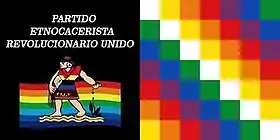
| Dual flag | |
.svg.png.webp) | |
The name etnocacerista is composed of two parts: the first evokes Peru's ethnic identity (specifically, its origins with the Quechua, a Native Peruvian people often identified in the popular imagination with the Inca, a pre-Columbian royal group); the second indicates the group's veneration of 19th century president and war hero Andrés Avelino Cáceres, who led a guerrilla resistance campaign against occupying Chilean troops during the War of the Pacific. Due to the latter, the movement also demands the return of the territories of Arica and Tarapacá that were lost to Chile in the war.
Most of its members are armed forces veterans of Peru's internal wars or the border disputes with Ecuador in the 1980s and 1990s.[1]
History
Origins
Etnocacerism as a doctrine was begun by Ollanta Humala and Antauro Humala in 1987 during the Internal War against the Shining Path.[2] Etnocacerism began as a military doctrine and organizing strategy, not a political doctrine, that was contesting the military doctrine and strategic errors of the Peruvian armed forces, which viewed the Indigenous countryside as a foreign territory and colony. Ollanta Humala explains that Etnocacerism began from the personal experiences of soldiers on the field in clandestine study groups. While critical of high military and political officials, it was not a conspiratorial movement against these official. Rather, Etnocacerism was developed to be an effective military doctrine that spoke to the experiences of Indigenous peoples (Quechua, Aymara, Amazonians), viewed the war as much a political campaign as a military one, and would win over Indigenous peoples in contested territories against the Shining Path.
Isacc Humala, Antauro and Ollanta's father, then founded his Instituto de Estudios Etnogeopolíticos (IEE) in 1989 to serve as a ethnocacerist think tank and then publishing company in Peru.[3]
Locumba Uprising
Ethnocacerism becomes a political doctrine following an uprising in Locumba, Tacna, in October 29, 2000, led by the Humala brothers. The goal was the overthrow of Alberto Fujimori from the presidency over the "vladi-video" corruption scandal where Vladimiro Montesinos, the head of the National Intelligence Service, was caught on video bribing a congressman on the opposition to defect and join Fujimori's party.
Ideology
"Neither Left nor Right"
Etnocacerists distinguish themselves from both the political right-wing (Free Markets, Liberalism) and "Eurocentric" left-wing (European radical theories, Marxist doctrine) in Peru. Being an opponent of Capitalism, Fascism, and Marxism,[4] Etnocacerism seeks to create an organic Indigenist ideology that comes from Peruvian history starting with the earliest Indigenous civilizations and the philosophical tradition of Peru starting from the Incas into the 21st century. Their use of the slogan "ni derecha ni izquierda" traces itself to Juan Velasco Alvarado's revolutionary military government (1968-1975) which remained unaligned to either the US (First World) or Soviet Union (Second World).[5] This position of non-alignment and Third-Worldism meant looking for solutions in Peruvian and Latin American history, such as the rebel hero Tupac Amaru and writer José Carlos Mariátegui. Furthermore, Progressive forces in the military and unions, including Marxist–Leninist parties, were friendly with Velasco due to his policies of nationalizing key industries, rural land reform, and Indigenous cultural promotion.
These anticolonial policies are still advocated by Antauro Humala and the Etnocacerists. Parallel to Velasco and the Marxist-Leninists, the Etnocaceristas have aligned themselves to the Marxist party Perú Libre and its presidential candidate Pedro Castillo since at least 2021.
2nd Tawantinsuyu and Colonial Borders
Following from his rejection of Peruvian nationalism, Antauro has pronounced himself against Peru’s borders as colonial impositions traced back to Spanish colonization. A common slogan of his ethnic nationalism is that Peruvian nationalism wants to “reclaim the word ‘Peru’” while his ethnic nationalism wants to reclaim “the concept of tawantinsuyo” (the Quechua name for the Inca Empire), because “as an ethnic nationalist, I cannot respect criollo borders, because when I reclaim Tawantinsuyo, my ancestral homeland encompasses Tucumán (Argentina) all the way to Pasto (Colombia). We are a single people disseminated amongst various criollo states”.[4]
Antauro calls the Andeans countries and regions “the Inkan International” (La Internacional Inkaica) showing solidarity with Bolivians, Ecuadorians, and the Andean regions of Southwestern Colombia, Northwestern Argentina, and Northern Chile.[6] Ethnocacerists supported Evo Morales's re-election to the presidency in 2019 and condemned the coup against Morales as "fascist" and "neocolonialist".[7]
See also
- Ollanta Humala
- Chilenophobia
- Locumba uprising (es)
- Peruvian Nationalist Party
- Union for Peru
- Indigenism
- National Bolshevism
References
- Jara Coa, Sandra. "La Gesta de Locumba". Antauro: La revista etnocacerista que el Perú necesita. Edición Especial No.1.
- Humala, Ollanta (2009). De Locumba A Candidato A La Presidencia en Perú. México: Ocean Sur. pp. 39–41. ISBN 978-1-921438-43-1.
- Radu, Michael (4 May 2005). "Andean Storm Troopers". Foreign Policy Research Institute. Archived from the original on 10 December 2008.
- Saldaña Ludeña, Pedro (2011). Conversaciones con Antauro Humala. Lima, Peru. p. 441. ISBN 978-9972-33-534-1.
- Saldaña Ludeña, Pedro (2007). Conversaciones con Antauro Humala. Lima, Peru. p. 206. ISBN 978-9972-33-534-1.
- Humala Tasso, Antauro (2011). Etnocacerismo: Izquierda y Globalidad (Visión Etnocacerista). Lima, Peru: Ediciones Antaurpi.
- "Resistencia en Bolivia". Antauro: Prensa Etnocacerista Regional de Lima. Año 2: Dec 2019: 5, 15. 29 December 2019.
External links
- L'un des frères Humala sera-t-il le Hugo Chávez du Pérou? (latinreporters.com; in French)
- Quiénes son los etnocaceristas (BBC; in Spanish)
- Ollanta Humala habla con la BBC (BBC; in Spanish)