Petar Čarnojević
Count Petar Čarnojević (Serbian: Петар Чарнојевић, Hungarian: Csernovits Péter; Mača, Kingdom of Hungary, 13 March 1810 - Fenj, Austria-Hungary, 27 April 1892) was Hungarian nobleman, politician, prefect of Tamis County and a royal commissioner during the Revolutions of 1848-1849.
Petar Carnojevic | |
|---|---|
| Петар Чарнојевић | |
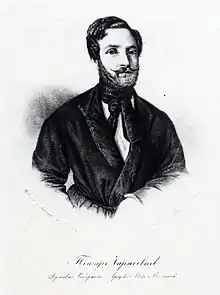 | |
| Born | 13 March 1810 |
| Died | 27 April 1892 |
| Citizenship | Austrian Serbian |
Origin
He comes from a branch of the family of Serbian descent of Joakim, his older brother Arsenije III Čarnojević. Joachim's son Michael received the Hungarian nobility in 1720. He had a son Jovan from his marriage with Ana Jorge, and two sons from another marriage with Ana Kovanja (widow of Ranko Sirovica): Pavle and Simon. Ana Kovanji brought her sons Arsenije (1716—1766) and Đorđe (1720—1759) from her first marriage, who were adopted by Mihajlo Čarnojević in 1742. The branches of John and Paul were left without descendants, only Simon had heirs; however, they lived in Russia. Of the adopted sons of Ranko Sirovica, Arsenija had eight, and George had three children. One of Arsenij's sons was Pavle Čarnojević (1755-1840), a royal adviser, and his grandson Petar Čarnojević. More specifically, Petar was the great-grandson of Ranko Sirovic.[1]
Political career
He entered political and public life very early, as an educated Serb and a Hungarian nobleman. He participated in all Serbian church-people's assemblies between 1837 and 1871. At the parliament in 1842, he stood out for the first time, supporting the candidate for Serbian Metropolitan Pantelejmon Živković. He was elected in 1843[2] to Arad County by the Hungarian parliament. Although loyal to the Hungarian authorities, he advocated against assimilation, and for the expansion of the rights of non-Hungarians. After the Revolution, he was arrested twice (1849 and 1852), because of his closeness and connection with Lajos Kossuth, whom he helped to save his death, but was soon released. He secretly buried his cousin, the infamous Hungarian General Damjanic. Generally speaking, he helped the Hungarians "to stand on their own two feet" after the revolution. In 1861, he was a member of the Annunciation Council, when he advocated rapprochement with the Hungarians. He participated little in the political life of the Serbs; at the parliament in 1864 he was in opposition, but he was one of the initiators of the Serbian People's Party.[3] He was a patron of the Arad Theater. From 1865 to 1875 he was a member of the Hungarian Parliament in three cycles.[4]
Revolution of 1848-49
At the end of April 1848, the revolutionary government of Lajos Bacani appointed him royal commissioner and grand prefect of Tamis County with the task of appeasing the insurgents in southern Hungary. He was also awarded the title of Count of Tamis. He served as commissioner from April 27 to July 28, 1848. Initially, it was supposed to examine the demands of the insurgents, and, if possible, reach an agreement within the law Kingdom of Hungary. However, after the riots in Velika Kikinda and the destruction of the Greater Kikinda District, his powers were expanded and his mission changed. Now his goal was to establish order and peace, property and personal security in Toronto County and to punish the perpetrators of the riots in Velika Kikinda. In the territories of the counties Bačko-Bodroške, Torontalske, Tamiške, Krašovske and Aradska, and in the royal cities Subotica, Sombor, Novi Sad, Arad and Timișoara, as well as in Šajkaškoj oblasti, courts were to be formed.[3]
His approach was based on a peaceful solution to the conflict, so that future coexistence of Serbs and Hungarians would be possible. Both sides condemned him - the Serbs considered him a betrayer of national interests, while the Hungarians resented his indecision and reluctance to use force to quell the Rebellion. When the Hungarian government decided to break the uprising with weapons in July 1848, Čarnojević openly opposed such a solution and was then relieved of his duties. He was replaced by the Deputy Mayor of Tamis Sava Vukovic.[3]
He was married to Ruža, the daughter of the captain Miše Anastasijević.[5] In marriage he had a son Arsenij and a daughter Laura, married to the blushing Cincarin, Močonji. After 1871, he materially "stumbled" materially, due to a debauched life (allegedly "gambled" on the cards, he is a big capital), so by force of circumstances he retired to a peaceful and scarce life. He was in his time of great repute with the Hungarians; respected and popular, because of his wealth, patriotism and generosity - chivalry.
Petar Čarnojević - an impoverished nobleman, died in 1892 in Fenj, with his daughter Laura Močonja, and his remains were transferred to the family tomb in Rusko Selo near Kikinda. The obituary states about him:" The late Čarnojević did not always hit a good path in politics; but he was an honest Serb, who always sincerely wished his people well, and who stood up for them to the best of his ability. He was a good and noble-hearted man. "[6]
See also
- Tomb of the Čarnojević family in Rusko Selo
- Serbian People's Movement 1848-1849
References
- Zbornik Matice srpske za istoriju. 61–62. pp. 241–244.
- "Portrait of Petar Čarnojević". Serbski narodni list. 28. 15 July 1843.
- Simić, Jovanka (11 May 2018). "Zakon biča Petra Čarnojevića". www.novosti.rs.
- "Magyar Electronics Lexicon 1000-1990". mek.oszk.hu. Retrieved 26 September 2018.
- "Ilija Servijaner i dunavski Rothschild". www.srpsko-nasledje.rs.
- Branik, Novi Sad 1892.
External links
- Proclamation of Petar Čarnojević on his appointment as royal commissioner, on patriotism and desire to help the Serbian people, assurance that everything can be achieved peacefully, without weapons, Location: Petrovaradin, Year: 1848 - Digital BMS
- Proclamation of Petar Čarnojević to border guards and sailors and invitation to a meeting where they would agree on all their difficulties, requests and wishes, Place: Petrovaradin, Year: 1848 - Digital BMS