Petrov–Galerkin method
The Petrov–Galerkin method is a mathematical method used to approximate solutions of partial differential equations which contain terms with odd order and where the test function and solution function belong to different function spaces.[1] It can be viewed as an extension of Bubnov-Galerkin method where the bases of test functions and solution functions are the same. In an operator formulation of the differential equation, Petrov–Galerkin method can be viewed as applying a projection that is not necessarily orthogonal, in contrast to Bubnov-Galerkin method.
Introduction with an abstract problem
Petrov-Galerkin's method is a natural extension of Galerkin method and can be similarly introduced as follows.
A problem in weak formulation
Let us consider an abstract problem posed as a weak formulation on a pair of Hilbert spaces and , namely,


- find such that for all .



Here, is a bilinear form and is a bounded linear functional on .


Petrov-Galerkin dimension reduction
Choose subspaces of dimension n and of dimension m and solve the projected problem:


- Find such that for all for all .



We notice that the equation has remained unchanged and only the spaces have changed. Reducing the problem to a finite-dimensional vector subspace allows us to numerically compute as a finite linear combination of the basis vectors in .


Petrov-Galerkin generalized orthogonality
The key property of the Petrov-Galerkin approach is that the error is in some sense "orthogonal" to the chosen subspaces. Since , we can use as a test vector in the original equation. Subtracting the two, we get the relation for the error, which is the error between the solution of the original problem, , and the solution of the Galerkin equation, , as follows


- for all .

Matrix form
Since the aim of the approximation is producing a linear system of equations, we build its matrix form, which can be used to compute the solution algorithmically.
Let be a basis for and be a basis for . Then, it is sufficient to use these in turn for testing the Galerkin equation, i.e.: find such that
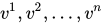
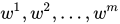



We expand with respect to the solution basis, and insert it into the equation above, to obtain
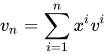

This previous equation is actually a linear system of equations , where


Symmetry of the matrix
Due to the definition of the matrix entries, the matrix is symmetric if , the bilinear form is symmetric, , , and for all In contrast to the case of Bubnov-Galerkin method, the system matrix is not even square, if




Examples
An example of differential equation containing a term with odd order is as follows:

If a test function is used to obtain the weak form, after integration by parts the final Galerkin formulation will be given as follows:


The term with even order (2nd term in LHS) is now symmetric, as the test function and solution function both have same order of differentiation and they both belong to . However, there is no way the first term on LHS can be made this way. In this case the solution space and test function space are different and hence the usually employed Bubnov-Galerkin method cannot be used.


See also
Notes
- J. N. Reddy: An introduction to the finite element method, 2006, Mcgraw–Hill