Phoenician metal bowls
Phoenician metal bowls are approximately 90 decorative bowls made in the 7th-8th centuries BCE from bronze, silver and gold (often in the form of electrum), found since the mid-19th century in the Eastern Mediterranean and Iraq.[1] They have historically been attributed to the Phoenicians, but are today considered to have been made by a broader group of Levantine peoples.[2][3][4][5][6]

The first such bowls were published by Austen Henry Layard in 1849 in the palace of Ashurnasirpal II at Nimrud.[1] The discovery of these bowls began not just the known corpus of Phoenician metal bowls, but according to Nicholas Vella: "effectively gave birth to Phoenician art as a style, a definition with which historians of art still largely concur."[1] The whole corpus was studied in detail by Glenn Markoe in 1985.[1]
They are thought to have been made using the repoussé and chasing metalworking technique.[1]
Discovery and identification
Nimrud bowls
.jpg.webp)
The first bowls of this type were identified in Nimrud in 1849 by Austen Henry Layard, a number of which contained short inscriptions in the Phoenician alphabet.[7][8] Layard described them as follows, identifying them as Phoenician with reference to the Biblical stories of Hiram I, who was described as a skilled bronzeworker, and the Sidonian silver mixing bowl described in book 23 of Homer's Iliad:[1]
The embossed and engraved vessels from Nimroud afford many interesting illustrations of the progress made by the ancients in metallurgy. From the Egyptian character of the designs, and especially of the drapery of the figures, in several of the specimens, it may be inferred that some of them were not Assyrian, but had been brought from a foreign people. As in the ivories, however, the workmanship, subjects, and mode of treatment are more Assyrian than Egyptian, and seem to show that the artist either copied from Egyptian models, or was a native of a country under the influence of the arts and taste of Egypt. The Sidonians, and other inhabitants of the Phœnician coast, were the most renowned workers in metal of the ancient world, and their intermediate position between the two great nations, by which they were alternately invaded and subdued, may have been the cause of the existence of a mixed art amongst them. In the Homeric poems they are frequently mentioned as the artificers who fashioned and embossed metal cups and bowls, and Solomon sought cunning men from Tyre to make the gold and brazen utensils for his temple and palaces.[lower-alpha 1] It is, therefore, not impossible that the vessels discovered at Nimroud were the work of Phœnician artists,[lower-alpha 2] brought expressly from Tyre, or carried away amongst the captives when their cities were taken by the Assyrians, who, we know from many passages in the Bibles, always secured the smiths and artizans, and placed them in their own immediate dominions. They may have been used for sacrificial purposes, at royal banquets, or when the king performed certain religious ceremonies, for in the bas-reliefs he is frequently represented on such occasions with a cup or bowl in his hand; or they may have formed part of the spoil of some Syrian nation, placed in a temple at Nineveh, as the holy utensils of the Jews, after the destruction of the sanctuary, were kept in the temple of Babylon. It is not, indeed, impossible, that some of them may have been actually brought from the cities round Jerusalem by Sennacherib himself, or from Samaria by Shalmaneser or Sargon, who, we find, inhabited the palace at Nimroud, and of whom several relics have already been discovered in the ruins.[9]
Four of the bowls with inscriptions were published in the second volume of Corpus Inscriptionum Semiticarum: CIS II 1.46 (British Museum ID: N.619), CIS II 1.47 (N.50), CIS II 1.48 (N.14), CIS II 1.49 (N.19).[1]
Cyprus bowls
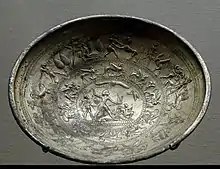
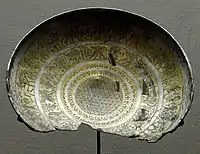
At around the same time, twelve silver bowls of a similar were found in Cyprus. Ten of the bowls were lost, and presumed to have been melted down for their metal. The two remaining were acquired by antiquities dealers, and later were – separately – given to the Louvre.[10][11]
Layard claimed a connection between the Nimrud and Cyprus bowls in his books.
Estruscan tombs

The first Phoenician bowls uncovered in modern times were in 1836 at the Regolini-Galassi tomb about 50km north of Rome; however these were not widely known at the time of Layard's 1849 discoveries in Nimrud, and the connection to the Phoenician bowls was only made in 1876.[12] Today these bowls are at the Museo Gregoriano Etrusco in the Vatican.[1]
In 1876 a number of silver bowls, including one with a detailed inscription, were found in an ancient tomb uncovered in Palestrina (ancient Praeneste), around 30km east of Rome.[13] Its inscription was published a few years later as CIS I 164.
Gallery
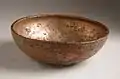
.jpg.webp) Michael C. Carlos Museum, Atlanta
Michael C. Carlos Museum, Atlanta

.jpg.webp)
 Bowls in the Corpus Inscriptionum Semiticarum II; the bottom of the page shows the sides of inscribed Nimrud bowls
Bowls in the Corpus Inscriptionum Semiticarum II; the bottom of the page shows the sides of inscribed Nimrud bowls
Notes
- Layard's footnote: "1 Kings, vii. 13, 14. 2 Chron. iv. The importance attached to such objects in metal, which were chiefly used for sacred purposes, is shown by its being especially recorded that Huram (or Hiram), the widow's son, was sent for to make "the pots, and the shovels, and the basons.” Homer particularly mentions Sidonian goblets as used at the funeral games of Patroclus."
- Layard's footnote: "It will be remembered that Phœnician characters occur on one of the plates. The discovery in Cyprus of twelve silver bowls very closely resembling those found at Nimroud, tend further to confirm the idea that many of these relics were the works of Phœnician artists; unfortunately only two of these curious vessels have been preserved; they are now in Paris; one, the most perfect, in the collection of the Duc de Luines, the other placed by M. de Saulcy in the Louvre."
References
- Nicholas Vella, “Phoenician” Metal Bowls: Boundary Objects in the Archaic Period*
- Karageorghis, Vassos. “A Cypriot Silver Bowl Reconsidered 1. The Iconography of the Decoration.” Metropolitan Museum Journal 34 (1999): 13–20. https://doi.org/10.2307/1513042.
- Francesca Onnis, “THE NIMRUD BOWLS: NEW DATA FROM AN ANALYSIS OF THE OBJECTS.” Iraq 71 (2009): 139–50. http://www.jstor.org/stable/20779008.
- Onnis, Francesca (2013). "The Influence of the Physical Medium on the Decoration of a Work of Art: A Case Study of the "Phoenician" Bowls". Critical Approaches to Ancient Near Eastern Art. EBL ebooks online. De Gruyter. p. 159-180. doi:10.1515/9781614510352.159. ISBN 978-1-61451-035-2. Retrieved 2021-12-13.
- Ferdinando Sciacca, La circolazione dei doni nell’aristocrazia tirrenica: esempi dall’archeologia
- Diana Neri, 2000, Le coppe fenicie della tomba Bernardini nel Museo di Villa Giulia
- Yigal Yadin, A NOTE ON THE NIMRUD BRONZE BOWLS.” Eretz-Israel: Archaeological, Historical and Geographical Studies (1967): 6*-7*. http://www.jstor.org/stable/23616860.
- Richard David Barnett, LAYARD’S NIMRUD BRONZES AND THEIR INSCRIPTIONS.” Eretz-Israel: Archaeological, Historical and Geographical Studies (1967): 1*-6*. http://www.jstor.org/stable/23616859.
- Layard, A.H. (1853). Discoveries in the Ruins of Nineveh and Babylon: With Travels in Armenia, Kurdistan and the Desert: Being the Result of a Second Expedition Undertaken for the Trustees of the British Museum. Discoveries in the Ruins of Nineveh and Babylon: With Travels in Armenia, Kurdistan and the Desert: Being the Result of a Second Expedition Undertaken for the Trustees of the British Museum. J. Murray. p. 192-193. Retrieved 2021-12-13.
- Robert Merrillees, Studies on the provenances of the stele of Sargon II from Larnaca (Kition) and the two so-called Dhali (Idalion) silver bowls in the Louvre, Cahiers du Centre d'Etudes Chypriotes. Volume 46, 2016. Hommage à Antoine Hermary. pp. 349-386; DOI: 10.3406/cchyp.2016.1698
- Adrien Prévost de Longpérier, 1853, Coupes d’argent assyriennes au musée du Louvre, L’Athenaeum français. Journal universel de la littérature, de la science et des beaux-arts, No. 10, 7 Mai, p. 443-444.
- HELBIG W., 1876. Cenni sopra l’arte fenicia (Lettera di W. Helbig al sig. senatore G. Spano). Annali dell’Instituto di Corrispondenza Archeologica, 48, 197–257
- Curtis, C. Densmore. “The Bernardini Tomb.” Memoirs of the American Academy in Rome 3 (1919): 9–90. https://doi.org/10.2307/4238513.
Further reading
- Markoe, G.; University of California, Berkeley (1985). Phoenician Bronze and Silver Bowls from Cyprus and the Mediterranean. Publications in classical studies. University of California Press. ISBN 978-0-520-09663-9.
- Imai, A. (1977). Some Aspects of "Phoenician Bowls" with Special Reference to the Proto-Cypriote Class and the Cypro-Phoenician Class. Some Aspects of "Phoenician Bowls" with Special Reference to the Proto-Cypriote Class and the Cypro-Phoenician Class. Columbia University.
- Falsone, G. (1985). A Syro-Phoenician Bull-Bowl in Geneva and Its Analogue in the British Museum. Anatolian Studies, 35, 131–142. https://doi.org/10.2307/3642879 (regarding a bowl at the Fondation Hardt pour l’Étude de l’Antiquité Classique)
- Histoire de l'art dans l'antiquité: Égypte, Assyrie, Perse, Asie Mineure, Grece, Etrurie, Rome, Perrot, Georges; Chipiez, Charles
- Der Orient und die frühgriechische Kunst, Poulsen, Frederik