Phosh
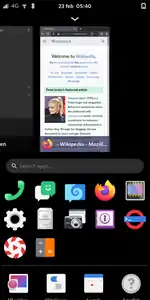
Phosh is a graphical user interface designed for mobile and touch-based devices. It is the default shell used on several mobile Linux operating systems including PureOS, Mobian, and Fedora Mobility. It is also an option on postmarketOS, Manjaro, and openSUSE. Its name originates from a portmanteau of the words "phone" and "shell".
 | |
 | |
| Developer(s) | Purism, SPC |
|---|---|
| Initial release | September 20, 2018 |
| Stable release | 0.14.0
/ October 28, 2021 |
| Repository | gitlab |
| Written in | C and JavaScript |
| Operating system | Linux |
| Size | 4.8 MB |
| Type | Graphical shell |
| License | GNU GPLv3 |
| Website | puri |
Development
.jpg.webp)
In August 2017, Purism, personal computing hardware vendors and developers of PureOS announced their intention to release a privacy-centric smartphone that ran a mobile-optimized version of their Linux-based operating system.[1] With this announcement, Purism released mockups of Phosh that resembled a modified GNOME Shell. This eventually became known as the Librem 5.
In April 2018, Purism started to publicly release documentation that referenced Phosh with updated mockups,[2] and hired GNOME UI/UX developer Tobias Bernhard to directly contribute to the shell.[3]
Despite the Librem 5 phone being delayed, Phosh received its first official release in October 2018, which was primarily focused-on developer usage. The first official hardware for direct use with Phosh was shipped several months later in December when Purism shipped hardware devkits.[4] In July 2020, the PinePhone was released with a version of postmarketOS that featured the Phosh interface.[5]
Related technologies
Phosh is based-on the GTK widget toolkit, and descends as a mobile-specific fork from the GNOME Shell.[6] It is both open source and libre software. Closely-related technologies used in conjunction with Phosh, and also significantly developed by Purism, are Phoc (a Wayland compositor), Squeekboard (an on-screen virtual keyboard), and portions of libadwaita in regards to adaptive windowing to allow for otherwise desktop-centric apps to act and feel as true mobile apps.[7][8]
Version history
The table illustrates major releases, and is not an exhaustive list of releases.
| Version | Date | Inclusion with initial OS release |
|---|---|---|
| 0.0.1 | September 20, 2018 | |
| 0.1.0 | September 30, 2019 | |
| 0.2.0 | February 26, 2020 | |
| 0.3.0 | May 19, 2020 | |
| 0.4.0 | July 1, 2020 | Fedora Linux 33 |
| 0.5.0 | October 28, 2020 | postmarketOS 20.05 |
| 0.6.0 | November 15, 2020 | postmarketOS 21.03 |
| 0.7.0 | December 10, 2020 | |
| 0.8.0 | January 19, 2021 | Fedora Linux 34 Mobian Bullseye |
| 0.9.0 | March 3, 2021 | |
| 0.10.0 | March 31, 2021 | PureOS Amber postmarketOS 21.06 |
| 0.11.0 | May 31, 2021 | |
| 0.12.0 | June 30, 2021 | |
| 0.13.0 | August 10, 2021 | Fedora Linux 35 |
| 0.14.0 | October 28, 2021 | PureOS Byzantium |
See also
References
- Claburn, Thomas (October 21, 2017). "Wanna exorcise Intel's secretive hidden CPU from your hardware? Meet Purism's laptops". The Register. Retrieved November 10, 2021.
- Larabel, Michael (April 11, 2018). "Purism Begins Librem 5 Developer Docs, Using "Phosh" Wayland Shell & GNOME Apps". Phoronix. Retrieved November 10, 2021.
- Larabel, Michael (April 16, 2018). "Purism Hires GNOME Developer For Librem 5 UI/UX Designer". Phoronix. Retrieved November 10, 2021.
- Torres, JC (December 20, 2018). "Purism Librem 5 dev kits ship, bodes well for Linux phone". SlashGear. Retrieved November 10, 2021.
- Tung, Liam (July 16, 2020). "This $200 Linux smartphone can also be used as a PC". ZDNet. Retrieved November 10, 2021.
- Smith, Ernie (June 11, 2021). "The $149 Smartphone That Could Bring The Linux Mobile Ecosystem to Life". Vice Media. Retrieved November 10, 2021.
- Guido Günther (December 29, 2020). "Phosh Overview". Purism. Retrieved November 10, 2021.
- Amadeo, Ron (January 24, 2020). "Librem 5 phone hands-on—Open source phone shows the cost of being different". Ars Technica. Retrieved November 10, 2021.