Phosphoryl bromide
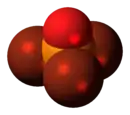
Phosphoryl bromide, also known as phosphorus oxybromide, is an inorganic compound with the formula POBr3.
| |||
| Names | |||
|---|---|---|---|
| Other names
Phosphorus oxybromide | |||
| Identifiers | |||
| |||
3D model (JSmol) |
|||
| ChemSpider | |||
| ECHA InfoCard | 100.029.252  | ||
| EC Number |
| ||
PubChem CID |
|||
| UNII | |||
| UN number | 1939 2576 | ||
CompTox Dashboard (EPA) |
|||
| |||
| |||
| Properties | |||
| POBr3 | |||
| Molar mass | 286.69 g/mol | ||
| Density | 2.82 g cm−3 | ||
| Melting point | 56 °C (133 °F; 329 K) | ||
| Boiling point | 192 °C (378 °F; 465 K) | ||
| Structure[1] | |||
| Pn21a, No. 33 | |||
a = 9.467 Å, b = 9.938 Å, c = 6.192 Å | |||
Formula units (Z) |
4 | ||
| Hazards | |||
| GHS labelling: | |||
  | |||
| Danger | |||
| H290, H314, H335 | |||
| P234, P260, P261, P264, P271, P280, P301+P330+P331, P303+P361+P353, P304+P340, P305+P351+P338, P310, P312, P321, P363, P390, P403+P233, P404, P405, P501 | |||
| Related compounds | |||
Related compounds |
Phosphorus tribromide Thiophosphoryl bromide Phosphoryl fluoride Phosphoryl chloride | ||
Except where otherwise noted, data are given for materials in their standard state (at 25 °C [77 °F], 100 kPa). | |||
| Infobox references | |||


Preparation
Phosphoryl bromide is prepared by the reaction between phosphorus pentabromide and phosphorus pentoxide:[2][3]
- 3 PBr5 + P2O5 → 5 POBr3
It can also be prepared via the slow addition of liquid bromine to phosphorus tribromide at 0 °C, followed by the slow addition of water and vacuum distillation of the resulting slurry.
Structure and properties
Phosphoryl bromide forms colorless crystals or thin plates with a faint orange tint.[4] Its crystals belong to the orthorhombic space group Pnma,[5] with intermolecular Br–O bridges creating infinite chains within the structure. The intermolecular bonding causes distortions from the C3v symmetry found in the free molecule.[1]
It reacts violently with water, forming phosphoric acid and hydrobromic acid. It is soluble in ether, benzene, chloroform, carbon disulfide, and concentrated sulfuric acid.[4] It is stored in sealed glass ampoules.
References
- Olie, K.; Mijlhoff, F. C. (1969-05-01). "The crystal structure of POBr 3 and intermolecular bonding". Acta Crystallographica Section B Structural Crystallography and Crystal Chemistry. 25 (5): 974–977. doi:10.1107/S056774086900327X. ISSN 0567-7408.
- Hönigschmid, O.; Hirschbold‐Wittner, F. (1940). "Das Atomgewicht des Phosphors. Analyse des Phosphoroxybromids". Zeitschrift für anorganische und allgemeine Chemie (in German). 243 (4): 355–360. doi:10.1002/zaac.19402430406. ISSN 1521-3749.
- Booth, Harold S.; Seegmiller, C. G.; Baker, Philip S.; Wexler, Sol; Johnson, Roy D. (2007-01-05), Fernelius, W. Conard (ed.), "Phosphorus(V) Oxybromide: (Phosphoryl Tribromide)", Inorganic Syntheses, Hoboken, NJ, USA: John Wiley & Sons, Inc., pp. 151–152, doi:10.1002/9780470132333.ch44, ISBN 978-0-470-13233-3, retrieved 2020-09-30
- Perry, Dale L. (2011). Handbook of Inorganic Compounds (2nd ed.). Boca Raton: Taylor & Francis. p. 310. ISBN 978-1-4398-1461-1. OCLC 587104373.
- Okuda, Tsutomu.; Hosokawa, Kazuto.; Yamada, Koji.; Furukawa, Yoshihiro.; Negita, Hisao. (1975). "Structural study of phosphoryl bromide by means of nuclear quadrupole resonance". Inorganic Chemistry. 14 (5): 1207–1209. doi:10.1021/ic50147a048. ISSN 0020-1669.