Ploudiry Parish close
The Ploudiry Parish close (Enclos paroissial) is located at Ploudiry within the arrondissement of Brest in Brittany in north-western France. It comprises a church, ossuary and calvary. Much of the old church was demolished and replaced in the 18th century and from 1853-1856, a major part of the church was rebuilt according to the designs of architect Joseph Bigot. The main surviving feature of the old church is the south porch. Until the French Revolution, the parish of Ploudiry was the largest in the Léon region and embraced Loc-Eguiner, Ploudiry, La Martyre, La Roche-Maurice and Saint Julien de Landerneau. It was one of the areas in the Élorn valley to be enriched by participation in the linen trade and much of this wealth was invested in the church and the enlargement of the church building.[1] It has been listed as a historical monument since 1916.[2]
The bell tower
The existing bell tower dates to 1854, with the original tower having collapsed four years prior. Due to a lack of funds, the new tower is much smaller than the original and is limited to one gallery.[1]
The south porch
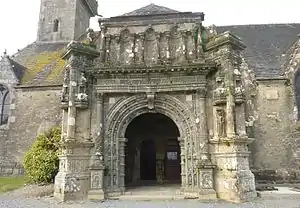
The south proch was built in 1665 in the Renaissance style with a mixture of yellow Logonna stone and Kersanton. The entrance arcade mountings and voussoirs are decorated with figures from the Old Testament and the Passion of Jesus Christ, including prophets and church teachers. There is a Kersanton statue of Saint Sebastian in a niche on the right side buttress. The porch at Ploudiry is much lauded and resembles those at Pencran and at Guimiliau although being built in 1685, is much older.
At the base of the arcade and in the "piédroits" (the individual bricks of the pillars supporting the arch) are six scenes inspired by the book of Genesis and the story of Adam and Eve. In the first piédroit at the base of the left hand pillar, Adam and Eve appear in a scene depicting their temptation in Paradise, with the tree and the snake. The snake has a human head whilst the body is reptilian and wraps itself around part of the piédroit. Eve is reaching towards the forbidden fruit. At the first piédroit at the base of the right-hand pillar is the result of Eve's failure to resist the temptation. Then Adam and Eve are expelled from Eden. They attempt to cover their pubic areas with a flower and their other arms rest on their chests. Above Eve an angel shakes her fist in anger. To the left and the second piédroit, Eve is shown as a mother holding a baby and Adam works in the field whilst Cain and Abel make their offerings/sacrifices. Back then to the right side, Cain is shielding his eye whilst his brother kneels in prayer. On the third piédroit on the left, Abel is in his death throes whilst his brother, full of regrets, turns towards a small depiction of God who is most unhappy. The final third piédroit on the right depicts Noah harvesting his grapes and then, having drunk well, he is intoxicated, whilst Cham tries to cover his father's nudity by drawing together his cloak and another, either Sem or Japhet, struggles to hold Cham back. There is a sort of sculptural full stop between the final piédroits and voussoires.
In the voussoires leading to the keystone are depictions of twelve people led by four prophets, Daniel, Jeremiah, Isiah and Ezekiel. Then come the four eastern doctors, Jean Chrysostome, Grégoire de Naziance, Athanase and Saint Basil and the four western doctors, Saint Augustine, Saint Jerome, Saint Gregory and Saint Ambrose. In the voussoires after the keystone are twelve monks and nuns carrying the instruments of the passion. They hold one instrument in each hand – the whip and column of the flagellation, the cross and the nails, Malchus' ear on Saint Peter's knife and his lantern, the crown of thorns and the roseau from the "Ecce Homo" scene, the bowl used by Pilate to wash his hands, the tools and the ladder used to bring the body down from the cross, Veronica's veil, the lance of the transfixion and the hammer, the sponge and Judas' thirty pieces of silver. The final two figures hold the long bars used to push the crown of thorns down onto Jesus' head. In the porch interior are twelve empty niches.[3][4]
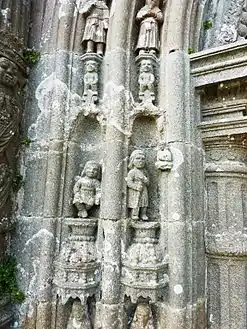 Piédroits on the left side of the entrance to the south porch at Ploudiry
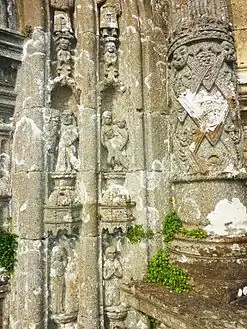 Piédroits on the right side of the entrance to the south porch at Ploudiry
_-PLOUDIRY.jpg.webp) Sculptures in voussure of entrance to south porch: Daniel at right, Isaiah on left, with heads of Jeremiah and Ezekiel below .
Sculptures in voussure of entrance to south porch: Daniel at right, Isaiah on left, with heads of Jeremiah and Ezekiel below ._%C3%89glise_Porche_sud_05.JPG.webp) Saint Sebastian
Saint Sebastian_%C3%89glise_Porche_sud_07.JPG.webp) Decoration on the porch
Decoration on the porch_%C3%89glise_Porche_sud_06.JPG.webp) Decoration on the porch
Decoration on the porch_%C3%89glise_Porche_sud_14.JPG.webp) Empty niches in the porch interior
Empty niches in the porch interior
The main altar
The main alter dates to the 16th/18th century and comprises three panels depicting the Nativity on the left, two shepherds in the centre and the visit of the Magi in the right panel. The tabernacle has niches containing depictions of the four Evangelists and its panels depict scenes from the life of the Holy Family and the Annunciation.[1][5]
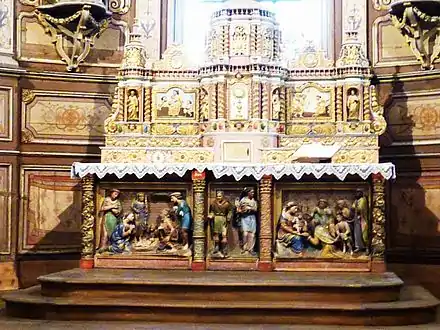 The main altar
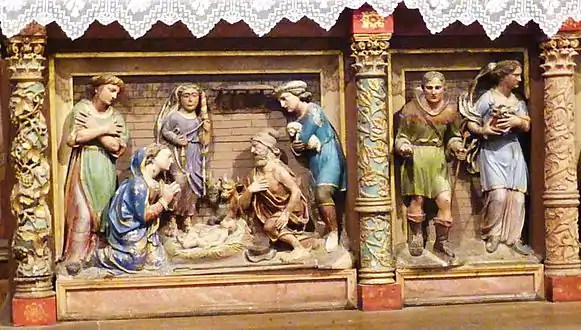 Part of main altar
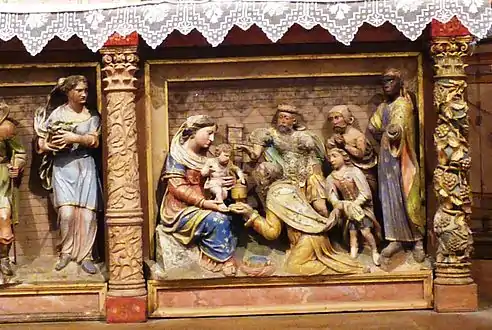 Part of main altar
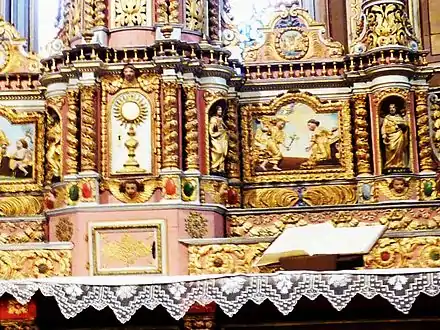 Part of main altar
The infant Jesus altarpiece
The infant Jesus alterpiece is located on the north side of the church and came from the church at La Martyre in 1793. Six columns divide the altarpiece into three sections and niches hold statues of Saint Guillaume and Saint Francis of Assisi. Further niches above contain images of a female saint and an "Ecce Homo". At the front, Saint Anne is shown teaching the Virgin Mary to read and smaller niches hold images of Saint Peter and Saint Paul and the whole composition is crowned by a statue of the crowned Christ.[1]
The Rosary altarpiece
This altarpiece came from the old church where it had been located in the "Rosary" chapel (Chapelle du Rosaire). It dates to 1644. In side niches are statues of Saint Dominic and Catherine of Sienna and in the altarpiece painting the saints are receiving the rosary from the Virgin Mary and Jesus. Under the altarpiece's niches are two panels depicting Saint Peter and Saint Paul. Beneath the painting, a garland contains the traditional fifteen medallions associated with the mysteries of the rosary (five of joy, five of sadness and five glory). Above the front of the altarpiece there is a composition involving the Virgin Mary and her child. The stained glass in the abside depicts the passion and dates from the early 16th century.[1]
Stained glass
The main window behind the altar came from the old church and depicts the crucifixion, with Christ on the cross and the two robbers on crosses nearby. Mary Magdalene is placed at the foot of the cross. Near to the good robber are some female saints and the disciples along with the soldier who would pierce Christ's side with a spear. On the other side are the High Priest and various other people. At the base of the window, and obscured by the altar, are scenes of Jesus in the Garden of Gethsemane, the Last Supper and Jesus' arrest. On each side of this window are statues of Saint Peter and the Virgin Mary with child. The two side windows are modern, date to 1957 and are signed "Guével". The left side window shows scenes from Saint Peter's life and the second scenes from the life of the Virgin Mary.[5]
The pulpit
The pulpit has five panels with palm leaves and flowers decorating the stairway and is itself decorated with three bas-reliefs. In one, the risen Christ is seen on a cloud handing the keys of heaven to Saint Peter who is the church's patron saint. In the central relief, Christ is shown in discussion with the lawyers and in the third relief, Saint Peter appears again. Above the pulpit there is a dove and at the top of the sounding board there is a carving of the papal crown and Saint Peter's keys. Facing the pulpit is a statue of Christ on the cross and a highly regarded pietà.[1][5]
The ossuary
The Saint Joseph chapel is a rectangular building built in 1635 and restored in 1731. The door has a Greek style front with a tympanum containing a bust of Saint Peter. To the left of the door are five bays separated by doric pilasters. Above a frieze is a depiction of the danse macabre featuring a labourer, a noblewoman, a judge, and a warrior, all equal before the "Ankou" or death. Over the ossuary stoup, an angel carries a banner reading "Bones gente qui par icy passez Priez Dieu les Trépassez 1635", a request to the passerby to respect the dead. A royal decree was passed in the early 18th century which effectively ended the use of ossuaries. Thereafter many such buildings were used as chapels, some as schools and many are now small museums.[1][5]
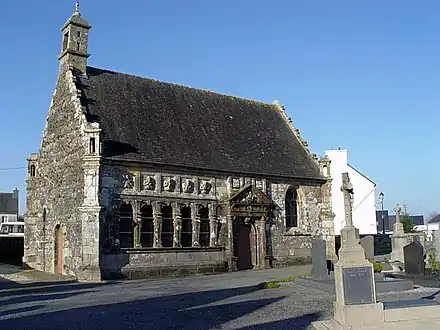 The Ploudiry ossuary
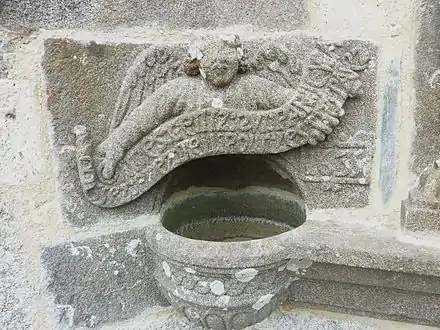 An angel with banner above the stoup
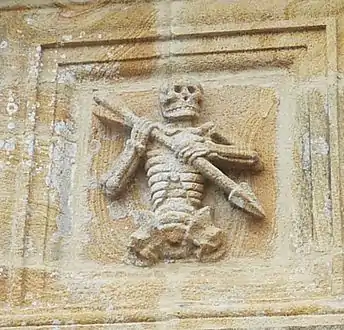 The Ankou
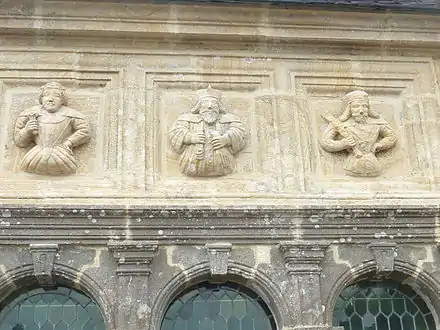 Other depictions in the ossuary frieze.
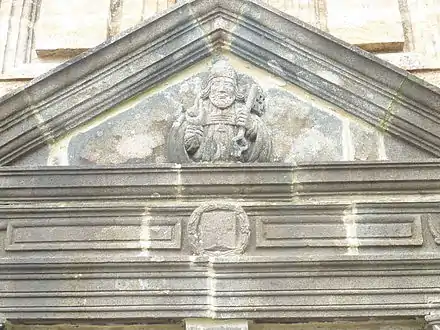 Saint Peter with key in the ossuary tympanum
_Ossuaire_02.jpg.webp) The five windows with frieze above.
The five windows with frieze above.
The Calvary
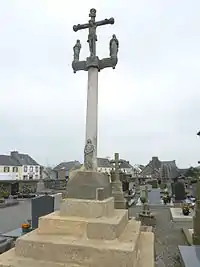
The calvary in the cemetery on the north side of the enclosure and carries two dates, "1633" and "1868".[1][6]
Sculptures by north entrance
There are sculptures decorating the north entrance, which may come from another calvary in the area.
_Enclos_paroissial_04.JPG.webp) Pietà, north entrance.
Pietà, north entrance._Enclos_paroissial_01.JPG.webp) A saint, north entrance
A saint, north entrance_Enclos_paroissial_03.JPG.webp) Jesus crucified, north entrance
Jesus crucified, north entrance
References
- "Infobretange website". Retrieved 23 March 2015.
- Base Mérimée: PA00090213, Ministère français de la Culture. (in French) Eglise Saint-Pierre
- Emmanuelle LeSeac'h. Sculpteurs sur pierre en Basse-Bretagne. Les Ateliers du XVe au XVIIe Siècle. Presses Universitaires de Rennes. ISBN 978-2-7535-3309-7.
- "Roland Doré et Les enclos paroissiaux" Booklet issued in 1988 by the Musée de Morlaix.
- "Apeve website". Retrieved 23 March 2015.
- "Calvary at Ploudiry". Archived from the original on 4 June 2012. Retrieved 24 March 2015.