Plumed basilisk
The plumed basilisk (Basiliscus plumifrons), also called commonly the green basilisk, the double crested basilisk, or the Jesus Christ lizard, is a species of lizard in the family Corytophanidae. The species is native to Central America.
| Plumed basilisk[1] | |
|---|---|
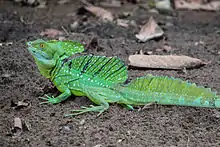 | |
| Male, Alajuela Province, Costa Rica | |
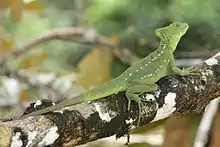 | |
| Female plumed basilisk | |
Scientific classification  | |
| Kingdom: | Animalia |
| Phylum: | Chordata |
| Class: | Reptilia |
| Order: | Squamata |
| Suborder: | Iguania |
| Family: | Corytophanidae |
| Genus: | Basiliscus |
| Species: | B. plumifrons |
| Binomial name | |
| Basiliscus plumifrons | |

Geographic range
The natural distribution of B. plumifrons ranges from eastern Honduras, through Nicaragua and Costa Rica, to western Panama.[3][4]
Taxonomy and etymology
The Green basilisk's generic name Basiliscus is taken from the legendary reptilian creature of European mythology which could turn a man to stone by its gaze: the Basilisk.[5] This name derives from the Greek basilískos (βασιλίσκος) meaning "little king".[5] This generic name was given in Carl Linnaeus' 10th edition of Systema Naturae.[5]
For the origin of the nickname "Jesus Christ lizard", see § Behaviour.
Description
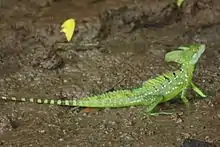
The plumed basilisk is the largest basilisk species, with an average snout-to-vent length(SVL) of approximately 10 inches (25 cm). Including the tail, it can reach 3 feet (91 cm) in total length. Adults are brilliant green, with bright yellow eyes, and small bluish spots along the dorsal ridge. Males have three crests: one on the head, one on the back, and one on the tail, while females only have the head crest.[6] Juveniles are less conspicuously colored, and lack the characteristic crests.[7]
Behaviour
Male plumed basilisks are territorial; a single male may defend a territory that several females inhabit, with which he mates. Plumed basilisks do not tolerate much handling when kept in captivity.
B. plumifrons is able to run short distances across the water using both its feet and tail for support, an ability shared with other basilisks and the Malaysian sail-finned lizard, When running, they create an air cavity which they use to push themselves forward with their feet which is mostly seen in adult basilisk lizards. The adults have a greater mass than juveniles so there is less hydrodynamic lag and they are able to run across the water in order to escape their predators. This has earned the plumed basilisk the nickname "Jesus Christ lizard".[8] It is also an excellent swimmer and can stay underwater for up to an hour.
Running on Water
Basilisk lizards are notable for their remarkable ability to scamper across water from the time they are born. Both juvenile and adult basilisk lizards tend to use this unique trait to avoid predation. The mechanisms that allow these lizards to accomplish this task, however, remain generally unknown to researchers.
While some insects are able to run on water using surface tension, basilisk lizards, which have much more mass, achieve this through alternative fluid dynamics. This lizard will use its hind leg to penetrate the surface of the water beneath it to create an air-filled cavity and then retract its leg before the cavity closes. This enables the basilisk lizard to minimize its contact with water. Additionally, this running technique reduces the drag experienced during the run while simultaneously allowing the lizard’s body to be propelled across the water at an average speed of 1.6 m/s. [9]
Although all Basilisk lizards harness this water-running ability, there is notably kinematic variation in these runs for these lizards - variation that is primarily due to differences in running velocity and not differences in the mass of the lizards running. This kinematic variation is unique to basilisk lizards. For other land lizards, kinematic variations in their running are generally similar. Studies have also indicated that the basilisks hindlimbs act as the primary force producer when they are running on water.[10]
The basilisk lizard's remarkable ability to run on water has allowed scientists working with bipedal and quadrupedal robots to potentially create man-made technology that could also run on water through similar mechanisms. [11]
Reproduction and Life Cycle
During the week prior to laying, sexually mature females of B. plumifrons were observed presenting herself to the male. The female would position herself about 0.5 m from the male, lowering her forebody to the sand and raising her pelvic region and tail. Females lay five to fifteen eggs at a time in warm, damp sand or soil. One mother lizard in captivity actually was observed to start digging holes (sometimes referred to as nests) in the soil six months prior to ovipositing, well ahead of the breeding season.[12] The eggs hatch after eight to ten weeks, at which point they emerge as fully independent lizards, although averaging only 43mm SVL (Snout-to-Vent Length) and weighing only about 2 grams.[12] The juvenile males would start to develop the large crests which are characteristic of the male B. plumifrons after six month or up to more than one year, depending on the body conditions of the juveniles.
References
- "Basiliscus plumifrons ". Integrated Taxonomic Information System. Retrieved July 14, 2018.
- "Basiliscus plumifrons ". The Reptile Database. www.reptile-database.org.
- Köhler G (2008). Reptiles of Central America, 2nd Edition. Offenbach, Germany: Herpeton Verlag. 400 pp. ISBN 978-3936180282
- Savage JM (2005). The Amphibians and Reptiles of Costa Rica: A Herpetofauna between Two Continents, between Two Seas. Chicago and London: University of Chicago Press. xx + 945 pp. ISBN 978-0226735382
- Sprackland, Robert George (1992). Giant lizards. Neptune, New Jersey: TFH Publications. ISBN 0-86622-634-6.
- Lanferwerf, Bert (2018). "Basilisk Lizard Care And Information". www.reptilesmagazine.com. Retrieved 2015-09-01.
- Reid, Fiona A.; et al. (2010). The Wildlife of Costa Rica: A Field Guide. Cornell University Press. p. 169. ISBN 978-0801476105.
- "Green Basilisk Lizard | National Geographic". 11 April 2010.
- Sweeney, Andrew. "Force Measurement of Basilisk Lizard Running on Water". ProQuest. Arizona State University. ProQuest Dissertations Publishing, 2019.
- Tonia, Hsieh. "Three-dimensional hindlimb kinematics of water running in the plumed basilisk lizard (Basiliscus plumifrons)". The Company of Biologists. Journal of Experimental Biology (2003).
- Xu, Lin Sen. "Designing and Kinematics Analysis on Running Mechanism of Biped Robot for Water-Running". Scientific.Net. Applied Mechanics and Materials (Volumes 130-134).
- Breeding and Growth of the Plumed Basilisk (Basiliscus Plumifrons) at the Royal Melbourne Zoo, Chris B. Banks, British Herpetological Society Bulletin, No. 8, 1983.
- Spinner, Leo (2018). "Plumed Basilisk Lizard Care Tips". www.reptilesmagazine.com. Retrieved 2015-09-01.
External links
 |
Wikimedia Commons has media related to Basiliscus plumifrons. |
 |
Wikispecies has information related to Basiliscus plumifrons. |
- Green Basilisk. Honolulu Zoo web site.
- Image of Plumed Basilisk.
- https://animals.mom.me/types-animals-jesus-lizards-predator-6521.html.

Further reading
- Cope ED (1865). "On the Batrachia and Reptilia of Costa Rica. With notes on the Herpetology and Ichthyology of Nicaragua and Peru". J. Acad. Nat. Sci. Philadelphia, Second Series 8: 93-188. (Basiliscus plumifrons, new species, pp. 125–127).
- Hsieh, Tonia. "Running on water: Three-dimensional force generation by basilisk lizards". PNAS. PNAS. Retrieved 29 October 2021.