Plus ultra
Plus ultra (Latin: [pluːs ˈʊltraː], Spanish: [plus ˈultɾa], English: "Further beyond") is a Latin phrase and the national motto of Spain. A reversal of the original phrase non plus ultra ("Nothing further beyond"), said to have been inscribed as a warning on the Pillars of Hercules at the Strait of Gibraltar (which marked the edge of the known world in antiquity), it has metaphorical suggestions of taking risks and striving for excellence. Its original version, the personal motto of the Holy Roman Emperor Charles V, also Duke of Burgundy and King of Spain, was Plus oultre in French. The motto was adopted some decades after the discovery of the New World by Columbus.


History
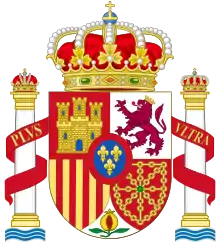
The motto was suggested to King Charles in 1516 by his adviser Luigi Marliano, an Italian physician.[1][2] It was emblematic of Marliano's vision of a Christian empire spanning beyond the boundaries of the Old World.[2] The motto is first recorded as Plus oultre on the back of Charles's chair in the church of St Gudule, Brussels.[2] In Spain, the original French was translated into Latin due to the hostility Spaniards bore for the French-speaking Burgundian advisors and ministers Charles brought with him to Spain from the Low Countries.[2] It was associated in particular with the desire to bring the Reconquista past Gibraltar and into North Africa. At Charles's entry into Burgos in 1520, an arch was set up bearing on one side, "Plus ultra", and on the other "All of Africa weeps because it knows that you have the key [Gibraltar and] have to be its master".[2] The motto continued to be popular in Spain after Charles V's death. It appeared in Habsburg propaganda and was used to encourage Spanish explorers to ignore the old warning and go beyond the Pillars of Hercules. Today it is featured on both the flag and arms of Spain.
Other uses
- The French built the Lines of Ne Plus Ultra which they hoped would stop the army of the Duke of Marlborough during the 1711 campaigning season in the War of Spanish Succession, but his army breached them without loss.[3]
- The motto is used by Veracruz State in Mexico as part of its flag.
- The motto is used by a number of institutions around the world, including the National University of San Marcos, the University of Mexico, Shepherd University, the Colombian Navy, St Peters Lutheran College in Indooroopilly, Queensland, Trompsburg Primary School, and Immanuel College (Australia) in Adelaide, South Australia. The French version, Plus oultre, is used as the motto of the Belgian city Binche and the US Air Force Academy's 15th Cadet Squadron. Charles V was born in Ghent, Flanders and as a result the motto is also used in this region.
- The English philosopher Sir Francis Bacon used “plus ultra” as his personal motto.
- In 1926 a crew of Spanish aviators including Ramón Franco and Julio Ruiz de Alda Miqueleiz completed the first transatlantic flight between Spain and South America on a seaplane named the Plus Ultra. 1930 saw the formation of a Madrid-based football team AD Plus Ultra, which eventually developed into Real Madrid Castilla.
- The Plus Ultra Brigade, composed of troops from five Spanish-speaking countries (Spain, the Dominican Republic, Nicaragua, Honduras, and El Salvador), served in the Iraq War in 2003.
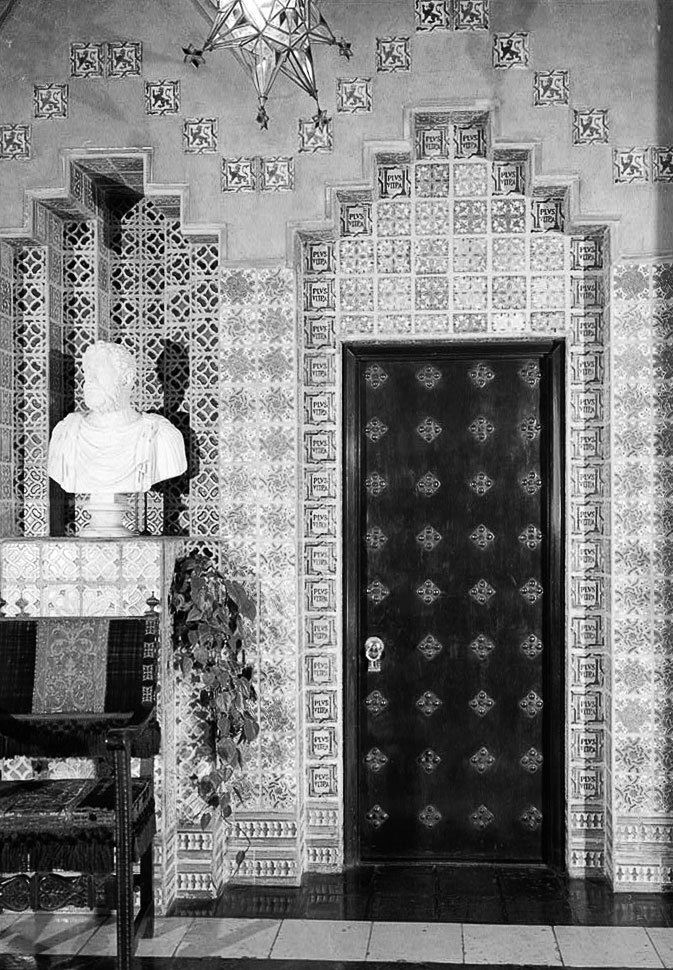
- The motto is written on the wall tiles of the cloak room at Mar-a-Lago,[4] a resort in Florida currently owned by Donald Trump.[5]
- The motto appears frequently in popular culture. In the manga and anime series My Hero Academia, it is used as the motto of the hero academy U.A. High School.
- The light novel series The Saga of Tanya the Evil, which uses Latin phrases and mottos for most of its titles, uses it as the name of the second volume.
- In the 2015 movie Tomorrowland, the Plus Ultra Society is the name of the fictional group of people responsible for creating a better tomorrow, whose founding members were Gustave Eiffel, Nikola Tesla, Thomas Edison, and Jules Verne.
- The motto is seen tattooed on the arm of Octane, one of the playable characters in the 2019 videogame Apex Legends, and Non terrae plus ultra is one of his possible voice lines entering a battle.
See also
- A.E.I.O.U., the motto of the Habsburgs, which is often being understand as "All the world is subject to Austria" (Alles Erdreich ist Österreich untertan in German or Austriae est imperare orbi universo in Latin), and shares a similar spirit with Plus ultra.
- A solis ortu usque ad occasum (English: From sunrise to sunset), another quote from the Spanish Coat of Arms
- List of national mottos
- Plus Ultra (aircraft)
References
- Giovio, Paolo (1658). Diálogo delas empresas militares y amorosas, compuesto en lengua italiana.
- Ferer, Mary Tiffany (2012). Music and Ceremony at the Court of Charles V. The Boydell Press. ISBN 9781843836995.
- Bromley, J.S. (1970), The New Cambridge Modern History: Volume 6, The Rise of Great Britain and Russia, 1688-1715/25, CUP Archive, pp. 440–442, ISBN 978-0-521-07524-4
- Photograph of the cloak room at Mar-a-Lago, www.historic-details.com, retrieved 27 September 2017
- Donald J. Trump [@realDonaldTrump] (18 January 2017). "Writing my inaugural address at the Winter White House, Mar-a-Lago, three weeks ago. Looking forward to Friday.…" (Tweet) – via Twitter.