Poached egg
A poached egg is an egg that has been cooked, outside the shell, by poaching (or sometimes steaming), as opposed to simmering or boiling. This method of preparation can yield more delicately cooked eggs than cooking at higher temperatures such as with boiling water.
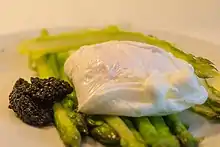 A poached egg served with asparagus | |
| Main ingredients | Eggs |
|---|---|
Preparation

The egg is cracked into a cup or bowl of any size, and then gently slid into a pan of water at approximately 75° C (167 °F) and cooked until the egg white has mostly solidified, but the yolk remains soft. The "perfect" poached egg has a runny yolk, with a hardening crust and no raw white remaining. In countries that mandate universal salmonella vaccination for hens, eating eggs with a runny yolk is deemed safe for consumption.[1]
Broken into water at the poaching temperature, the white will cling to the yolk, resulting in cooked egg white and runny yolk.
Any given chicken egg contains some egg white that is prone to dispersing into the poaching liquid and cooking into an undesirable foam. To prevent this, the egg can be strained beforehand to remove the thinner component of the egg white.[2] A small amount of vinegar may also be added to the water, as its acidic qualities accelerate the poaching process.[3] Stirring the water vigorously to create a vortex may also reduce dispersion.[4]
The age of the eggs affects the cooking process. The whites of freshly-laid eggs are less likely to disperse. With less fresh eggs, the whites are more likely to disperse, so acidulating the water will assist in preventing excessive egg white dispersement.
Steamed
The term "poaching" is often used for this cooking method but it is actually incorrect, as this method is closer to "coddling".
The egg is placed in a cup and suspended over simmering water, using a special pan called an "egg-poacher". This is usually a wide-bottomed pan with an inner lid, with holes containing a number of circular cups that each hold one egg, with an additional lid over the top. To cook, the pan is filled with water and brought to a simmer, or a gentle boil. The outer lid holds in the steam, ensuring that the heat surrounds the egg completely. The cups are often lubricated with butter in order to effect easy removal of the cooked egg.
The result of steamed eggs is similar to making a coddled egg, although steamed eggs are often cooked longer, and hence tend to be firmer in texture. Eggs prepared by this method are often served on buttered toast.
Steamed eggs are often made in a home environment in place of Poached eggs, as it is easier to obtain consistent results with this alternative method. However, Poached eggs remain the preference of professional kitchens as it is easier to cook larger quantities, and no additional equipment or appliance is needed to do so.
Dishes with poached eggs

Poached eggs are used in the traditional American breakfast dish Eggs Benedict, and similar style dishes like Eggs Florentine and Eggs Mornay.

Poached eggs are the basis for many dishes in Louisiana Creole cuisine, such as Eggs Sardou, Eggs Portuguese, Eggs Hussarde and Eggs St. Charles. Creole poached egg dishes are typically served for brunches.[5]
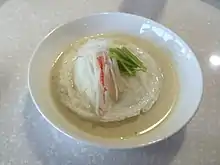
Several cuisines include eggs poached in soup or broth and served in the soup. In parts of central Colombia, for instance, a popular breakfast item is eggs poached in a scallion/coriander broth with milk, known as changua or simply caldo de huevo ("egg soup").
The North African dish shakshouka consists of eggs poached in a spicy tomato sauce.
In Italy poached eggs are typically seasoned with grated parmigiano reggiano and butter (or olive oil).
In Portugal poached eggs are known as ovos escalfados and are typically done with boiled peas and chouriço.
In Korean cuisine, poached eggs are known as suran (수란) and is topped with variety of garnishes such as chili threads, rock tripe threads, and scallion threads.
Turkish dish çılbır consists of poached eggs, yogurt sauce with garlic and butter with red peppers.
In Bulgaria poached eggs are served on a bed of yogurt and often sirene, topped with butter and paprika. The dish is called Panagyurishte-style eggs (or "eggs Panagyurian" or something similar depending on the translator, as there is no direct translation), and is similar to the Turkish Çılbır.
In India, fried eggs are most commonly called "poached," but are sometimes also known as bullseyes, as a reference to "bullseye" targets, or "half-boil" in Southern India, indicating that they are partly cooked. These eggs are "poached" in name only and so do not share the same preparation method as poached eggs in other countries.
In Indonesia, poached eggs are staple condiment in instant noodle dish. Boiled together with the instant noodle in the pan, when its ready, then mixed with the seasoning from the instant noodle package.
References
- "Runny eggs declared 'safe to eat'".
- "How to Poach Eggs, the Foolproof Method (Really!)".
- "everybody likes sandwiches: how to make the perfect poached egg". Retrieved 2009-08-02.
- "how to poach an egg, smitten kitchen-style". smitten kitchen. Retrieved 2009-08-02.
- John D. Folse, The Encyclopedia of Cajun & Creole Cuisine, Chef John Folse & Company Publishing, December 2004, ISBN 0-9704457-1-7
External links
 |
Wikibooks Cookbook has a recipe/module on |
 |
Wikimedia Commons has media related to Poached eggs. |
| Types |  | |
|---|---|---|
| Fossil record | ||
| Biology | ||
| Components | ||
| As food | ||
| In culture | ||
| ||
