Polymer-cased ammunition
Polymer-cased ammunition (PCA) is firearm ammunition (cartridge) with casings made from synthetic polymer instead of the typical metallic casing. PCA is considered a new alternative that potentially reduces production cost and weight for long guns and handguns.
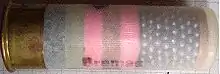
A 12-gauge shotgun shell in a transparent plastic hull, allowing the contents to be seen.
Origin
The first references to the possible use of polymers in the manufacture of casings come from the early 1950s. One of the earliest is the patent filed by Jack W. Roske in 1950[1] and the idea was to use a metal cup joined with a polymer shell "that will be converted to gas during the firing phase to assist in propelling the projectile and thereby permit reduction in the use of the propelling powder charge".
Examples
- The majority of commonly found shotgun shell hulls are constructed of polymer with metal only found on the lower or rim portions of the shells.
- The Steyr ACR was a notable user of polymer cased ammunition.
- The US Army ARDEC developed a 5.56mm Telescoped ammunition[2] for its LSAT program.
- The Assistant Secretary of Defense for Special Operation's TSWG program developed lightweight cartridges in multiple calibers for USSOCOM.[3]
Manufacturers
- PCP Tactical offers a variety of calibers in 5.56mm NATO/.223 Rem, 7.62mm NATO/.308 Win, .260 Rem, 6.5mm Creedmoor, 6.8mm PCP and .50 BMG.[4]
- PolyCase Ammunition offered a .380 Polymer Cased Round.[5]
- True Velocity offers polymer ammunition in a variety of calibers including 5.56 NATO, 6.5mm Creedmoor, 6.8mm TVCM, .308 Win/7.62mm NATO, .338 Norma Mag and .50 BMG.[6]
See also
References
- "US Patent 2654319". Retrieved 10 March 2013.
- "Lightweight Small Arms Technologies" (PDF). Archived from the original (PDF) on 10 January 2017. Retrieved 10 March 2013.
- "Archived copy". Archived from the original on 2017-01-31. Retrieved 2017-04-18.CS1 maint: archived copy as title (link)
- "PCP Ammunition". Retrieved 10 March 2013.
- "PolyCase Ammunition". Archived from the original on 27 January 2013. Retrieved 10 March 2013.
- https://www.tvammo.com/composites. Retrieved 2021-09-30. Missing or empty
|title=(help)
External links
This article is issued from Wikipedia. The text is licensed under Creative Commons - Attribution - Sharealike. Additional terms may apply for the media files.