Polytrichum piliferum
Polytrichum piliferum, the bristly haircap, is an evergreen perennial species of moss in the family Polytrichaceae.[2] It has a bipolar, cosmopolitan distribution, occurring on all continents including mainland Antarctica.
| Polytrichum piliferum | |
|---|---|
_7699.jpg.webp) | |
Scientific classification  | |
| Kingdom: | Plantae |
| Division: | Bryophyta |
| Class: | Polytrichopsida |
| Order: | Polytrichales |
| Family: | Polytrichaceae |
| Genus: | Polytrichum |
| Species: | P. piliferum |
| Binomial name | |
| Polytrichum piliferum Hedw. | |
| Synonyms[1] | |
|
Synonyms
| |
Common names
In English the species goes by the common names polytrichum moss, bristly haircap,[3] or bristly haircap moss. In Finnish its common name is karvakarhunsammal, while in German it is called Glashaar-Frauenhaarmoos, Glashaar-Haarmützenmoos, Glashaar-Widertonmoos, Haartragendes Frauenhaar-Moos, or Haartragendes Frauenhaarmoos.[2]
Distribution
The species has a bipolar cosmopolitan distribution, occurring in suitable habitats on all continents[2][4] including Antarctica.[5]: 39 It is found in similar situations to Polytrichum juniperinum,[3] although P. piliferum prefers more open and mobile areas than P. juniperinum[6]: 324 as well as more dry areas.[7] In dry areas the species is able to handle temperatures as high as 90 C to 100 C.[8]
Its habitat includes gravel that is dry and sandy gravel. Another habitat is rocks on road banks or pastures.[9] It is also found in shallow and drained sandy or gravel like ground over rocks and boulders in situations when its sunny.[10]
P. piliferum is less common than Polytrichum juniperinum.[3] It often occurs in association with species of Cladonia.[10] In sandy dry grass lands the species prevents higher plants from growing.[11]
Description
Leaves
_5598.JPG.webp)
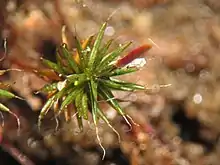
In P. piliferum shorter leaves are located close together towards the tip of its red stems, giving the shoot a characteristic tapered shape.[3] The leaves have white, hair like awns at the tips, in contrast to the short red-brown awns of P. juniperinum. These leaves can be from 4 mm to 7 mm long,[9] although they may be shorter in dry areas.[7] The leaves have parallel, longitudinal lamellae of photosynthetic tissue on their upper surfaces. Under a microscope the cross section of each lamella appears 1 cell wide and 5 to 7 cells high.[9]
It is the only species in its genus where the awn is completely hyaline.[7]
Reproduction

The species is dioicious, having separate male and female plants.[10] In this species the antheridia develop from cells below the leaves.[12]
References
- "Polytrichum piliferum". The Plant List. Royal Botanic Garden Kew and Missouri Botanic Garden. 2013. Retrieved 8 October 2021.
- "Polytrichum moss - Encyclopedia of Life". eol.org. Retrieved 2021-10-05.
- Watson, EV (1981). British Mosses and Liverworts: An Introductory Work (3 ed.). Cambridge University Press. p. 148. ISBN 978-0-521-28536-0.
- Ros, Rosa María; Cano, María J.; Guerra, Juan (1999). "Bryophyte checklist of Northern Africa". Journal of Bryology. 21 (3): 207–244. doi:10.1179/jbr.1999.21.3.207.
- Putzke, J.; Pereira, A.B. (2001). The Antarctic mosses with special reference to the South Shetland Islands. Brazil: Ed. Ulbra. ISBN 85-7528-008-2.
- Atherton, I; Bosanquet, S; Lawley, M, eds. (2010). Mosses and liverworts of Britain and Ireland, a field guide (PDF). Plymouth, UK: British Bryological Society Publications. ISBN 978-0-9561310-1-0.
- Webmaster, David Ratz. "Frosted Haircap Moss - Montana Field Guide". fieldguide.mt.gov. Retrieved 2021-10-06.
- Stoutjesdijk, Ph; Barkman, J. J. (2014-12-01). Microclimate, Vegetation & Fauna. BRILL. p. 152. ISBN 978-90-04-29780-7.
- McKnight, Karl B.; Rohrer, Joseph R.; Ward, Kirsten McKnight; Perdrizet, Warren J. (2013-02-21). Common Mosses of the Northeast and Appalachians. Princeton University Press. p. 65. ISBN 978-1-4008-4588-0.
- "Polytrichum piliferum in Flora of North America @ efloras.org". www.efloras.org. Retrieved 2021-10-06.
- Leuschner, Christoph; Ellenberg, Heinz (2017-09-13). Ecology of Central European Non-Forest Vegetation: Coastal to Alpine, Natural to Man-Made Habitats: Vegetation Ecology of Central Europe, Volume II. Springer. p. 569. ISBN 978-3-319-43048-5.
- Goffinet, Bernard (2008-10-30). Bryophyte Biology. Cambridge University Press. p. 76. ISBN 978-1-107-37728-8.