Pontiac Trophy 4 engine
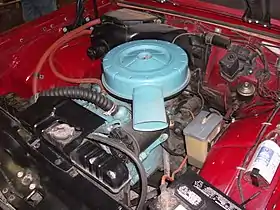
The Pontiac Trophy 4 engine (also called the Indianapolis 4,[1] or Indy 4) is a 194.5 cu in (3.2 L) inline four-cylinder engine[2] produced by the Pontiac Motor Division of General Motors for model years 1961 through 1963.[3] Created from one bank of Pontiac's powerful 389 cu in (6.4 L) Trophy V8,[3] its only application was in the first generation Pontiac Tempest. It was dubbed by Pontiac the Trophy 4,[4] playing off the racing success that had earned the 389 V8 engine the nickname Trophy V-8 after just two years of competition.
| Pontiac Trophy 4 engine | |
|---|---|
 1962 Pontiac Tempest LeMans | |
| Overview | |
| Manufacturer | Pontiac Division of General Motors |
| Also called | Indianapolis 4 Indy 4 |
| Production | 1961-63 |
| Layout | |
| Configuration | Naturally aspirated Inline four |
| Displacement | 194.5 cu in (3.2 L) |
| Cylinder bore | 4+1⁄16 in (103.2 mm) |
| Piston stroke | 3+3⁄4 in (95.3 mm) |
| Valvetrain | OHV 2 valves x cyl. |
| Combustion | |
| Fuel system | Single or 4-barrel carburetor |
| Fuel type | Gasoline |
| Cooling system | Water-cooled |
| Output | |
| Power output | 110–166 hp (82–124 kW) |
| Torque output | 190–215 lb⋅ft (258–292 N⋅m) |
| Dimensions | |
| Dry weight | 470 lb (210 kg) |
History
The Trophy 4 engine is a short-stroke, 45-degree inclined[4] inline four created from the right bank of the 389 V8 for the debut of the Tempest in 1961. Its 194.43 cu in (3.2 L) displacement is precisely half of the 389, with an identical bore and stroke of 4+1⁄16 in × 3+3⁄4 in (103.2 mm × 95.3 mm). It shared most of the 389's tooling and up to 120 of its parts. This degree of commonality enabled it to be produced on the same lines as the V8, allowing substantial cost savings. The Trophy 4 weighed about 470 lb (210 kg), as compared to the 650 lb (290 kg) V8 it was based on.[1]
The brainchild of auto industry legend John DeLorean,[5] then the head of a design team responsible for the birth of the Tempest line, the Trophy 4 produced 110 hp (82 kW) (gross) at 3800 rpm and 190 lb⋅ft (258 N⋅m) at 2000 rpm with a single-barrel carburetor (as fitted with manual transmission using regular gas, and 120 hp (89 kW) with premium); 130 hp (97 kW) with regular gas (and 140 hp (104 kW) with premium), as fitted with automatic transmission; and 155 hp (116 kW) at 4800 rpm and 215 lb⋅ft (292 N⋅m) at 2800 rpm with the optional four-barrel carburetor and automatic transmission.[4] A "power pack" option for the 1962 four-barrel carburator increased rated power to 166 hp (124 kW).[6]
.JPG.webp)
The Tempest's drivetrain featured a rear-mounted transaxle connected to the engine via a torque tube,[2] giving the car a near-perfect 50-50 front/rear weight balance.[5] As the driveshaft ran at engine speed, rather than the transmission output speed, it ran at a higher speed and lower torque than a conventional driveshaft for a rear wheel drive car. This allowed it to be made an unusually small 5⁄8 inch (16 mm) solid rotating shaft, inside the pressed steel square torque tube. Uniquely, the shaft was also bent downwards into a curve, which had the effect of making the critical speed of such a flexible shaft higher than the engine's maximum rpm.[1] The curve of this flexible, thin driveshaft earned it the nickname "Rope Drive".
A downside of the Trophy 4 was engine vibration,[2] as an inline four-cylinder engine suffers from inherent secondary imbalance resulting from its 180 degree crankshaft. The two outside cylinders move together simultaneously, as do the two inside cylinders. Due to the geometry of the wrist pins, connecting rods and crankshaft journals a piston descending from top dead center will always move quicker through the first 30 degrees of crankshaft travel than a piston moving upward from bottom dead center, meaning that more mass is moving downward than is moving upward, causing a shaking in the vertical plane. Modern engines larger than 122 cu in (2.0 L) tend to have twin counter-rotating balance shafts to counteract these vibrations, but balance shafts were not commonly used until the mid-1970s.[7] The Trophy 4 was instead cushioned by flexible rubber engine mounts designed to isolate the engine from the rest of the car, and its forces were further damped by the Tempest's unusual drivetrain that distributed these forces through the torque tube to the rear-mounted transaxle. The timing chain in the Trophy 4 was originally the same as the 389, but was prone to stretch and break from engine vibration; a special high-strength version was developed as a replacement.
The Trophy 4 was dropped from the Tempest line when it upgraded from a compact to an intermediate for the 1964 model year.[2]
References
- Fermoyle, Ken (September 1960). "Pontiac Tempest: Radical New Compact". Popular Science. Popular Science Publishing Co. pp. 53–58.
- LaChance, Dave (August 2010). "1961–'63 Pontiac Trophy 4". Hemmings Motor News.
- Martin, Murilee (20 September 2017). "Cut-Down Engine of the Week: Pontiac Trophy 4". Autoweek.
- "The New Sweet Running Trophy 4 Engine from Pontiac Performance Specialists!". Popular Science. December 1960. p. 4.
- Baumann, Johnny (3 June 2021). "What's It Worth? 1962 Pontiac Tempest "Trophy 4" Convertible ..A Johnny D Gem". Vintage Auto Appraisal.
- "Pontiac 1962". Classic Car Catalogue.
- Martin, Murilee (2 January 2015). "John Delorean's weirdest production Pontiac spotted at Southern California wrecking yard". Autoweek.