Pre-Columbian trans-Bering Strait contact
The similar cultures of peoples across the Bering Strait in both Siberia and Alaska suggest human travel between the two places ever since the strait was formed.[1] After Paleo-Indians arrived during the Last Glacial Period and began the settlement of the Americas, a second wave of people from Asia came to Alaska around 8000 BCE. These "Na-Dene" peoples, who share many linguistic and genetic similarities not found in other parts of the Americas, populated the far north of the Americas and only made it as far south as Oasisamerica. It is suggested that by 4000-3000 BCE "Eskimo" peoples began coming to the Americas from Siberia. "Eskimo" tribes live today in both Asia and North America and there is much evidence that they lived in Asia even in prehistory.[2]
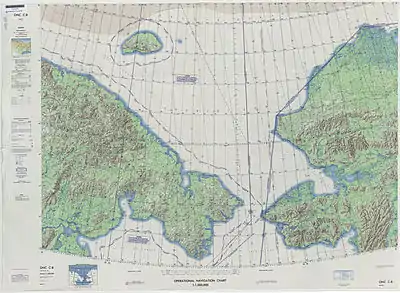
Bronze artifacts discovered in a 1,000-year-old house in Alaska suggest pre-Columbian trade. Bronze working had not been developed in Alaska at the time, and the findings suggest the bronze came from nearby Asia—possibly China, Korea, or Russia. Also inside the house were found the remains of obsidian artifacts, which have a chemical signature that indicates the obsidian is from the Anadyr River valley in Russia.[3]
Pre-Columbian contact between Alaska and Kamchatka via the subarctic Aleutian Islands would have been conceivable, but the two settlement waves on this archipelago started on the American side and its western continuation, the Commander Islands, remained uninhabited until after Russian explorers encountered the Aleut people in 1741. There is no genetic or linguistic evidence for earlier contact along this route.[4] The Asian war bow appears to have been introduced to North America in the 8th century via the Bering Strait.[5]
In June 2016, Purdue University published the results of research on six metal and composite metal artifacts excavated from a late prehistoric archaeological context at Cape Espenberg on the northern coast of the Seward Peninsula in Alaska. Also part of the team were researchers from the University of Georgia and the University of Pennsylvania. The report is the first evidence that metal from Asia reached prehistoric North America before the contact with Europeans, stating that X-ray fluorescence identified two of these artifacts as smelted industrial alloys with large proportions of tin and lead. The presence of smelted alloys in a prehistoric Inuit context in northwest Alaska was demonstrated for the first time and indicated the movement of Eurasian metal across the Bering Strait into North America before sustained contact with Europeans.
This is not a surprise based on oral history and other archaeological finds, and it was just a matter of time before we had a good example of Eurasian metal that had been traded [...] We believe these smelted alloys were made somewhere in Eurasia and traded to Siberia and then traded across the Bering Strait to ancestral Inuits [sic] people, also known as Thule culture, in Alaska. Locally available metal in parts of the Arctic, such as native metal, copper and meteoritic and telluric iron were used by ancient Inuit people for tools and to sometimes indicate status. Two of the Cape Espenberg items that were found – a bead and a buckle — are heavily leaded bronze artifacts. Both are from a house at the site dating to the Late Prehistoric Period, around 1100-1300 AD, which is before sustained European contact in the late 18th century. [...] The belt buckle also is considered an industrial product and is an unprecedented find for this time. It resembles a buckle used as part of a horse harness that would have been used in north-central China during the first six centuries before the Common Era.
— H. Kory Cooper, Purdue.[6]
References
- Jordan Paper (August 1993). "A Material Case for a Late Bering Strait Crossing Coincident with Pre-Columbian Trans-Pacific Crossings". Sino-Platonic Papers (39). Retrieved August 3, 2018.
- Vajda, Edward. "The Siberian Origins of Native Americans". Archived from the original on December 30, 2018. Retrieved August 3, 2018.
- Owen Jarus (April 16, 2015). "Evidence of Pre-Columbus Trade Found in Alaska House". www.livescience.com. Retrieved August 3, 2018.
- "The Peopling of the Aleutians". Science. 335 (6065). January 13, 2012. pp. 158–161. Bibcode:2012Sci...335..158B. doi:10.1126/science.335.6065.158.
- The Bow and Arrow in Northern North America, https://onlinelibrary.wiley.com/doi/10.1002/evan.21357
- "Old World metals were traded on Alaska coast several hundred years before contact with Europeans". Purdue University. 2016.