Pre-revolutionary Iranian cinema
Pre-revolutionary Iranian cinema (Persian: سینمای ایران قبل از انقلاب) contains films and cinematic events made in Iran before Iranian revolution era. Hooshang Kavoosi, an Iranian film critic first used term Filmfarsi (Persian: فیلمفارسی) to point to Iranian popular films before revolution.[1]
Sepas Film Festival was held for these films.
History
Visual arts in Iran
The earliest examples of visual representations in Iranian history may be traced back to the bas-reliefs in Persepolis (c. 500 BC). Bas relief is a method of sculpting which entails carving or etching away the surface of a flat piece of stone or metal. Persepolis was the ritual center of the ancient kingdom of Achaemenids and "the figures at Persepolis remain bound by the rules of grammar and syntax of visual language."[2]
Iranian visual arts may be said to have peaked about a thousand years later during the Sassanian reign. A bas-relief from this period in Taq Bostan (western Iran) depicts a complex hunting scene. Similar works from the period have been found to articulate movements and actions in a highly sophisticated manner. It is even possible to see the progenitor of the cinema close-up: a wounded wild pig escaping from the hunting ground,[3] among these works of art.
After the conversion from Zoroastrianism to Islam; Persian art continued its visual practices. Persian miniatures provide great examples of such continued attempts. The deliberate lack of perspective in Persian miniature enabled the artist to have different plots and sub-plots within the same image space. A very popular form of such art was Pardeh Khani. Another type of art in the same category was Naqqali.[3]
Popular dramatic performance arts in Iran, before the advent of cinema, include Marionette, Saye-bazi (shadow plays), Rouhozi (comical acts), and Ta'zieh.[4]
Early Persian cinema
Cinema was only five years old when it came to Persia at the beginning of the 20th century. The first Persian filmmaker was Mirza Ebrahim Khan Akkas Bashi, the official photographer of Muzaffar al-Din Shah, the King of Persia from 1896–1907. After a visit to Paris in July 1900, Akkas Bashi obtained a camera and filmed the Shah's visit to Europe upon the Shah's orders. He is said to have filmed the Shah's private and religious ceremonies, but no copies of such films exist today. A few years after Akkas Bashi started photography, Khan Baba Motazedi, another pioneer in Iranian motion picture photography emerged.[5] He shot a considerable amount of newsreel footage during the reign of Qajar to the Pahlavi dynasty.[6]
The first public screening took place in Tehran in 1904, presented by Mirza Ebrahim Khan Sahaf Bashi. He arranged the screening in the back of his antique shop. In 1905, Sahaf Bashi opened the first movie theater in Cheragh Gaz Avenue in the national capital. In 1909, with fall of the Mohammad Ali Shah Qajar heir of Mozaffar ad-Din Shah Qajar and the success of the constitutionalists, Russi Khan lost his support. Consequently, his film theatre and photography studios were destroyed by the public. Soon after, other cinema theatres in Tehran closed down. Movie theatres sprang up again in 1912 with the help of Ardeshir Khan, an Armenian-Iranian.[7] In 1904, Mirza Ebrahim Khan Sahhafbashi opened the first movie theater in Tehran.[5] The cinematographic camera was introduced to Iran in 1929, as yet another tool of modernization. After Mirza Ebrahim Khan, several others like Russi Khan, Ardeshir Khan, and Ali Vakili tried to establish new movie theaters in Tehran. Until the early 1930s, there were little more than 15 theatres in Tehran and 11 in other provinces.[3] In 1925, Ovanes Ohanian, decided to establish the first film school in Iran. Within five years he managed to run the first session of the school under the name "Parvareshgahe Artistiye Cinema".[8]
1930s and 1940s
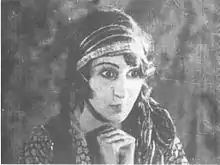
In 1930 the first Iranian silent film was made by Professor Ovanes Ohanian called Abi and Rabi. In 1933 he made his second film titled Haji Agha. Later that year, Abdolhossein Sepanta made the first Iranian sound film, entitled Lor Girl, which was released in 1933 in two Tehran cinemas, Mayak and Sepah. The story of the film was based on a comparison between the state of security in Iran at the end of the Qajar dynasty and during Reza Shah period. Sepanta would go on to direct movies such as Ferdowsi (the life story of the most celebrated epic poet of Iran), Shirin and Farhad (a classic Iranian love story), and Black Eyes (the story of Nader Shah's invasion of India). In 1937, he directed Laili and Majnoon, an Eastern love story similar to the English story of Romeo and Juliet.
The present day Iranian film industry owes much of its progress to two industrious personalities, Esmail Koushan and Farrokh Ghaffari. By establishing the first National Iranian Film Society in 1949 at the Iran Bastan Museum and organizing the first Film Week during which English films were exhibited, Ghaffari laid the foundation for alternative and non-commercial films in Iran.
Early Persian directors like Abdolhossein Sepanta and Esmail Koushan took advantage of the richness of Persian literature and ancient Persian mythology. In their work, they emphasized ethics and humanity.[9]
Pre-revolutionary cinema, 1950s–1970s
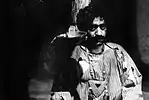
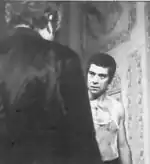
The 1960s was a significant decade for Iranian cinema, with 25 commercial films produced annually on average throughout the early ‘60s, increasing to 65 by the end of the decade. The majority of production focused on melodrama and thrillers. From 1937 till 1947 because of the world economic conditions and then the involvement in World War Two, the motion picture industry in Iran did not produce a single film, but the flow of foreign film to Iran did not stop. In 1947, Esmail Koushan, with the help of some of his colleagues, established Mitra Films (1997), the first real film company in Tehran. Through their persistence, local feature film production was born and survived. The movie that really boost the economy of Iranian cinema and initiated a new genre was Ganj-e Qarun (Croesus Treasure), made in 1965 by Siamak Yasemi. Three years later Davoud Mollapour directed Shohare Ahoo Khanoom (Madam Ahou's Husband), which revolutionized Iranian Cinema by portraying women's role in the Iranian society at that time.[10][11] It also showed actresses (Mehri Vadadian and Adile Eshragh) to be the heroes on big screen for the first time. In 1969, Masoud Kimiai made Kaiser. With Kaiser (Qeysar), Kimiai depicted the ethics and morals of the romanticized poor working class of the Ganj-e-Qarun genre through his main protagonist, the titular Qeysar. But Kimiay's film generated another genre in Iranian popular cinema: the tragic action drama.[12]
With the screening of the films Shohare Ahoo Khanoom directed by Davoud Mollapour in 1968, and Kaiser and The Cow, directed by Masoud Kimiai and Darius Mehrjui respectively in 1969, alternative film established their status in the film industry. By 1970 Iranian cinema entered into its mature stage. The College of Dramatic Arts, instituted in 1963, produced its first graduates at the decade's beginning. Many progressive film co-ops and associations came into existence and there were a few regular film festivals taking place in the country. Attempts to organize a film festival that had begun in 1954 within the framework of the Golrizan Festival, bore fruits in the form of the Sepas Film Festival in 1969. The first Iranian film festival was held in 1970 with Kaiser, The Cow, and Shohare Ahoo Khanoom winning the first, second and third prize for the best pictures respectively. The endeavors of Ali Mortazavi also resulted in the formation of the Tehran International Film Festival in 1973. From 1950 to the mid-1960 the Iranian film industry grew rapidly. Many studios were established as well as others that entered the Cycle of the film industry independently. There were 324 films produced during this period 1950 for 1965. By 1965 there were 72 movie theatres in Tehran and 192 in other Provinces. Ebrahim Golestan in 1965 directed by films of interest Brick and Mirror 1965. Bahram Beyzai is the director of one of the ground-breaking films of the Iranian New wave, 1972 Ragbar (Downpour). Sohrab Shahid-Saless is auteur director who embodied his original style in his 1975 film Still Life. Abbas Kiarostami is now a well-known director of the 1990s who directed one of the last films that screened before the revolution in 1978, Gozaresh (The Report).
Post-revolutionary cinema
In the early 1970s, a New Iranian Cinema emerged (cinema motefävet). However, following the Revolution in 1979, a few filmmakers and actors went into exile as Khomeini altered the focus in features. Between 1979 and 1985, about 100 features were released.[13] While Khomeini's censorship remained, the small number of features produced focused on sexual display and European influence.[13]
In 1982, the annual Fajr Film Festival financed films. The Farabi Cinema Foundation then stepped in to try and reassemble the disorganized cinema. The following year, the government began to provide financial aid. This change in regime encouraged a whole new generation of filmmakers, which included female directors as well. With this, the focus shifted to children overcoming obstacles: true stories, lyrical, mystical drama, real-life problems, documentary footage, etc.
Post-revolutionary Iranian cinema has been celebrated in many international forums and festivals for its distinct style, themes, authors, idea of nationhood, and cultural references. Starting With Viva... by Khosrow Sinai and followed by many excellent Iranian directors who emerged in the last few decades, such as Abbas Kiarostami and Jafar Panahi. Kiarostami, who some critics regard as one of the few great directors in the history of cinema,[14] planted Iran firmly on the map of world cinema when he won the Palme d'Or at the Cannes Film Festival for Taste of Cherry in 1997.
The continuous presence of Iranian films in prestigious international festivals such as the Cannes Film Festival, the Venice Film Festival, and the Berlin Film Festival attracted world attention to Iranian masterpieces .. In 2006, six Iranian films, of six different styles, represented Iranian cinema at the Berlin Film Festival. Critics considered this a remarkable event in the history of Iranian cinema.[15][16]
An important step was taken in 1998 when the Iranian government began to fund ethnic cinema. Since then Iranian Kurdistan has seen the rise of numerous filmmakers. In particular, the film industry got momentum in Iranian Kurdistan and the region has seen the emergence of filmmakers such as Bahman Ghobadi, actually the entire Ghobadi family, Ali-Reza Rezai, Khosret Ressoul and many other younger filmmakers.[17]
There is also movie-documentary production, often critical of the society in the name of the Islamic revolution ideal, like the films directed by Mohammedreza Eslamloo.
By the year 2001 the number of features produced in Iran rose to 87 (from 28, which is the number of films that were produced in 1980, after the fall of the Shah). The most popular genres were melodramas and historical pageants which seldom went to festivals. In 1997, the newly elected president, Mohammed Khatemi, would eventually come to play a role in helping filmmakers achieve a certain degree of artistic freedom.[18]
Notable directors
Notable actors
Notable films
See also
References
- http://www.dw-world.de/dw/article/0,,2615122,00.html
- Honour, Hugh and John Fleming, The Visual Arts: A History. New Jersey, Prentice Hall Inc, 1992. Page: 96.
- Iranian Cinema: Before the Revolution
- M. Ali Issari, Cinema in Iran: 1900–1979 pages 40–67.
- "The history of Iranian cinema, Part I by Masoud Mehrabi". Archived from the original on 2018-06-23. Retrieved 2007-01-30.
- M. A Issari, Cinema in Iran, page 96.
- Iranian Cinema: Before the Revolution
- Omid, Jamal. The History of Iranian Cinema 1900–1978. Tehran: Rozaneh Publication, 1995, 1174 pgs (Persian).
- Iranian filmmakers and influence of Ancient Persian literature
- Issa, Rose (1999). Life and art : the new Iranian cinema. London: National Film Theatre. ISBN 0851707750.
- Sanatjoo, Hamid; Adibi, Mehdi (November 2013). "Sociological Explanation of the Advancements in Iranian Artistic Cinema after the Islamic Revolution (with Emphasis on the Two Decades: 1980s −1990s)". Mediterranean Journal of Social Sciences. 4 (13): 664. ISSN 2039-9340.
- Shahin Parhami, Iranian Cinema: Before the Revolution
- Thompson, Kristin; Bordwell, David (2010). Film History: An Introduction (3rd ed.). New York: McGraw-Hill. p. 608. ISBN 978-0-07-338613-3.
- Kiarostami Will Carry Us; The Iranian Master Gives Hope
- Iran's strong presence in 2006 Berlin Film Festival
- Iran films return to Berlin festival
- "Kurdish Cinema Really Started out with Yilmaz Güney"
- Thompson, Kristin (2003). Film History: An Introduction. New York, NY: McGraw Hill. pp. 670–71. ISBN 0-07-038429-0.