Precentor's Court
Precentor's Court is an historic street in the English city of York. Shown on a map of 1610, it is not given a name (Precentor's Lane) until 1722. It was given its current name exactly a century later.[1] It is a cul-de-sac, running northwest from High Petergate at the western end of York Minster, in front of which the road apexes.[2] A snickelway, known as the Hole-in-the-Wall, cuts through to the street from High Petergate.
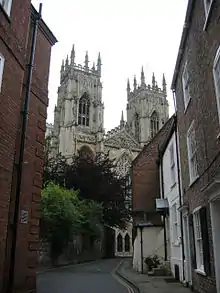 Looking east down Precentor's Court to York Minster in 2006. The southern wall of Purey Cust Lodge (left) is the only building on the northern side of the street | |||
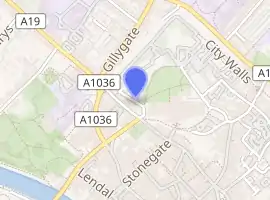
Location within York | |||
| Length | 0.073 mi (0.117 km) | ||
|---|---|---|---|
| Location | York, England | ||
| Coordinates | 53°57′44.90″N 1°5′2″W | ||
| South end | High Petergate | ||
Around 1540, the marble and stone bases of two shrines in the Minster were dismantled and buried in what is now Precentor's Court. One was later exhumed during construction work[3] and is now preserved in the Yorkshire Museum.[4]
In 1763, artist Nathan Drake married and moved his painting room from Colliergate to Precentor's Court, where he remained for the rest of his life.[5] It was there that his two sons were born: Nathan (1766–1836), a physician and essayist, and Richard (b. 1767), a surgeon.[6]
Peter Gibson, a glazier who worked on all of the Minster's stained-glass windows, lived in the same house on Precentor's Court for almost all of his 87 years. "I live here, and I look out of the window, and there it is, the Minster. It is one of the greatest buildings in the world," he said. "People cross oceans, cross the world, to come and see it."[7]
The street was home to St Stephen's orphanage in the 1870s.[8][9]
Fenton House
Formerly the prebendal house of Fenton,[1] Fenton House, at 9 Precentor's Court, is a Grade II* listed building dating to around 1705.[10][11]
In 2013, the eight-bedroom home was put on the market for £1.1 million.[11]
Notable buildings
Below is a selection of notable buildings and structures on Precentor's Court, ordered from east to west. All are listed buildings at Historic England. Four are Grade II*; two are Grade II.[12] Each building is on the southern side of the street, except Fenton House (which faces the street from its western end) and number 10 (which is around the corner at the same end). The southern wall of Purey Cust Lodge, a Grade II listed building,[13] occupies the northern section of the western end of the street. A group of buildings on the northern side were demolished in 1913.[14]
- York Arms, 1 Precentor's Court (Grade II; dating to 1838, incorporating an early-18th-century house at each end)
- 2, 3, 4 and 4a Precentor's Court (Grade II*; dating to around 1710)[1]
- 5 Precentor's Court (Grade II*; early 18th century with later alteration and extension)
- 6 and 7 Precentor's Court (Grade II; mid-19th century, renovated in the 20th century; no. 7 has earlier origins)
- Fenton House, 9 Precentor's Court (Grade II*; dating to around 1705)
- 10 Precentor's Court (Grade II*; dating to early 18th century, incorporating remains of a 15th-century house)[1]
 The entrance to Purey Cust Lodge, with Precentor's Court on the left
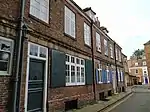 Numbers 3, 4 and 4a
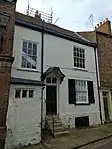 Number 5
.jpg.webp) Number 9, Fenton House
Number 9, Fenton House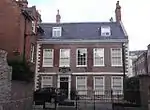 Number 10, the last building on the street
In popular culture
Precentor's Court was featured in the final scenes of the finale of the Gentleman Jack television series, a co-production between the BBC and HBO.[15]
References
- An Inventory of the Historical Monuments in City of York, Volume 5, Central, pp. 199–212
- View from the east, with High Petergate on the left – British History Online
- "York saint's shrine on show for first time in 400 years" – BBC News, 7 June 2010
- York: Art, Architecture and Archaeology, Sarah Brown, Sarah Rees Jones, Tim Ayers (2021), p. 264 ISBN 9781000399738
- "The New Terrace Walk, York, 1733-56, by Nathan Drake" – The Press, 18 April 2020
- Ingamells 2004.
- "Tributes paid to Peter Gibson, renowned York craftsman and glazier" – The Press, 15 November 2016
- Historic England: York. Unique Images from the Archives of Historic England, Paul Chrystal (2017) ISBN 9781445675299
- "York in old photos, from new book Old York" – The Press, 21 October 2019
- Historic England. "Fenton House (1256868)". National Heritage List for England. Retrieved 19 September 2021.
- "£1.1m York home with out-of-this-world views" – The Press, 3 April 2013
- Precentor's Court – Historic England
- Historic England. "Purey Cust Lodge, attached walls and gateways (1257883)". National Heritage List for England. Retrieved 19 September 2021.
- "This York street was notorious for its 'destitute prostitutes'. But where was it?" – The Press, 10 June 2019
- "How York reacted to finale of Gentleman Jack on BBC" – The Press, 9 July 2019
- Ingamells, John (2004). "Drake, Nathan (1726–1778)". Oxford Dictionary of National Biography. Oxford University Press. doi:10.1093/ref:odnb/65542.
External links
- Precentor's Court – Google Street View, January 2021