Museum of Contemporary Art Australia
The Museum of Contemporary Art Australia (MCA), located in George Street in Sydney's The Rocks neighbourhood, is a museum solely dedicated to exhibiting, interpreting and collecting contemporary art, both from across Australia and around the world. It is the only contemporary art museum in Australia with a permanent collection.[3] The museum is housed in the Art Deco-style[4] former Maritime Services Board Building on the western edge of Circular Quay, and a modern wing built in 2012.
 | |
Museum_of_Contemporary_Art-1.jpg.webp) | |
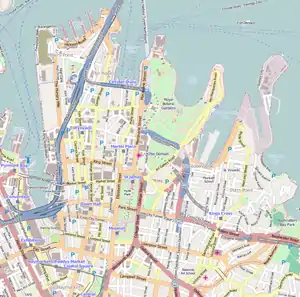  Location in Sydney central business district | |
| Established | 1991 |
|---|---|
| Location | George Street, Sydney, Australia |
| Coordinates | 33°51′36″S 151°12′32″E |
| Type | Contemporary art |
| Collections | Raminging, Maningrida, Arnott's, Smorgon |
| Collection size | 4,500 |
| Visitors | 1,206,243 (2016)[2] |
| Founder | John Power; University of Sydney |
| Director | Suzanne Cotter |
| Chairperson | Lorraine Tarabay |
| Curator | Lara Strongman |
| Architect | William Henry Withers, Sam Marshall |
| Public transit access | |
| Website | mca |
While the museum as an institution was established in 1991, its roots go back a half-century earlier. Expatriate Australian artist JW Power provided for a museum of contemporary art to be established in Sydney in his 1943 will, bequeathing both money and works from his collection to the University of Sydney, his alma mater. The works, along with others acquired with the money, were exhibited mainly as a travelling collection in the decades afterward, stored in two different university buildings, until the MSB building became available.
At first it was known as the Museum of Contemporary Art, Sydney. The new museum rapidly outgrew its space, and after two proposed expansions failed, a design by local architect Sam Marshall met with sufficient approval to raise money for its construction. From 2010 the building underwent an A$58 million expansion and re-development,[5] reopening in March 2012 as the Museum of Contemporary Art Australia.[6][7]
Power's original intent was for the museum to exhibit contemporary art from all over the world, with work by Australian artists shown only if it was relevant to the other works, but its focus has since changed primarily to Australian art. The museum's collection contains over 4,000 works by Australian artists acquired since 1989. They span all art forms with strong holdings in painting, photography, sculpture, works on paper and moving image, as well as significant representation of works by Aboriginal and Torres Strait Islander artists. The museum runs programs to engage the interest of youth and disabled communities in appreciating and making art.
Building
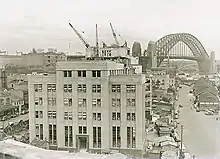
The museum building has two wings: a main section housed in the former Maritime Services Board (MSB) building, and the newer Mordant Wing on the museum's northern end. It is located on the waterfront in Sydney's The Rocks neighbourhood. George Street is to the west, and First Fleet Park to the south, Circular Quay on the north and east (pedestrians only on that side, abutting the water), and the small First Fleet Park is to the south. Immediately beyond it the Cahill Expressway separates the park and The Rocks from Sydney's central business district (CBD).[8] Two of the city's landmarks are nearby—the Sydney Opera House is visible a short distance across the harbour and the Cahill turns onto the Sydney Harbour Bridge to the north. Just beyond the expressway to the south are some of Sydney's skyscrapers such as 1 Macquarie Place and the Salesforce Tower[9]
A broad lawn separates the museum from the quay to its east. To the west and northwest the Rocks is urban and densely developed up to the bridge's southern approach, with attached two- and three-storey mixed-use buildings from the 19th and early 20th centuries. Cruise ships moor at the quay to the northeast and ferries serving the Sydney area arrive and depart from slips to the southeast, just opposite the Circular Quay railway station.[8]
Exterior
The former MSB building is a six-storey, 17-bay light orange-brown stone structure in the Stripped Classicism style with Art Deco ornamentation. A slightly projecting central clock tower is complemented by three-bay pavilions projecting two bays at the ends of both elevations. Atop the roof is a modern penthouse with glass facing and a flat roof with wide eaves.[10] Two modern roofs, supported by circular metallic pillars, shelter the concrete deck in front of the ground-floor windows between the entrance and the pavilions. The one on the south side has tables and chairs serving the museum's restaurant.[11] On the west (rear) elevation, the space between the pavilions is filled in with a block of modern shop spaces in an irregularly alternating black and white pattern on the upper storeys similar to that on the museum's newer Mordant Wing.[12]
On the exterior the foundation level is one course of rusticated polished pink Rob Roy granite which also forms the surround of the main entrance on the east elevation and the auxiliary entrance on the south. The rest of the facade is smooth dressed orange sandstone,[10] which also forms the surround of the tertiary entrance on the north pavilion of the west facade.[13]
Fenestration takes the form of triple-paned double windows separated by a continuous stone muntin in a continous vertical recessed strip. On the south end of the building the windows on the first two storeys are also continuous. The recessed strips and muntins end in a broad plain frieze above the fifth storey separating similar but shorter windows on the sixth storey of the main block.[11]
On the central clock tower, the main entrance is a recessed pair of dark bronze doors topped by a sandstone frieze depicting sailors and dockworkers. Above it is a transom of three small four-paned windows with stone muntins. Atop the entryway is a bronze plaque with "Museum of Contemporary Art".[11]
Above the entrance the clock tower treatment consists of three more widely separated but otherwise similar windows rising from the third storey to the sixth and topped with a decorative pink granite facade depicting a propeller, wheel and anchor. A clock set against the sandstone is above. The tower is topped by a narrower stage, a square cupola and three flagpoles.[11]
Mordant Wing
The Mordant Wing on the MSB building's north end is roughly six storeys high as well, occupying the three-quarters of the remainder of the block not taken up by a local police station building. It is faced in smooth, mostly windowless panels of black, white and brown stone, made of blocks rectilinear in shape and irregular in size. On the north end is a basement delivery entrance.[14]
The main entrance to the museum is at the southeast corner of the wing, where it abuts the MSB building at a glass-faced stairwell. Sliding glass doors in a glass two-storey entryway open onto a wide stair to the main foyer. Above it is an unsupported projecting three-storey pavilion with strip windows. North of it a large downward-pointing arrow in the facade at ground level directs visitors to a poem carved in the concrete deck.[15]
On the west, the wing is similarly faced, with an alleyway leading to another service entrance between the wing and the MSB building. At street level is another, smaller entrance, with glass doors, accompanying the museum's gift shop to its south. The facade also overhangs this entrance, but to a lesser extent than its counterpart on the other facade.[16] On the roof is a cafe, partially open, with views of the bridge, opera house and harbour.[17]
Interior
When used as the MSB building the interior made extensive use of scagliola and terrazzo to imitate marble flooring and walls, a common technique at the time. A war memorial and associated artwork were also included.[10] These features remain in what was known as Wharfage Hall, the two-story lobby at the building's central entrance.[18] Today, adapted for use as a museum, much of the interior is now gallery space with plain white walls, concrete floor and high ceilings.[19][20][21]
History
The Museum of Contemporary Art Australia is located just south of the landing spot of the First Fleet. The site originally housed two Commissariat Stores. Joseph Foveaux designed the first, built in 1809 following the previous year's Rum Rebellion. The second, facing George Street North, was built in 1813 under Governor Lachlan Macquarie's authority; both used convict labour.[22]
The state government assumed control of the Commissariat Stores in 1901 and leased them to commercial tenants. In 1937, the Circular Quay Planning Committee, which had originally recommended the buildings be demolished to provide parkland, changed its mind and called for them to be replaced with a new office for the Maritime Services Board (MSB),[10] which had been displaced by the Circular Quay Railway.[22] An intense community effort arose to save the buildings; while it ultimately failed it helped give rise to the creation of the National Trust of Australia after the war. The stone blocks of the Stores were kept and reused in other buildings throughout The Rocks.[18]
Demolition was completed in 1939. Originally the committee had considered holding a competition for the new building's design, but by then it decided to use the MSB's own architects.[10] One, William Henry Withers, designed a Stripped Classical building for the agency, with a central tower meant to echo the pylons of the nearby bridge.[23]: 17 After site clearance construction was halted in late 1940 since restrictions resulting from the onset of World War II made continued work impossible.[10] The building was resumed in late 1944 with the erection of its steel frame[18] and the offices were opened eight years later[22] by Premier Joseph Cahill.[10] It is listed on both state and national heritage registers.[10][24]
Power Gallery of Contemporary Art
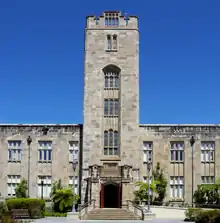
The establishment of the MCA was mandated in the will of Australian expatriate artist JW Power (1881–1943), who had been the first Australian-born painter to experiment with Cubism.[25] Independently wealthy from his previous medical career, he bequeathed his personal fortune, mostly stock worth £A2 million, to his alma mater, the University of Sydney, with the express purpose of informing and educating Australians in the contemporary visual arts. He directed that it be used specifically for "museums and other places for the purpose ... of suitably housing the works purchased so as to bring the people of Australia in more direct touch with the latest art developments in other countries."[26]
The bequest was not made or disclosed to the public until Powell's wife's death in 1961; she also willed most of her husband's works to the university. At the time it was the largest monetary bequest ever made to any Australian university.[25] Four years later the university's senate voted to create the Power Institute of Fine Arts as a beginning of fulfilling Power's wishes.[26]
In December 1970 the University of Sydney also received the Seymour Bequest for the purposes of a performing arts centre, and sought to combine the two bequests into an arts complex that would include within it the Seymour Centre and the Power Institute facilities, including a home for the Power Gallery.[27][28] It was opened in 1975 as just a performing arts venue.[29]
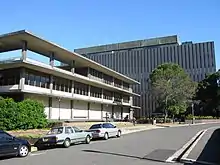
This collection of artworks took the form of the 'Power Gallery of Contemporary Art', a travelling collection without a permanent address. Between John Power's death and the eventual establishment of the museum, the collection was mainly housed in the University of Sydney's Fisher Library during the 1970s. It was exhibited in the Madsen Building on campus between 1980 and 1989.[28]
Museum of Contemporary Art
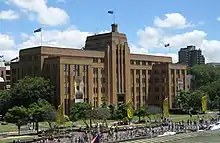
After the relocation of the Maritime Services Board (MSB) to larger premises in 1989, the building and site were donated by the Government of New South Wales to the Museum of Contemporary Art.[30] Funded by the University of Sydney and the Power Bequest, restoration and refurbishment of the building commenced in 1990 under the direction of Andrew Anderson of Peddle Thorp/John Holland Interiors and in November 1991 the Museum of Contemporary Art, Sydney, officially opened.[31]
Those early years in the museum's own space were difficult. The university agreed to help fund the museum's initial costs but did not make any commitment to the long term, as it was expected that the museum would eventually become financially independent. To that end an admission fee was charged; it did not make up for the shortfall as the university began phasing out its support, and the local and national media began expressing concern for the museum's future.[3]
The building's former offices had been renovated into a more open space with movable walls to accommodate exhibition requirements, with some rooms left intact as archival spaces. The inadequacy of the renovated MSB building as a gallery space, including circulation and accessibility issues, prompted plans for further renovations.[3] In 1997, an international competition was launched for redesigns of the site.[32] The Japanese architectural studio SANAA won, but its plans were abandoned after site investigations revealed the archaeological remains of a colonial dockyard beneath the museum's car park.[1] Plans by Sauerbruch Hutton, winners of a 2000 competition, were also abandoned following public outcry over the proposed demolition of the MSB building.[1]
In 1999 the museum's board hired Elizabeth Ann Macgregor, a Scotswoman who had worked with the Arts Council of Great Britain and as director of the Ikon Gallery, a major contemporary art museum also housed in a repurposed heritage-listed building in Birmingham, as the MCA's director. To encourage more visitation, she eliminated the entrance fee. "As soon as we did that, it completely changed the atmosphere. People came in out of curiosity", she later told The New York Times.[3] In 2005, the museum's permanent collection was moved to storage offsite to create more exhibit space.[31]
The sixfold increase in annual visitation that ensued made problems with the museum's aging physical plant more apparent. "The elevators were well past their natural life, the stair circulation was not appropriate and there was no infrastructure to deal with disabled people", recalled Simon Mordant, a Sydney investment banker who then chaired the MCA board. "We started to burst at the seams." Some state officials, hoping to redevelop the site more commercially, urged the museum to move and tried to direct it to other locations, but Mordant and the museum management insisted on remaining, finding the current site to be a unique asset.[3] In 2002 McGregor had begun developing plans for an extension to the museum.[32]
Addition
.jpg.webp)
In 2010 the museum closed for its long-desired extensions. They were built to a design by Sydney architect Sam Marshall, taking two forms: infill on the building's west facade, allowing shop space on the ground floor facing George Street, and the new Mordant Wing on the north. The latter was named after the board chairman and his wife, whose initial gift of $A10 million, followed by a later $A5 million, was the largest single financial contribution to it (the federal, state and city governments would combine for $A27 million).[31] Private benefactors donated the remaining A$7.5 million[33] of the building's total A$53 million cost.[3] It was constructed in a Cubist architectural style, appearing as a series of overlapping white, black, and brown boxes that contrasts with the Art Deco main building.[34]
A portion of the new wing opened with an exhibit of work by Rafael Lozano-Hemmer in December 2011;[3] the remainder was opened the following March.[1][35] The wing added 4,500 square metres (48,000 sq ft) in floor space,[32] including a café, sculpture terrace and two harbour-side function venues, nearly doubling the museum's available exhibit space and allowing additional revenue to keep the museum financially independent (Approximately 70 per cent of the museum's annual income is from a variety of sources such as exhibitions and events, sponsorship, donations and venue hire. The balance is made up through ongoing funding and support from the state government through Create NSW and the federal government through the Australia Council.[36]). The renovations additionally supplied the new National Centre for Creative Learning with multimedia and digital studios, as well as a 117-seat lecture theatre.[1] The dual entranceways of the new wing additionally connected George Street and Circular Quay for the first time.[33]
Marshall's primary inspiration for the new wing was the sculptures of Donald Judd. The volumes of the individual blocks vary to reflect the function of the space within them. Their colors are taken from those apparent in the vicinity: the bridge, expressway and various buildings in The Rocks, all visible from the museum. Marshall and the architects who reviewed and advised on his plans were mindful of modern additions to older museums that have not been seen as architecturally successful, such as Daniel Libeskind's addition to Toronto's Royal Ontario Museum, where the inclined walls precluded hanging paintings.[23]: 28–30
The architecture of the Museum of Contemporary Art has drawn criticism and praise from both Australian and international commentators, mainly over the buildings' contrasting facades.[34][37]
In July 2020, Lorraine Tarabay took over the role of chairperson of the board from Mordant.[38]
Collections
What is now the museum's main collection emerged from the Power Collection in the original founding of the museum. The museum's initial acquisitions policy, based on the will of John Power, sought to acquire mainly international contemporary art whilst only "very occasionally" purchasing Australian art as complementary to its foreign collection.[39] From 2002, the museum has shifted to increase its emphasis on Australian artists and currently holds over 4,500 works.[40]
The Ramingining Collection
The Ramingining collection, purchased in 1984–1985, comprises more than 250 works by over 80 Yolŋu artists.[41] The collection contains bark paintings, woven objects, sculpture and cultural objects such as spears and tools.[42][41] The collection was originally acquired by the University of Sydney for the Power Collection following the 1984 exhibition Objects and Representations from Ramingining, curated by Djon Mundine for the Power Gallery of Contemporary Art.[41][43]
In 1996, the Ramingining Collection was displayed at the MCA. The Native Born: Objects and Representations from Ramingining, Arnhem Land., its first exhibition, was curated by Djon Mundine.[41] Four years later, it was displayed in the entrance galleries in the Yolnu Science: Objects and Representations from Ramingining, Arnhem Land exhibition to coincide with the Olympics,[41] curated by Djon Mundine and Linda Michael.[41]
The Maningrida Collection
Formed by Diane Moon in 1990,[44] the Maningrida Collection contains 560 works from the Maningrida community in Arnhem Land, Northern Territory.[42] Ownership of the pieces belongs to the Maningrida people, with the collection subject to a unique cultural agreement between the museum and the community.[42] The collection includes sculpture, woven objects and bark paintings.[42] The museum works with Indigenous researchers, curators and artists and Maningrida Arts and Culture to document and research objects within the collection.[45] The cultural agreement between both parties is renegotiated regularly to ensure a positive relationship.[46]
In 2018, the MCA in association with Maningrida Arts and Culture held the John Mawurndjul: I am the old and new exhibition of works by John Mawurndjul.[46] More than 130,000 people attended;[46] it was additionally displayed at eight regional Australian galleries.[47] Two works by John Mawurndjul, Nawarramulmul (Shooting Star Spirit, 1988) and Ngalyod (Female Rainbow Serpent, 1988), were the first artworks acquired for the dedicated MCA collection in 1989.[47]
The Arnott's Collection
The Arnott's Collection was formed following the donation of 285 bark paintings by the Arnott family in 1993.[48] The collection featured in Djon Mundine's 2008 exhibition They are meditating: bark paintings from the MCA's Arnott's Collection.[49]
The Smorgon Collection
The Smorgon Collection was donated to the MCA in 1995 by philanthropists Loti and Victor Smorgon.[42] It contains 149 contemporary Australian works[42] from the 1980s and 1990s.[50] In 2012, a donation by Loti went to build a sculpture terrace on the museum's fourth level, subsequently named for her.[51]
Selected temporary exhibitions
_Yoko_Ono'_exhibition_-_Sydney%252C_Museum_of_Contemporary_Art_Australia_(10867844565).jpg.webp)
- Pipilotti Rist – ‘Sip My Ocean’ (2018)
- Grayson Perry – ‘My Pretty Little Art Career’ (2016)
- Yoko Ono – ‘War is Over! (if you want it)’ (2013)
- Anish Kapoor (2013)
- Annie Leibovitz – ‘A Photographer’s Life 1990–2005’ (2011)
- Yayoi Kusama – ‘Mirrored Years’ (2009)
- Patricia Piccinini – ‘Call of the Wild’ (2002)
- Cindy Sherman – ‘Retrospective’ (1999)
- Marina Abramović – ‘objects, performance, video, sound’ (1998)
- Keith Haring (1996)
- Andy Warhol – 'Portraits’ (1994)
Primavera Exhibition
Primavera: The Belinda Jackson Exhibit, Australia's longest running exhibition, has been staged annually since 1992 in honour of Edward and Cynthia Jackson's daughter Belinda, a jewellery maker.[52] It exhibits the work of Australian artists aged 35 or younger for several summer months.[53] Primavera provides the opportunity for artists not yet established to have their work displayed in a large institution.[54] The exhibition often utilises guest curators, although curatorial staff from the Museum of Contemporary Art have also worked on past Primaveras.[55] Each yearly exhibit is designed with a unique theme. In 2011, as a result of the museum renovations, the Primavera exhibit was held off-site. Artworks from the exhibition were displayed in various places around the museum and throughout The Rocks area of Sydney.[55]
Tate x MCA Collaboration
In 2015, a five-year collaborative project was announced between the Tate Galleries of Britain and the Museum of Contemporary Art Australia for the mutual acquisition of contemporary Australian artworks.[56] The project is aimed at increasing the reputation of Australian art internationally. Funded by a $2.75 million donation from the Qantas Foundation, the galleries have acquired 23 pieces by 16 major Australian artists, many of which have been displayed at both institutions.[57]
The National
The National is a series of biennial survey exhibitions featuring contemporary artists, run as a partnership between the Art Gallery of New South Wales, Carriageworks and the MCA and held across the three venues.[58][59] The National: New Australian Art exhibition was launched in 2017, designed to "reflect the diversity of cultural, political and social perspectives that preoccupy [Australian] artists". The National was designed in three iterations, with the later ones in 2019 and 2021, exhibiting the work of 150 Australian artists.[60]
Programs
The Museum of Contemporary Art holds a number of public programs over its calendar year, including an Indigenous learning program and an 'Art + Dementia' research program.[61]
The Bella program
The Bella program was established in 1993[62] by patrons Edward and Cynthia Jackson and the Jackson family.[63] The program season previously coincided with the Primavera exhibition, however the addition of the National Centre for Creative Learning and funding from private benefactors in 2012 allowed for the Bella program to be run year-round. Tailored for young people[64] the program focuses on issues of access to contemporary art for people with disabilities, and socially and financially disadvantaged individuals. The program offers sessions in the galleries and hands-on workshops.[63]
In 2011, the Bella program collaborated with Good Vibrations, a touring interactive art project for young people and adults with disabilities.[63] The caravan, designed by artists Bruce Odland and Michael Luck Schneider,[64] is fitted with technical devices that create sensory responses to sights, sounds and vibrations.[63]
The dedicated Bella Room was installed in the National Centre for Creative learning in 2012. Each year a new artist is commissioned to produce a work in the Bella Room concerned with a different type of disability.[64] The room offers a sensory environment in which students, led by artist educators, can interact with art.[62]
Genext
'GENEXT' has been held since 2005 as an public engagement program aimed at young people aged from 12 to 18, run by MCA's Youth Committee. GENEXT is an after-hours program that includes activities such as live music, discussions, and art workshops.[65] It is held four times annually, and included over 16,000 participants over the course of its first ten years of operation.[66]
In collaboration with the Art Gallery of New South Wales, the Museum of Contemporary Art takes part in the Sydney Festival and the Biennale of Sydney, an event held partially online in 2020 due to the COVID-19 pandemic.[67]
MCA Zine Fair
The annual MCA Zine Fair, first held in 2008, is organised in conjunction with the Sydney Writers' Festival. Held on the front lawn of the MCA, the free fair features over 50 stalls of new and established zine artists.[68]
The Artful: Art and Dementia
In 2016, The Artful: Art and Dementia program was launched as a three-year research collaboration between the MCA, the Brain and Mind Centre, the University of Sydney and Dementia Australia with the goal of establishing a link between art and enhanced neuroplasticity.[69] The program continues annually.
The six-week program includes a tour of selected works throughout the museum, weekly two-hour creative art making sessions with trained artist-educators and an 'Artful at home' package containing materials for art making at home. The final week of the program is an exhibition session, in which participant's friends and family are invited to view their art.[69] In 2020, the program launched an online digital toolkit to enable offsite participation.[70]
Access and environs
The nearest station to the MCA is Circular Quay station, Circular Quay. Paid parking is available within five minutes walk of the museum.
Transport connections
| Service | Station/Stop | Lines/Routes served | Distance
from the Museum of Contemporary Art |
|---|---|---|---|
Sydney Buses  |
Circular Quay, Young St, Stand D  |
333, 392, 394, 396, 397, 399, L94 | 400 metres (5-minute walk)[71] |
| Circular Quay, Alfred St, Stand A |
304, 339, 343, 373, 374, 377 | 400 metres (5-minute walk)[72] | |
| Argyle Pl at Lower Fort St | 311 | 400 metres (6-minute walk)[73] | |
| Circular Quay, Alfred St, Stand B |
333, 392, 394, 396, 397, 399, L94, X94, X97 | 450 metres (6-minute walk)[74] | |
| Exchange Square, Bridge St |
115 | 500 metres (6-minute walk)[75] | |
Sydney Light Rail  |
Circular Quay |
L2 ■, L3 ■ | 280 metres (3-minute walk)[76] |
| Bridge St |
L2 ■, L3 ■ | 550 metres (7-minute walk)[77] | |
| Wynyard |
L2 ■, L3 ■ | 850 metres (11-minute walk)[78] | |
Sydney Trains  |
Circular Quay |
T2 ■, T3 ■, T4 ■, T7 ■, T8 ■ | 300 metres (4-minute walk)[79] |
| Wynyard |
Central Coast and Newcastle Line ■, T1 ■, T2 ■, | 700 metres (9-minute walk)[80] | |
Sydney Ferries  |
Circular Quay ferry wharf |
F1, F2, F3, F4, F5, F6, F7, F8, F9 | 300 metres (4-minute walk)[81] |
See also
References
- Craswell, Penny (12 April 2012). "The reimagined Museum of Contemporary Art". ArchitectureAU. Architecture Media Pty Ltd. Retrieved 1 February 2019.
- "Visitor Figures 2016" (PDF). The Art Newspaper Review. April 2017. p. 14. Retrieved 23 March 2018.
- Brownell, Ginanne (20 March 2012). "A Makeover for Contemporary Art in Sydney". The New York Times. Retrieved 13 December 2021.
- "Museum of Contemporary Art". Sydney Architecture. n.d. Retrieved 1 February 2019.
- "Sydney Museum of Contemporary Art to reopen in 2012". World Interior Design Network. Australia. 26 May 2012. Archived from the original on 10 February 2013. Retrieved 4 June 2012.
- Brownell, Ginanne (20 March 2012). "A Makeover for Contemporary Art in Sydney". The New York Times. Retrieved 14 October 2012.
- Kneen, Dale (Summer 2012). "Starchitects in Our Eyes". High Life. British Airways: 16–17.
- Google (11 December 2021). "Google Maps" (Map). Google Maps. Google. Retrieved 11 December 2021.
- Google (11 December 2021). "Google Maps" (Map). Google Maps. Google. Retrieved 11 December 2021.
- "Heritage and Conservation Register". www.shfa.nsw.gov.au. Property NSW. Retrieved 12 December 2021.
- Google (12 December 2021). "Museum of Contemporary Art Australia" (Map). Google Maps. Google. Retrieved 12 December 2021.
- Google (12 December 2021). "119 George Street" (Map). Google Maps. Google. Retrieved 12 December 2021.
- Google (12 December 2021). "199 George Street" (Map). Google Maps. Google. Retrieved 12 December 2021.
- Google (13 December 2021). "Sydney, New South Wales" (Map). Google Maps. Google. Retrieved 13 December 2021.
- Google (13 December 2021). "Sydney, New South Wales" (Map). Google Maps. Google. Retrieved 13 December 2021.
- Google (13 December 2021). "Museum" (Map). Google Maps. Google. Retrieved 13 December 2021.
- Google (14 December 2021). "Museum of Contemporary Art Australia" (Map). Google Maps. Google. Retrieved 14 December 2021.
- Ellmoos, Laila (2008). "Museum of Contemporary Art". Dictionary of Sydney. Retrieved 14 December 2021.
- Google (14 December 2021). "Museum of Contemporary Art Australia" (Map). Google Maps. Google. Retrieved 14 December 2021.
- Google (14 December 2021). "Museum of Contemporary Art Australia" (Map). Google Maps. Google. Retrieved 14 December 2021.
- Google (14 December 2021). "Museum of Contemporary Art Australia" (Map). Google Maps. Google. Retrieved 14 December 2021.
- Architects, Tanner (October 2008). "Museum of Contemporary Art, Circular Quay: Redevelopment and Expansion Heritage Impacts Statement". NSW Department of Planning, Industry and Environment. Retrieved 20 April 2021.
- Margalit, Harry (2018). "3: Composing in Public". In Murray, Ainslie; Ruan, Xing (eds.). Hand & Mind: Conversations on Architecture and The Built World (PDF). Randwick, New South Wales: University of New South Wales Press. pp. 17–32. ISBN 9781742234366. Retrieved 16 December 2021.
- "Maritime Services Board Building (former), 136–140 George St, The Rocks, NSW, Australia (Place ID 102747)". Australian Heritage Database. Department of the Environment. 21 October 1980. Retrieved 28 August 2021.
- Bradley, Anthony; Smith, Bernard (2006). "Power, John Joseph Wardell (1881–1943)". Australian Dictionary of Biography. Retrieved 9 December 2021.
- "JW Power Collection". Museum of Contemporary Art Australia. 2021. Retrieved 8 December 2021.
- Archibald, J. F; Haynes, John (11 January 1969). "Art bequests (11 January 1969)". The Bulletin. 091 (4635). Retrieved 28 August 2021.
- Murphy, Bernice (1993). Museum of contemporary art : vision & context. Sydney: Museum of contemporary art. p. 105. ISBN 976-8097-22-1. OCLC 443910300.
- "Our History". Seymour Centre. 2021. Retrieved 8 December 2021.
- Stephensen, PR (1966). The History & Description of Sydney Harbour. Rigby. p. 160. ISBN 0589502433.
- "Our Building". Museum of Contemporary Art Australia. 2021. Retrieved 9 December 2021.
- Humphries, Oscar (May 2012). "A New Horizon: the Museum of Contemporary Art in Sydney reopened in March following an 18-month redevelopment. Its transformation further enlivens the cultural landscape of Australia, and is the latest development in the increasingly international profile of Australian art". Apollo. 175: 62–65 – via Gale Academic Onefile.
- Phillips, Juanita (May 2010). "Major Facelift to Make Sydney's MCA World Class: Work Will Begin next Month on a Major Upgrade of Sydney's Museum of Contemporary Art". ABC News NSW. Anne Maria Nicholson, Anthony Albanese, Kristina Keneally, and Elizabeth Ann Macgregor. doi:10.3316/tvnews.ten20101801895 (inactive 31 October 2021). Retrieved 28 August 2021.CS1 maint: DOI inactive as of October 2021 (link)
- "Lines of division: The new MCA in Sydney". Australian Design Review. 8 May 2012. Retrieved 28 May 2020.
- "The MCA's new Mordant Wing". Artist Profile. 29 April 2012. Retrieved 17 April 2019.
- "About the MCA". Museum of Contemporary Art Australia. Retrieved 28 August 2021.
- Aston, Heath (3 March 2012). "MCA's chequered reception". The Sydney Morning Herald. Retrieved 28 May 2020.
- Kembrey, Melanie (30 April 2020). "Lorraine Tarabay named next chair of Museum of Contemporary Art". The Sydney Morning Herald. Retrieved 28 August 2021.
- Murphy, Bernice (1993). Museum of contemporary art : vision & context. Sydney: Museum of contemporary art. p. 93. ISBN 976-8097-22-1. OCLC 443910300.
- "The 'outsider' steering the MCA through the crisis". Australian Financial Review. 30 April 2020. Retrieved 29 May 2020.
- Liberiou, Katrina (2021). "Crossing Paths with the Ramingining Collection". In Conway, Rebecca (ed.). Djalkiri: Yolŋu Art, Collaborations and Collections. Sydney: Sydney University Press. pp. 202–211. ISBN 9781743327272.
- Wallace, Sue‐anne (2000). "From campus to city: university museums in Australia". Museum International. 52 (3): 32–37. doi:10.1111/1468-0033.00270. ISSN 1350-0775. S2CID 145320336. Retrieved 28 August 2021.
- Jagodzińska, Katarzyna (2018). "Museum of Contemporary Art, Sydney". Art Museums in Australia (PDF). Krakow: Jagiellonian University Press. p. 214. ISBN 9788323343363. Retrieved 28 August 2021.
- Australia, National Museum of (8 June 2011). "Understanding Museums – Transforming culture". nma.gov.au. Retrieved 29 May 2021.
- Bawinanga Aboriginal Corporation Maningrida (2020). "Maningrida Arts & Culture: Annual Report 2019–20" (PDF). Maningrida Arts & Culture. Retrieved 21 May 2021.
- Bawinanga Aboriginal Corporation Maningrida (2019). "Maningrida Arts & Culture: Annual Report 2018–19" (PDF). Maningrida Arts and Culture. Retrieved 21 May 2021.
- Charles Darwin University Australia (2021). "Charles Darwin University Art Gallery presents John Mawurndjul: I am the old and the new" (PDF). Retrieved 21 May 2021.
- Eccles, Jeremy (March 2011). "Bardayal 'Lofty' Nadjamerrek AO". Art Monthly Australia. 237: 26–29. Retrieved 28 August 2021 – via Informit.
- Sprague, Quentin (2016). "Making in translation: the intercultural broker in indigenous Australian art". Doctor of Philosophy Thesis, School of the Arts, English and Media, University of Wollongong: 1–353. Retrieved 28 August 2021.
- Bojic, Zoja (2012). "Art curatorship within and outside museum". ICOM SEE Singidunum University CIK: 1–93. Retrieved 28 August 2021 – via ResearchGate.
- "MCA Commemorates Arts Benefactor Loti Smorgon on Art.Base.BASE". Art.Base (Press release). Museum of Contemporary Art Australia. 21 August 2013. Retrieved 28 August 2021.
- Fitzgerald, Michael (December 2016). "A Transfer of Stimulus and Creativity: 25 Years of 'Primavera'". Art Monthly Australasia. 295: 54–65. ISSN 1033-4025 – via Informit.
- Fortescue, Elizabeth (15 December 2016). "Cynthia Jackson looks back on 25 years of the Primavera exhibition, which celebrates her daughter's life". The Daily Telegraph. Retrieved 21 May 2020.
- O'Toole, Phil (December 1997). "Primavera: The Belinda Jackson Exhibition of Young Artists". Eyeline. 35: 37–38. ISSN 0818-8734 – via Informit.
- Novak, Karolina (2013). Marianne Hulsbosch. "Examining Museum Education Kits Using a Cultural Capital Lens: The Positioning of Visual Arts Teachers and Their Students Within Museum Education Kits". The International Journal of the Inclusive Museum. 5 (3): 37–49. doi:10.18848/1835-2014/CGP/v05i03/58323. Retrieved 28 August 2021 – via ResearchGate.
- Tate (24 May 2019). "MCA, Tate and Qantas announce three new Australian artwork acquisitions – Press Release" (Press release). Tate. Retrieved 28 August 2021.
- Eccles, Jeremy (January 2017). "Museum of Contemporary Art Australia/Tate Project". Eyeline. 86: 62–65. Retrieved 28 August 2021 – via Informit.
- "The National 2021: New Australian Art". The National. 5 September 2021. Retrieved 15 September 2021.
- "About". The National. 28 October 2020. Retrieved 15 September 2021.
- Yip, Andrew (2017). "The National 2017: New Australian Art: Art Gallery of New South Wales, Carriageworks, Museum of Contemporary Art Australia, 30 March – 16 July 2017". Australian and New Zealand Journal of Art. 17: 256–260. doi:10.1080/14434318.2017.1450065. S2CID 194997479 – via Taylor and Francis Online.
- "Artful: Art and Dementia report | MCA Australia | MCA Australia". www.mca.com.au. Retrieved 29 May 2020.
- Cann, Richard (May 2012). "MCA brings art education into the digital age". Education. 93: 17. Retrieved 28 August 2021 – via Trove.
- McMillen, Rebecca (2011). "Diverse audiences: disability access and the art museum". Pacific Journal. 6: 65–73. hdl:11418/510. Retrieved 28 August 2021 – via Fresno Pacific University.
- McDonald, Gay (2012). "Engaging art museum audiences: the MCA's National Centre for Creative Learning". Art and Australia. 49: 403–405 – via Gale Academic Onefile.
- Boyce, Brooke (2018). "Evaluating with the next Generation". Patternmakers.
- "Genext Turns 10! on Art.Base.BASE". Art.Base (Press release). Museum of Contemporary Art. 2 November 2015. Retrieved 28 August 2021.
- "The End of the Art World as We Know It". Hyperallergic. 4 April 2020. Retrieved 28 August 2021.
- Cox, Debbie (August 2009). Marjorie Currie. "Zooming into the world of comics, graphic novels and zines". National Library of Australia Gateways. 100. Retrieved 28 August 2021 – via Trove.
- Howarth, Lynne C. (2019). "Dementia Friendly Memory Institutions: Designing a Future for Remembering". The International Journal of Information, Diversity, & Inclusion. 4: 20–41.
- Morris, Linda (26 February 2020). "Artpacks designed to empower dementia sufferers become national tool". The Sydney Morning Herald. Retrieved 19 May 2021.
- "Museum of Contemporary Art Australia to Circular Quay, Young St, Stand D". Museum of Contemporary Art Australia to Circular Quay, Young St, Stand D. Retrieved 30 May 2021.
- "Museum of Contemporary Art Australia to Circular Quay, Alfred St, Stand A". Museum of Contemporary Art Australia to Circular Quay, Alfred St, Stand A. Retrieved 30 May 2021.
- "Museum of Contemporary Art Australia to Argyle Pl at Lower Fort St". Museum of Contemporary Art Australia to Argyle Pl at Lower Fort St. Retrieved 30 May 2021.
- "Museum of Contemporary Art Australia to Circular Quay, Alfred St, Stand B". Museum of Contemporary Art Australia to Circular Quay, Alfred St, Stand B. Retrieved 30 May 2021.
- "Museum of Contemporary Art Australia to Exchange Square, Bridge St". Museum of Contemporary Art Australia to Exchange Square, Bridge St. Retrieved 30 May 2021.
- "Museum of Contemporary Art Australia to Circular Quay". Museum of Contemporary Art Australia to Circular Quay. Retrieved 30 May 2021.
- "Museum of Contemporary Art Australia to Bridge Street". Museum of Contemporary Art Australia to Bridge Street. Retrieved 30 May 2021.
- "Museum of Contemporary Art Australia to Wynyard". Museum of Contemporary Art Australia to Wynyard. Retrieved 30 May 2021.
- "Museum of Contemporary Art Australia to Circular Quay". Museum of Contemporary Art Australia to Circular Quay. Retrieved 30 May 2021.
- "Museum of Contemporary Art Australia to Wynyard". Museum of Contemporary Art Australia to Wynyard. Retrieved 30 May 2021.
- "Museum of Contemporary Art Australia to Circular Quay, Wharf 4". Museum of Contemporary Art Australia to Circular Quay, Wharf 4. Retrieved 30 May 2021.
External links
 |
Wikimedia Commons has media related to Museum of Contemporary Art Australia. |
- Museum of Contemporary Art official website
- Museum of Contemporary Art Artabase page
- "Commissariat Stores". Dictionary of Sydney. Dictionary of Sydney Trust. 2008. Retrieved 13 October 2015. [CC-By-SA]. (Building that formerly occupied site, demolished 1939.)
Authority control  | |
|---|---|
| General | |
| National libraries | |
| Other | |