Prince Friedrich Karl of Prussia (1828–1885)
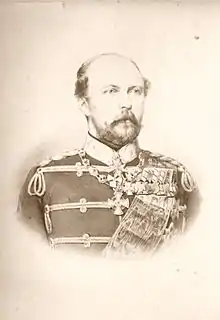
Prince Friedrich Karl Nikolaus of Prussia (20 March 1828 – 15 June 1885) was the son of Prince Charles of Prussia (1801–1883) and his wife, Princess Marie of Saxe-Weimar-Eisenach (1808–1877). Prince Friedrich Karl was a grandson of King Frederick William III of Prussia and a nephew of Frederick William IV and William I.
| Prince Friedrich Karl of Prussia | |||||
|---|---|---|---|---|---|
 | |||||
| Born | 20 March 1828 Berlin, Kingdom of Prussia | ||||
| Died | 15 June 1885 (aged 57) Jagdschloss Glienicke, Potsdam, Kingdom of Prussia, German Empire | ||||
| Spouse | |||||
| Issue | Princess Marie Elisabeth, Hereditary Grand Duchess of Oldenburg Princess Anna Victoria Princess Louise Margaret, Duchess of Connaught and Strathearn Prince Friedrich Leopold | ||||
| |||||
| House | Hohenzollern | ||||
| Father | Prince Charles of Prussia | ||||
| Mother | Princess Marie of Saxe-Weimar-Eisenach | ||||
| Military career | |||||
| Allegiance | .svg.png.webp) Kingdom of Prussia Kingdom of Prussia.svg.png.webp) German Empire German Empire | ||||
| Service/ | .svg.png.webp) Prussian Army Imperial German Army Prussian Army Imperial German Army | ||||
| Rank | Generalfeldmarschall | ||||
| Commands held | III Corps First Army Second Army | ||||
| Battles/wars | First Schleswig War Second Schleswig War Austro-Prussian War Franco-Prussian War | ||||
| Awards | Pour le Mérite (Grand Cross) Iron Cross (Grand Cross) Order of the Black Eagle | ||||
| Prussian Royalty |
| House of Hohenzollern |
|---|
 |
| Descendants of Frederick William III |
As a military commander, the Prince had a major influence on the Royal Prussian Army's advances in training and tactics in the 1850s and 1860s. He commanded one of the armies which defeated the Austrian army at the Battle of Königgrätz in 1866 and the French Army of the Rhine at the Battle of Mars-la-Tour, overseeing the defeat of the Army of the Rhine at the Siege of Metz in 1870.
Biography
Friedrich Karl was born at the Royal Palace in Berlin on 20 March 1828, as the only son of Prince Charles of Prussia, the brother of future German emperor William I. From 1842 to 1846, Frederick Charles was under the military tutelage of then Major Albrecht von Roon. In 1845, the Prince joined the army and was sent to an infantry company. Roon accompanied the Prince to the University of Bonn in 1846. He was the first Hohenzollern prince to study in a university. He became a member of the Corps Borussia Bonn in 1847 and was awarded Prussia's Lifesaving Medal for rescuing a child from the Rhine the same year. After his studies, the Prince went back to his regiment in 1848, where he was promoted to captain. His company was issued the breech-loading Dreyse needle gun and the Prince produced an article on its probable future impact, writing that the troops could be prevented from firing off all their ammunition through good training and discipline. He served on Friedrich Graf von Wrangel's staff during the First Schleswig War of 1848. He shifted to the cavalry branch in October 1848 and was promoted to major in June 1849. He partook in a campaign in the Baden Revolution of 1849, during which he was wounded twice while leading a Guards Hussar squadron at the battle of Wiesenthal against Baden rebels. He continued to lead his squadron up till 1852.
In 1851, the Prince wrote a radical field manual for light troops, underlining the importance of training individual soldiers to take the initiative and not wait for orders. During the following peace years he was promoted to colonel in 1852 and granted the command of the Guards Dragoon Regiment, where he introduced realistic field exercises and insisted on combat readiness. He became major general and commander of the 1st Guards Cavalry Brigade in 1854 and lieutenant general in 1856. He commanded the 1st Guards Infantry Division from 19 February to 18 September 1857, but resigned after encountering significant opposition to his approach on training. In 1859, he published the study On French Tactics, which highlighted the decisiveness of troop morale. In 1860, the Prince published a military book, titled, "Eine militärische Denkschrift von P. F. K.", which contained a series of reform proposals. As commander of III Army Corps from 1 July 1860 to 17 July 1870, the Prince implemented his reforms and turned his corps into a leader in Prussian military innovation.
Promoted to General der Kavallerie, the Prince took part in the Second Schleswig War of 1864 against Denmark, where he held command over the Prussian troops in the Austro-Prussian expeditionary force and defeated the Danes at the Battle of Dybbøl. In May 1864, he became supreme commander of the Austro-Prussian allied army and conquered Jutland.
He served with distinction in the Austro-Prussian War where he commanded the First Army, with Konstantin Bernhard von Voigts-Rhetz as his chief of staff, consisting of the II, III and IV corps.[1] Arriving first at Königgrätz, the First Army single-handedly held the numerically superior Austrians at bay for seven hours from 08:00 to 15:00, inflicting such massive casualties on the Austrians that it took the arrival of just one division from his cousin the Crown Prince Frederick William's Second Army to complete the victory and cause the Austrians to order a general withdrawal at 15:00. The First Army then marched on Vienna. After the war, he was awarded the Grand Cross of the Pour le Mérite.
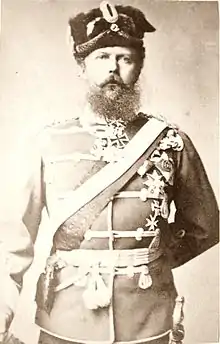
He was elected to the North German Reichstag in the February 1867 North German federal election, representing the East Prussian constituency of Labiau-Wehlau. At the outbreak of the Franco-Prussian War, the Prince was given command of the Second Army, and defeated the French Army of the Rhine at the Battle of Mars-la-Tour on 16 August 1870, cutting off its escape route to the west. The battle was followed by another victory at Gravelotte-St.Privat on 18 August and the encirclement and annihilation of the Army of the Rhine at the Siege of Metz. After the fall of Metz on 27 October, his army was sent to the Loire to clear the area around Orléans, where French armies, first under Aurelle de Paladines, then under Chanzy, were trying to march north to relieve Paris. He won battles at Orléans on 2 December and Le Mans from 10–12 January 1871. For his services he was promoted to the rank of Generalfeldmarschall. After the war, the Prince was made Inspector-General and was given the rank of Field Marshal of Russia by Alexander II of Russia.
He died of a heart attack at Jagdschloss Glienicke on 15 June 1885. He became the namesake of SMS Friedrich Carl.
Family
On 29 November 1854 at Dessau he married Princess Maria Anna of Anhalt-Dessau (1837–1906), daughter of Leopold IV, Duke of Anhalt. He had met her at a hunt. They had five children:
| Name | Birth | Death | Notes |
|---|---|---|---|
| Princess Marie Elisabeth Luise Friederike of Prussia | 14 September 1855 | 20 June 1888 | married twice (1) Prince Henry of the Netherlands; (2) Prince Albert of Saxe-Altenburg |
| Princess Elisabeth Anna of Prussia | 8 February 1857 | 28 August 1895 | married Frederick Augustus II, Grand Duke of Oldenburg |
| Princess Anna Viktoria Charlotte Auguste Adelheid of Prussia | 26 February 1858[2] | 6 May 1858[2] | |
| Princess Luise Margarete Alexandra Viktoria Agnes of Prussia | 25 July 1860 | 14 March 1917 | married Prince Arthur, Duke of Connaught and Strathearn |
| Prince Joachim Karl Wilhelm Friedrich Leopold of Prussia | 14 November 1865 | 13 September 1931 | married Princess Louise Sophie of Schleswig-Holstein-Sonderburg-Augustenburg |
Honours
He received the following decorations and awards:[3]
- German honours
.svg.png.webp) Prussia:
Prussia:
- Knight of the Black Eagle, 20 March 1838; with Collar, 1847[4]
- Pour le Mérite (military), 16 September 1848; with Oak Leaves, 27 February 1864; Grand Cross, 20 September 1866; with Oak Leaves, 2 September 1873[5]
- Knight of the Red Eagle, 1st Class with Swords and Oak Leaves, 1849; Grand Cross with Swords on Ring, 18 October 1861[4]
- Grand Commander's Cross of the Royal House Order of Hohenzollern, 1851; with Star and Swords, 18 April 1864[4]
- Commander of Honour of the Johanniter Order, 1854[4]
- Knight of the Crown Order, 1st Class, 18 October 1861[4]
- Grand Cross of the Iron Cross, 22 March 1871[6]
- Lifesaving Medal
- Service Award Cross
 Hohenzollern: Cross of Honour of the Princely House Order of Hohenzollern, 1st Class with Swords
 Ascanian duchies: Grand Cross of the Order of Albert the Bear, 14 February 1853; with Swords, 12 September 1864[7]
.svg.png.webp) Baden:[8]
Baden:[8]
- Knight of the House Order of Fidelity, 1849
- Grand Cross of the Zähringer Lion, 1849
- Commander of the Military Karl-Friedrich Merit Order, 1849; Grand Cross, 1871[9]
.svg.png.webp) Bavaria:
Bavaria:
- Knight of St. Hubert, 1853[10]
- Grand Cross of the Military Order of Max Joseph, 18 October 1870[11]
 Brunswick: Grand Cross of the Order of Henry the Lion
.svg.png.webp)
.svg.png.webp)
 Ernestine duchies: Grand Cross of the Saxe-Ernestine House Order, November 1854[12]
Ernestine duchies: Grand Cross of the Saxe-Ernestine House Order, November 1854[12] Hanover:[13]
- Grand Cross of the Royal Guelphic Order, 1847
- Knight of St. George, 1864
 Hesse-Kassel: Grand Cross of the Golden Lion, 22 May 1850[14]
 Hesse-Darmstadt:[15]
- Grand Cross of the Ludwig Order, 20 December 1846
- Military Merit Cross, 22 March 1871
 Lippe-Detmold: Military Merit Medal
 Mecklenburg:
- Grand Cross of the Wendish Crown, with Crown in Ore
- Cross for Distinction in War (Strelitz)
 Oldenburg: Grand Cross of the Order of Duke Peter Friedrich Ludwig, with Golden Crown, 18 September 1861; with Swords, 7 September 1870[16]
.svg.png.webp) Saxe-Weimar-Eisenach: Grand Cross of the White Falcon, 26 November 1845[17]
Saxe-Weimar-Eisenach: Grand Cross of the White Falcon, 26 November 1845[17].svg.png.webp) Saxony:[18]
Saxony:[18]
- Knight of the Rue Crown, 1867
- Grand Cross of the Military Order of St. Henry, 1870
 Schaumburg-Lippe: Military Merit Medal
 Württemberg: Grand Cross of the Military Merit Order, 30 December 1870[19]
- Foreign honours
 Austrian Empire:[20]
- Grand Cross of the Royal Hungarian Order of St. Stephen, 1852
- Commander of the Military Order of Maria Theresa, 1864
.svg.png.webp) Belgium: Grand Cordon of the Order of Leopold (military), 25 April 1867[21]
Belgium: Grand Cordon of the Order of Leopold (military), 25 April 1867[21].svg.png.webp) Kingdom of Greece: Grand Cross of the Redeemer
Kingdom of Greece: Grand Cross of the Redeemer.svg.png.webp) Kingdom of Hawaii: Grand Cross of the Order of Kalākaua, 1881[22]
Kingdom of Hawaii: Grand Cross of the Order of Kalākaua, 1881[22]_crowned.svg.png.webp) Kingdom of Italy:
Kingdom of Italy:
- Gold Medal of Military Valour, 3 July 1866[23]
- Knight of the Annunciation, 13 January 1867[24]
- Grand Cross of the Military Order of Savoy
 Netherlands:
- Grand Cross of the Military William Order, 23 August 1878[25]
- Grand Cross of the Netherlands Lion
.svg.png.webp) Ottoman Empire:
Ottoman Empire:
- Order of the Medjidie, 1st Class in Diamonds
- Order of Osmanieh, 1st Class in Diamonds
 Beylik of Tunis: Husainid Family Order
 Russian Empire:
- Knight of St. Andrew, 1838
- Knight of St. Alexander Nevsky
- Knight of the White Eagle
- Knight of St. Anna, 1st Class
- Knight of St. Stanislaus, 1st class
- Knight of St. George, 4th Class, 22 June 1849; 2nd Class, 1 July 1870
.svg.png.webp) United Principalities of Romania: Grand Cross of the Star of Romania
United Principalities of Romania: Grand Cross of the Star of Romania.svg.png.webp) Siam: Knight of the Order of the Royal House of Chakri
Siam: Knight of the Order of the Royal House of Chakri.svg.png.webp) Spain: Knight of the Golden Fleece, 12 November 1871[26]
Spain: Knight of the Golden Fleece, 12 November 1871[26].svg.png.webp)
 Sweden-Norway: Knight of the Seraphim, 19 July 1874[27]
 United Kingdom: Honorary Grand Cross of the Bath (military), 3 July 1878[28][29]
Ancestry
| Ancestors of Prince Friedrich Karl of Prussia (1828–1885) |
|---|
Portrayal in media
- He is portrayed by German actor Barnaby Metschurat in the Danish miniseries 1864.
References
- "Friedrich Karl Nikolaus Prinz von Preußen K.H." prussianmachine.com. Retrieved 2021-12-11.
- "Anna Victoria Charlotte Auguste Adelheid von Preussen". Find A Grave. 13 November 2007. Retrieved 25 September 2019.
- Hof- und Staats-Handbuch des Königreich Preußen (1884-85), Genealogy p. 2.
- Königlich Preussische Ordensliste (in German), 1, Berlin, 1877, pp. 8, 30, 573, 921, 964 – via hathitrust.org
- Lehmann, Gustaf (1913). Die Ritter des Ordens pour le mérite 1812–1913 [The Knights of the Order of the Pour le Mérite] (in German). 2. Berlin: Ernst Siegfried Mittler & Sohn. p. 415.
- Königlich Preussische Ordensliste (in German), 3, Berlin, 1877, p. 5 – via hathitrust.org
- Hof- und Staats-Handbuch des Herzogtum Anhalt (1867) "Herzoglicher Haus-orden Albrecht des Bären" p. 17
- Hof- und Staats-Handbuch des Großherzogtum Baden (1862), "Großherzogliche Orden" pp. 32, 37, 44
- Hof- und Staats ... Baden (1873), "Großherzogliche Orden", p. 63
- "Königliche Orden", Hof- und – Staatshandbuch des Königreichs Bayern (in German), Munich: Druck and Verlag, 1882, p. 7 – via hathitrust.org
- Ruith, Max (1882). Der K. Bayerische Militär-Max-Joseph-Orden. Ingolstadt: Ganghofer'sche Buchdruckerei. p. 83 – via hathitrust.org.
- Staatshandbücher für das Herzogtums Sachsen-Altenburg (1869), "Herzogliche Sachsen-Ernestinischer Hausorden" p. 21
- Staat Hannover (1865). Hof- und Staatshandbuch für das Königreich Hannover: 1865. Berenberg. p. 38, 76.
- Kurfürstlich Hessisches Hof- und Staatshandbuch: 1855. Waisenhaus. 1855. p. 12.
- Hof- und Staats-Handbuch des Großherzogtum Hessen (1879), "Großherzogliche Orden und Ehrenzeichen" pp. 10, 130
- Hof- und Staatshandbuch des Großherzogtums Oldenburg: für das Jahr 1872/73, "Der Großherzogliche Haus-und Verdienst Orden" p. 31
- Staatshandbuch für das Großherzogtum Sachsen / Sachsen-Weimar-Eisenach (1846), "Großherzogliche Hausorden" p. 10
- Staatshandbuch für den Freistaat Sachsen: 1873. Heinrich. 1873. pp. 4, 35.
- Württemberg (1873). Hof- und Staats-Handbuch des Königreichs Württemberg: 1873. p. 71.
- "Ritter-Orden", Hof- und Staatshandbuch der Österreichisch-Ungarischen Monarchie, 1884, pp. 117, 121, retrieved 13 June 2020
- Almanach royal officiel de Belgique. Librairie polytechnique De Decq. 1868. p. 52.
- Kalakaua to his sister, 4 August 1881, quoted in Greer, Richard A. (editor, 1967) "The Royal Tourist—Kalakaua's Letters Home from Tokio to London", Hawaiian Journal of History, vol. 5, p. 104
- "Hohenzollern Principe Federico Carlo" (in Italian), Il sito ufficiale della Presidenza della Repubblica. Retrieved 2018-08-14.
- Cibrario, Luigi (1869). Notizia storica del nobilissimo ordine supremo della santissima Annunziata. Sunto degli statuti, catalogo dei cavalieri (in Italian). Eredi Botta. p. 121. Retrieved 2019-03-04.
- "Militaire Willems-Orde: Preussen, Friedrich Karl Nicolaus Prinz von" [Military William Order: Prussia, Frederick Charles Nicholas Prince of]. Ministerie van Defensie (in Dutch). 23 August 1878. Retrieved 13 June 2020.
- "Caballeros de la insigne orden del toisón de oro". Guía Oficial de España (in Spanish). 1883. p. 141. Retrieved 13 June 2020.
- Sveriges statskalender (in Swedish), 1877, p. 369 – via runeberg.org
- "Prince Frederick Charles of Prussia", The Irish Times, 27 July 1878
- Shaw, Wm. A. (1906) The Knights of England, I, London, p. 197
Authority control  | |
|---|---|
| General | |
| National libraries | |
| Other | |