Programa Nacional de Población
Programa Nacional de Población was a program conducted in Peru in the early 1990s to reduce population growth as a way of meeting international demographic standards. Plans for the "total extermination" of impoverished Peruvians through sterilization were included in Plan Verde, a covert military operation created to establish a neoliberal military junta. Compulsory sterilization, which is a method that forces individuals to partake in sterilization operations, was the main method employed by the Peruvian government to decrease population.
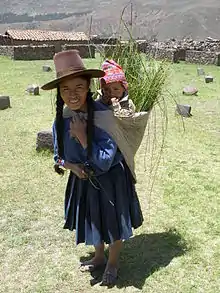
While the motives and practices for such sterilizations vary, Compulsory Sterilization in the case of Peru under President Alberto Fujimori was a program strictly intended to lower national population growth by decreasing the fertility rate among women.[1] The program, titled Programa Nacional de Población (National Population Program), was directed at Peru's impoverished, indigenous, and marginalized communities and therefore implied the government's intention to diminish the rural population in order to enhance future economic growth.[1]
Political and economic background
The social and political climate of Peru in the 1990s at the time of the aforementioned sterilization program was the result of decades of class struggle and institutionalized inequality. Peru is a country that has long been subordinate to oligarchy in its society and as a result the class divide between a handful of "powerful individuals" and the remaining "poor and impotent majority" is significant.[2]
This issue of class - in addition to Peru's political instability and dependency on capitalist order from international governments left the country in a vulnerable political, social, and economic position. In positions such as these, the poor are left inevitably to suffer from the failed policies of the upper class. This vulnerable state proved to be detrimental to Peru's constitutional government and civil society when the military overthrew President Fernando Belaúnde Terry in 1968 and remained in occupation of the government for an entire decade. Within this decade-long military regime under appointed President Juan Velasco Alvarado, the Peruvian government made significant leftist reforms and intended to give justice to the poor. However, these reforms were unsuccessful and the poor and indigenous suffered as the country plummeted further into debt. It was not until 1979, under General Francisco Morales Bermúdez that Peru adopted a new national constitution and focused on regaining economic strength within the country.[3]
Under this new constitution, population growth and families' rights to fertility were topics of political concern.[3] As a result of this new focus, the Ministry of Health began to offer public services towards family planning in 1983.[3] In 1985, the National Population Policy Law was passed and shortly thereafter the National Population Program was established.[3]
The population policy law, which continues to be in effect, intends to promote "a balanced relationship between population size, structure and distribution, and socio-economic development."[3] The law also specifically catered to the enhancement and protection of the human rights of Peruvian citizens with its promise to ensure voluntary and informed consent in issues regarding contraception and health services. However, Peru's government was still in the midst of internal conflict. Due to a lack of political support, there was not enough funding for the programs needed to carry out the National Population Policy Law. As a result, implementation of the law remained stagnant until the presidency of Alberto Fujimori in 1990.
Plan Verde
The Peruvian armed forces grew frustrated with the inability of the García administration to handle the nation's crises and began to draft a plan to overthrow his government.[4][5] According to Peruvian sociologist and political analyst Fernando Rospigliosi, Peru's business elites held relationships with the military planners, leaving an impression that a neoliberal economy must be adopted in Peru.[6]
Between 1988 and 1989, a coup d'état was initially planned to oust President García.[7] In October 1989, a group of the armed forces finalized plans to overthrow the García government with a volume of the plan titled Driving Peru into the XXI century.[8][9] The goals were to establish Peru as a developed country through the turn of the twenty-first century by establishing a neoliberal economy with policies similar to Chile's or those proposed by Mario Vargas Llosa.[10] This volume also details plans to sterilize impoverished citizens in what Rospigliosi described as "ideas frankly similar to the Nazis", with the military writing that "the general use of sterilization processes for culturally backward and economically impoverished groups is convenient", describing these groups as "unnecessary burdens" and that "given their incorrigible character and lack of resources ... there is only their total extermination".[10] The extermination of vulnerable Peruvians was described by planners as "an economic interest, it is an essential constant in the strategy of power and development of the state".[10]
Plan Verde was later redeveloped to include Alberto Fujimori as the head of a "civil-military" government.[11][12] Peruvian magazine Oiga reported that Fujimori was to be directed on accepting the military's plan at least twenty-four hours before his inauguration.[13] Fujimori would go on to adopt many of the policies outlined in Plan Verde.[14][15]
In 1991, a new National Population Program was developed, known as Programa Nacional de Población.[3] Although Fujimori was an avid public supporter of family planning, the new National Population Program and its specific goals and strategies seemingly counteracted the law's initial purpose of preserving individual human rights.
Demographics
In 1992, Peru was ranked as having the fifth highest population in the Latin American region with an estimated number of 22,767,543 inhabitants.[16] The country is generally split into three geographic regions: the coastal region, the highlands, and the selva (Amazon region). As of 1990, the demographics for these areas were as follows: 53% of the nation's population in the coastal region, 36% percent in the highlands, and 11% in the selva.[16] The National Population Program under Fujimori focused heavily on highland population, as it was the region inhabited by the largest amount of the country's indigenous peoples.
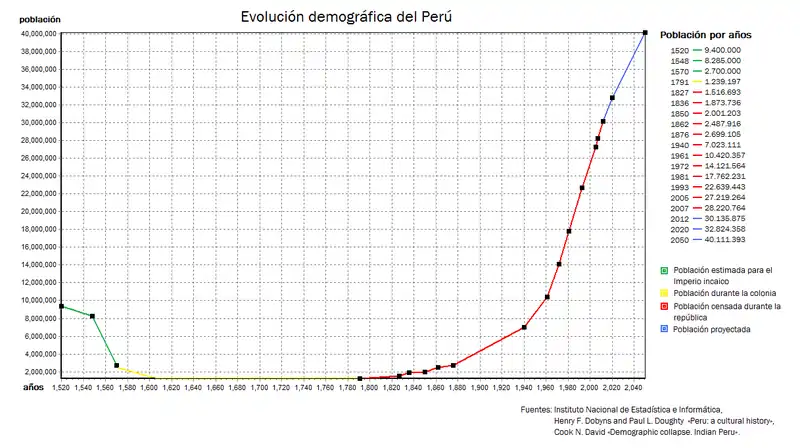
The chart below portrays the demographic evolution of Peru since the year 1520. The green colored points on the chart mark the population at the time of the Inca Empire prior to Spanish conquest. The yellow marks the population during Spanish colonization. The red signifies population during the independent republic of what Peru is today, and the blue is the projected population by the National Institute of Statistics and Information Technology (Instituto Nacional de Estadística e Informática) up until the year 2050.
Population issues
The issue of population growth in Peru is directly connected with the social, political and economic inequality within the country. The average number of childbirths for Peruvian women is higher than that of Latin America's general average and also higher than the average of women in the United States.[17] As for the comparison of birth rates within the country, 1.7 is the average number of children per woman with a university or college education while the average is 6.2 children per woman for those who have little or no education.[17] Women living in rural areas, mostly of indigenous descent, have the highest average birth rate at 7.1 children per woman.[17]
In the Andean countryside, the maternal mortality ratio is "very high for the region" at 185 deaths per 100,000 live births.[1] In addition, there are 66 abortions for every 100 live births, even though abortion is illegal in Peru and therefore is most likely conducted with high risk.[1]
The issues that arise from this discrepancy in birth rates are troubling. When looking solely at statistics, it can be said that the high birth rate among the lower classes of society continues the cycle of poverty. The reason for such high birth rates is linked to factors such as the lack of access to education and income disparity.
The National Population Program (1991–1995)
Goals
With the newly drafted version of the National Population Program (Programa Nacional de Población) under Fujimori, goals were specified in the context of demographics. The Peruvian Ministry of Health's program manager stated that impoverished indigenous women are "poor and producing more poor people. The President is aware that the government cannot fight poverty without reducing the poor people's fertility. Thus, demographic goals are a combination of the population's right to access family planning and the government's anti-poverty strategy."[3] The program was targeted towards poor women who had "little or no formal education".[3] Thus, the program intended to:
- reduce population growth rate from 2.1% to 2%
- reduce the total fertility rate from 3.5% to 3.3%
- reduce maternal and child mortality rates
- foster "equitable socio-economic opportunities" between men and women[3]
Strategies
The National Population program called on both public and private sectors to assist in its strategic implementation. Furthermore, seven strategies were laid out as guidelines to reach the intended demographic goals:
- reproductive health and family planning
- communication and information dissemination
- decentralization of population policy
- education
- production of research and statistics
- advancement of women and youth
- environmental protection[3]
Setbacks
Because these strategies required the cooperation of various institutions, the program failed to be carried out with ease yet again due to the lack of coherence within the involved political sectors and agencies. Many agencies "lacked sufficient power to carry out [its] functions" and others were either "not interested" or opposed to working in agreement "due to inter-institutional rivalries".[3] Peru's internal conflict from decades past continued to work against the overall productivity of the institution and its ability to sufficiently serve constituents.
Funding was also a crucial issue that proved to be an additional setback to the National Population Program. In Peruvian government, as with many Latin American countries, the Catholic Church held significant power over issues both public and private. Essentially, the moral support of the distinguished members of the Church would result in financial support. However the Catholic community looked down upon the National Population Program due to its promise to provide modern contraceptives.[3] Knowing fully well that his program would not be a success without the Catholic Church's approval, President Fujimori "toned down" the program's focus on contraception.[3]
Implementation
After the goals were defined and the funding for the National Population Program was in place, the number of annual sterilizations in Peru rose drastically. Prior to the program, there were less than 15,000 sterilizations performed per year and women could only have the operation performed "if they had a health risk, four or more children, or were above a certain age".[3] However, after 1995 when sterilizations began to be performed, there were no pre-existing conditions necessary for sterilizations other than that women had to be considered part of Peru's poor and disenfranchised community. In addition, the number of annual sterilization procedures rose after the program's implementation from 15,000 to 67,000 in 1996 and 115,000 in 1997.[3]
The program's implementation also brought up several issues in terms of the quality and care of the procedures. Most of the personnel hired to perform sterilizations were not properly trained and much of the equipment used was outdated and lacking in quality. The counseling services provided to patients were also backed by poorly trained staff and many women were not given "quality information prior to procedures".[3] When sterilizations were given, they were done so in a hurriedly manner. "Teams were dispatchd one day at a time to perform procedures" and therefore attempted to cover large masses of women in rural areas in very minimal amounts of time.[3] As a result, patients were denied sufficient and proper treatment and rarely received follow-up care.
Bribery, threats, and deception were methods used in the implementation of such procedures by medical personnel. A large number of the indigenous Peruvian population speaks Quechua and are unable to read, write, and sometimes even communicate in Spanish. Many women were deceived by personnel and told that the procedures were operations other than sterilization. There were also instances of men being told they would be fined or jailed if they did not order their wives to have the operation. A former physician for the Ministry of Health confirms these practices:
We were required to perform a certain number of sterilizations each month. This was obligatory and if we did not comply, we were fired. Many providers did not inform women that they were going to be sterilized - they told them that the procedure was something else. But I felt this was wrong. I preferred to offer women a bag of rice to convince them to accept the procedure and explained to them beforehand what was going to happen.[3]
Controversy
Forced sterilizations
The plan's forced sterilization of vulnerable groups through the Programa Nacional de Población has been variably described as an ethnic cleansing or genocidal operation.[18][19][20][21] According to Back and Zavala, the plan was an example of ethnic cleansing as it targeted indigenous and rural women.[18] Jocelyn E. Getgen of Cornell University wrote that the systemic nature of sterilizations and the mens rea of officials who drafted the plan proved an act of genocide.[19] The Centro Amazónico de Antropología y Aplicación Práctica non-profit stated that the act "was the largest genocide since [Peru's] colonization".[21] At least 300,000 Peruvians were victims of forced sterilization in the 1990s, with the majority being affected by the PNSRPF.[22] The policy of sterilizations resulted in a generational shift that included a smaller younger generation that could not provide economic stimulation to rural areas, making such regions more impoverished.[23]
In 1997, the newspaper La República reported on the human rights violations of the National Population Program and sparked a nationwide debate that brought the government's actions to the forefront of Peruvian media.[3] Because the procedures of the National Population Program went against Peru's constitutional law and violated human rights law, foreign donors threatened to suspend support for any aspects of the program that were sterilization related. Many public organizations, such as the Flora Tristán Peruvian Women's Center and the Comité de América Latina y el Caribe para la Defensa de los Derechos de la Mujer (CLADEM), began to voice their concerns for the program and attempt to obtain evidence against the Ministry of Health and the Peruvian government for their covert actions.[3]
Foreign involvement
Without full support from the Catholic Church, outside funding was required for the program's success. International pressure to meet population standards became evident when the International Monetary Fund suggested that the Peruvian government cut funding for social services to allow for more spending in areas called for by the program.[3] In addition, USAID (United States Agency for International Development) contributed US$85 million between 1994 and 1998. Because the financial support from foreign donors brought economic and political pressure upon Fujimori to meet international standards, the plan to decrease population growth consequently became more focused on quotas than individual rights and health issues.
In 1998 after facing pressure following investigations by the Population Research Institute, USAID ceased funding for sterilizations in Peru.[24] Sterilizations continued until President Fujimori fled to Japan in 2000.[25]
Program reform
In 1998, the Peruvian government and the Ministry of Health agreed to reform the controversial aspects of the National Population Program, establishing the Plan Nacional de Población.[3] The elimination of numeric goals was arguably the most important change to the program as demographic goals and quotas were no longer needed. While sterilization was not eliminated entirely, the reforms for the implementation of the procedure included:
- new counseling guidelines
- new consent forms
- two counseling sessions for patients
- 72-hour waiting period between second counseling session and sterilization
- 24-hour hospitalization after the procedure
- certifications for health facilities and physicians[3]
Finally, the language of the National Population Program was also changed. Rather than a target of 2.5 births per woman as it was written in the original law in 1991, the reformed program intended to "reach a total fertility rate compatible with the individual reproductive intentions".[3]
The reformed Plan Nacional de Población existed from 1998 to 2002.[26]
References
- Boesten, Jelke. "Free Choice or Poverty Alleviation? Population Politics in Peru under Alberto Fujimori." European Review of Latin American and Caribbean Studies / Revista Europea de Estudios Latinoamericanos y del Caribe, No. 82 (April 2007), pp. 3-20
- Gorman, Stephen M. "The Economic and Social Foundations of Elite Power in Peru: A Review of the Literature." Social and Economic Studies , Vol. 29, No. 2/3 (June/September 1980), pp. 292-319
- Coe, Anna-Britt. "From Anti-Natalist to Ultra-Conservative: Restricting Reproductive Choice in Peru" Reproductive Health Matters, Vol. 12, No. 24, Power, Money and Autonomy in National Policies and Programmes (November 2004), pp. 56-69
- Burt, Jo-Marie (September–October 1998). "Unsettled accounts: militarization and memory in postwar Peru". NACLA Report on the Americas. Taylor & Francis. 32 (2): 35+.
the military's growing frustration over the limitations placed upon its counterinsurgency operations by democratic institutions, coupled with the growing inability of civilian politicians to deal with the spiraling economic crisis and the expansion of the Shining Path, prompted a group of military officers to devise a coup plan in the late 1980s. The plan called for the dissolution of Peru's civilian government, military control over the state, and total elimination of armed opposition groups. The plan, developed in a series of documents known as the "Plan Verde," outlined a strategy for carrying out a military coup in which the armed forces would govern for 15 to 20 years and radically restructure state-society relations along neoliberal lines.
- Alfredo Schulte-Bockholt (2006). "Chapter 5: Elites, Cocaine, and Power in Colombia and Peru". The politics of organized crime and the organized crime of politics: a study in criminal power. Lexington Books. pp. 114–118. ISBN 978-0-7391-1358-5.
important members of the officer corps, particularly within the army, had been contemplating a military coup and the establishment of an authoritarian regime, or a so-called directed democracy. The project was known as 'Plan Verde', the Green Plan. ... Fujimori essentially adopted the 'Plan Verde,' and the military became a partner in the regime. ... The autogolpe, or self-coup, of April 5, 1992, dissolved the Congress and the country's constitution and allowed for the implementation of the most important components of the 'Plan Verde.'
- Avilés, William (Spring 2009). "Despite Insurgency: Reducing Military Prerogatives in Colombia and Peru". Latin American Politics and Society. Cambridge University Press. 51 (1): 57–85.
- Rospigliosi, Fernando (1996). Las Fuerzas Armadas y el 5 de abril: la percepción de la amenaza subversiva como una motivación golpista. Lima, Peru: Instituto de Estudios Peruanos. pp. 28–40.
- Gaussens, Pierre (2020). "The forced serilization of indigenous population in Mexico in the 1990s". Canadian Journal of Bioethics. 3 (3): 180+.
a government plan, developed by the Peruvian army between 1989 and 1990s to deal with the Shining Path insurrection, later known as the 'Green Plan', whose (unpublished) text expresses in explicit terms a genocidal intention
- "El "Plan Verde" Historia de una traición". Oiga. 647. 12 July 1993.
- Rospigliosi, Fernando (1996). Las Fuerzas Armadas y el 5 de abril: la percepción de la amenaza subversiva como una motivación golpista. Lima, Peru: Instituto de Estudios Peruanos. pp. 28–40.
- Rospigliosi, Fernando (1996). Las Fuerzas Armadas y el 5 de abril: la percepción de la amenaza subversiva como una motivación golpista. Lima, Peru: Instituto de Estudios Peruanos. pp. 28–40.
- Rospigliosi, Fernando (1996). Las Fuerzas Armadas y el 5 de abril: la percepción de la amenaza subversiva como una motivación golpista. Lima, Peru: Instituto de Estudios Peruanos. pp. 46–47.
- "El "Plan Verde" Historia de una traición". Oiga. 647. 12 July 1993.
- Alfredo Schulte-Bockholt (2006). "Chapter 5: Elites, Cocaine, and Power in Colombia and Peru". The politics of organized crime and the organized crime of politics: a study in criminal power. Lexington Books. pp. 114–118. ISBN 978-0-7391-1358-5.
important members of the officer corps, particularly within the army, had been contemplating a military coup and the establishment of an authoritarian regime, or a so-called directed democracy. The project was known as 'Plan Verde', the Green Plan. ... Fujimori essentially adopted the 'Plan Verde,' and the military became a partner in the regime. ... The autogolpe, or self-coup, of April 5, 1992, dissolved the Congress and the country's constitution and allowed for the implementation of the most important components of the 'Plan Verde.'
- Avilés, William (Spring 2009). "Despite Insurgency: Reducing Military Prerogatives in Colombia and Peru". Latin American Politics and Society. Cambridge University Press. 51 (1): 57–85.
- United States Library of Congress. Peru: Environment and Population. Washington: US Library of Congress, 1992. Web.
- Schmidt, Bria. "Forced Sterilization in Peru." Political Environments #6, 1998
- Back, Michele; Zavala, Virginia (2018). Racialization and Language: Interdisciplinary Perspectives From Perú. Routledge. pp. 286–291. Retrieved 4 August 2021.
At the end of the 1980s, a group of military elites secretly developed an analysis of Peruvian society called El cuaderno verde. This analysis established the policies that the following government would have to carry out in order to defeat Shining Path and rescue the Peruvian economy from the deep crisis in which it found itself. El cuaderno verde was passed onto the national press in 1993, after some of these policies were enacted by President Fujimori. ... It was a program that resulted in the forced sterilization of Quechua-speaking women belonging to rural Andean communities. This is an example of 'ethnic cleansing' justified by the state, which claimed that a properly controlled birth rate would improve the distribution of national resources and thus reduce poverty levels. ... The Peruvian state decided to control the bodies of 'culturally backward' women, since they were considered a source of poverty and the seeds of subversive groups
- Getgen, Jocelyn E. (Winter 2009). "Untold Truths: The Exclusion of Enforced Sterilizations from the Peruvian Truth Commission's Final Report". Third World Journal. 29 (1): 1–34.
This Article argues that these systematic reproductive injustices constitute an act of genocide ... those individuals responsible for orchestrating enforced sterilizations against indigenous Quechua women arguably acted with the necessary mens rea to commit genocide since they knew or should have known that these coercive sterilizations would destroy, in whole or in part, the Quechua people. Highly probative evidence with which one could infer genocidal intent would include the Family Planning Program's specific targeting of poor indigenous women and the systematic nature of its quota system, articulated in the 1989 Plan for a Government of National Reconstruction, or 'Plan Verde.' ... The Plan continued by arguing ... the targeted areas possessed 'incorrigble characters' and lacked resources, all that was left was their 'total extermination.'
- Carranza Ko, Ñusta (4 September 2020). "Making the Case for Genocide, the Forced Sterilization of Indigenous Peoples of Peru". Genocide Studies and Prevention: An International Journal. 14 (2): 90–103. doi:10.5038/1911-9933.14.2.1740. ISSN 1911-0359.
a genocide did occur ... there was a case of genocide that involved the state against the reproductive rights of an ethnic minority, an institutionalized genocide via a state policy.
- "La esterilización forzada en Perú fue el mayor genocidio desde su colonización". Centro Amazónico de Antropología y Aplicación Práctica (CAAAP) (in Spanish). 31 May 2016. Retrieved 4 August 2021.
- Gaussens, Pierre (2020). "The forced serilization of indigenous population in Mexico in the 1990s". Canadian Journal of Bioethics. 3 (3): 180+.
a government plan, developed by the Peruvian army between 1989 and 1990s to deal with the Shining Path insurrection, later known as the 'Green Plan', whose (unpublished) text expresses in explicit terms a genocidal intention
- "Mass sterilisation scandal shocks Peru". BBC News. 24 July 2002. Retrieved 4 August 2021.
- Rendón, Silvio (2013). La intervención de los Estados Unidos en el Perú. Editorial Sur. pp. 256–259. ISBN 9786124574139.
this genocide stopped not due to the decisive intervention of Peruvian political and social organizations or forces, but by ... the PRI
- "Mass sterilisation scandal shocks Peru". BBC News. 24 July 2002. Retrieved 4 August 2021.
- "1.6 Perú: Política y Plan Nacional de Población". proyectos.inei.gob.pe. Retrieved 12 October 2021.