Prosapia bicincta
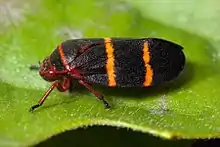
The two-lined spittlebug (Prosapia bicincta) is a species of insect in the family Cercopidae. Adults are black with two red or orange lines crossing the wings. It reaches a length of 8–10 mm. It is widespread in the eastern half of the United States.[1] A similar but possibly distinct species can be found throughout Central America where it is considered an agricultural pest.[2]
| Prosapia bicincta | |
|---|---|
 | |
| Scientific classification | |
| Kingdom: | |
| Phylum: | |
| Class: | |
| Order: | |
| Suborder: | |
| Superfamily: | |
| Family: | |
| Genus: | |
| Species: | P. bicincta |
| Binomial name | |
| Prosapia bicincta (Say, 1830) | |
Nymphs feed on various grasses (including centipedegrass, bermudagrass and corn) from within foam (consisting of their own spittle) produced from juices of their host plant.[1] Adults feed on the leaves of both native and introduced species of holly, as well as on the leaves of the eastern redbud tree. It is a pest of forage grasses and turf grasses such as those grown for lawns and its consumption of these plants causes economic damage throughout the southeastern United States.[3]
References
- "Species Prosapia bicincta - Two-lined Spittlebug". BugGuide.Net. Retrieved 2011-08-29.
- Peck, Daniel C. (1998-07-01). "Natural History of the Spittlebug Prosapia nr. bicincta (Homoptera: Cercopidae) in Association with Dairy Pastures of Costa Rica". Annals of the Entomological Society of America. 91 (4): 435–444. doi:10.1093/aesa/91.4.435. ISSN 0013-8746.
- Peck, Daniel C. (December 1998). "Use of Alternative Food Plants Exclusively by Adult Male Froghoppers (Homoptera: Cercopidae)1". Biotropica. 30 (4): 639–644. doi:10.1111/j.1744-7429.1998.tb00103.x. ISSN 0006-3606.