Psilocybe alutacea
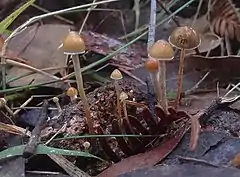
Psilocybe alutacea is a species of agaric fungus in the family Hymenogastraceae.[1][2] It was described in 2006 and is known from Australia and New Zealand. It is corprophilous, growing on animal dung. The fruitbodies have a small conical or convex cap, subdistant gills with an adnate attachment, and a slender brown stipe.[3] As a blueing member of the genus Psilocybe it contains the psychoactive compounds psilocin and psilocybin.
| Psilocybe alutacea | |
|---|---|
 | |
Scientific classification  | |
| Kingdom: | Fungi |
| Division: | Basidiomycota |
| Class: | Agaricomycetes |
| Order: | Agaricales |
| Family: | Hymenogastraceae |
| Genus: | Psilocybe |
| Species: | P. alutacea |
| Binomial name | |
| Psilocybe alutacea Y.S. Chang & A.K. Mills | |
Taxonomy
Psilocybe alutacea was described by Y.S. Chang and A.K. Mills in 2006. The holotype was collected by Chang in 1990 in Tasmania and deposited at the herbarium in Hobart with accession #HO132672. Due to the ellipsoid-oval spores, conical cap, adnate gills and faint blueing reaction this species is placed in section Semilanceatae. The name means leathery.[3]
Psilocybe alutacea | |
|---|---|
 | gills on hymenium |

 | cap is conical or convex |
 | hymenium is adnate |
 | stipe is bare |
 | spore print is purple-brown |
 | ecology is saprotrophic |
 | edibility: psychoactive |
Description
The cap is 10-13 mm in diameter, conical to convex in shape, somewhat sticky or tacky when moist, hygrophanous (abruptly changing colour from wet to dry), smooth, radially striate at the edge, coloured leathery brown to ochraceous brown. The gills are adnate, subdistant and greyish brown with white edges, sometimes unevenly coloured. The stipe is 25-46 mm x 1-2.5 mm, pale brown, cylindrical and stuffed. There is a blueing reaction to damage but it is faint and slow, only showing at the edges of the gills. The Spore print is purple-brown.[3]
Microscopic characteristics
Spores measure 11.7-15.8 (-16.7) x 7.9-9.2 μm, ellipsoid with a distinct germ pore. Basidia 25.8 - 34.2 x 9.2-12.1 μm, 4-spored, transparent, clavate or obovate. Cheilocystidia measure 22.5-35.9 (-44.2) x 5 - 10 μm, they are transparent with long necks of 6.7-15 μm, in shape simple, bifurcate or trifurcate (one, two or three prongs or forks). Pleurocystidia are rare, measure 17.5-30.4 x 4.6 - 10 μm, are lageniform (shaped like a bottle or flask) with long necks. Subhymenium subcellular. Trama regular, pale brown in 5% KOH, with hyphae measuring 3.3-15 μm. Epicutis is a layer of subgelatinised, encrusted hyphae with brown pigments, 2.5-5 μm broad. Clamp connections present.[3]
Published description
Some new species in the Strophariaceae (Agaricales) in Tasmania full text in PDF as published in Australasian Mycologist, by Chang, Gates and Ratkowsky in 2006.
Similar species
Members of sect. Semilanceatae, genetically similar species and small brown corprophilous fungi. P. semilanceata is more umbonate and grows in grasslands from debris and roots. On dung: P. fimetaria has a stipe that discolours yellow with handling or age. P. liniformans has a convex to applanate cap. P. pelliculosa is closely related with a similar appearance. P. tasmaniana is similar in description and corprophilous habit but microscopic features differ; pleurocystidia in that species are reportedly abundant, and fusiod-ventricose with short necks. Deconica corprophila and similar Deconica sp. are close lookalikes but with subdecurrent gills and no blueing reaction. Protostropharia semiglobata has a slippery glutinous stipe when wet and no blueing reaction. Panaeolus spp. spores in deposit are brown, greyish or black, not purple-brown.[3]
Distribution and habitat
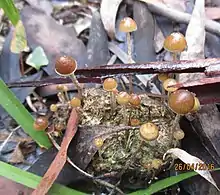
Solitary to subgregarius on cow dung, also collected on horse and wombat dung. Present in Australia and New Zealand. In Tasmania collections were made at Snug Falls Track, Mount Field National Park (Pandanus Walk) and Kermandie Falls (Upper Track).[3]
See also
References
- "Psilocybe alutacea Y.S.Chang & A.K.Mills". www.gbif.org. GBIF. Retrieved 2021-09-30.
- Australia, Atlas of Living. "Species: Psilocybe alutacea". bie.ala.org.au. Atlas of Living Australia. Retrieved 2021-09-30.
- Chang, Y.S.; Gates, G.M.; Ratkowsky, D.A. (2006). "Some new species in the Strophariaceae (Agaricales) in Tasmania". Australasian Mycologist. 24 (3): 61–64.
External links
 Media related to Psilocybe alutacea at Wikimedia Commons
- Landcare Research Manaaki Whenua New Zealand records of this species.
- Observations on iNaturalist
- Observations on Mushroom Observer