Pulse (2017 film)
Pulse is a 2017 Australian fantasy drama film produced and directed by Stevie Cruz-Martin and co-produced, written and starring Daniel Monks. It was screened locally at Sydney and Melbourne Queer Film Festivals before being considered for international premiere at the Busan International Film Festival in its Flash Forward section in October of the same year.[1]
| Pulse | |
|---|---|
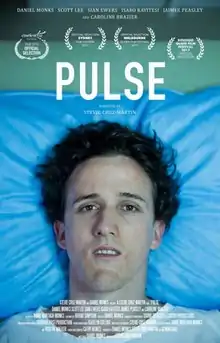 Film poster | |
| Directed by | Stevie Cruz-Martin |
| Written by | Daniel Monks |
| Produced by | Stevie Cruz-Martin Daniel Monks Gemma Hall |
| Starring |
|
| Cinematography | Stevie Cruz-Martin |
| Edited by | Daniel Monks |
| Music by | Featurette |
Production company | Dark Star Pictures |
| Distributed by | Oration Films |
Release date |
|
Running time | 84 minutes |
| Country | Australia |
| Language | English |
| Budget | $20,100[1] |
Plot
Being straight and loved by girls was always Olly's dream, a gay and disabled teenager who lives with a straight roommate. His desperation leads him into a clinic, where he pursues body transplantation and becomes a straight woman. Less he knows that following this body swap not only his roommate will be attractive to him (point for the body swap), but also his girl friends (who will stop at nothing from teaching him how to put the make-up on and to teach him how to flirt with the guys).
Cast
- Daniel Monks as Olly
- Caroline Brazier as Jacqui
- Scott Lee as Luke
- Sian Ewers as Nat
- Isaro Kayitesi as Britney
- Jaimee Peasley as Olivia
- Troy Rodger as Mark
- David Richardson as Brandon
- Lee Jankowski as Trev
- Kate Neylon as Dr. Barker
- Evan Williams as physiotherapist
- Alex Malone as Sarah
- Jad Abid as Sonny
- Jack Hyslop as nightclub man #1
- Joshua Charles Dawe as nightclub man #2
- Josephine Langford as student
- Meghann Herlihy as student
- Isabella Birighitti as party girl
- Tessa Carmody as party girl
- Sean Schliwa as bar patron
Production and filming
Pulse's screenplay was written by Daniel Monks who based it on his experiences as a teen struggling to fit it. According to an interview conducted by Accessible Arts, the screenwriter and actor became quadriplegic at the age of 11 and the same year was diagnosed with hemiparesis.[2]
Pulse was in production for seven years and was shot in Western Australia.[3]
Release
The rights for Pulse were brought by Oration Films to be released in the United States.[1] However, it was Dark Star Pictures which announced its release via video-on-demand on 2 June 2020.[4]
Reception and accolades
On review aggregator website Rotten Tomatoes, the film has an approval rating of 86% based on 7 critics, with an average rating of 6.9/10.[5]
Lochley Shaddock of FilmInk said "With a flair for the visual and aural, and featuring solid performances, Pulse does not answer enough of the questions that the film wants to raise".[6]
Norman Gidney of Film Threat gave the film a score of 6 out of 10 and wrote: "…poignant but problematic sci-fi film that explores youth, sexuality, and gender identity".[7]
Writing for the Australian Cinematographer Dash Wilson called the film "brave and ultimately unique" and added that "[the film] probably won't win any Oscars, [despite it] it is still an impressive feature debut by its female director/cinematographer".[3]
On 23 October 2017, Pulse became the first Australian film to win $20,000 USD prize at the Busan International Film Festival.[8]
References
- Frater, Patrick (14 October 2017). "Busan: Australian Film 'Pulse' Is Tale of Triumph Over Adversity". Variety.
- "Sydney Film Festival interview". Accessible Arts. 17 May 2017. Retrieved 15 October 2021.
- Wilson, Dash (1 June 2017). "Film Review: Pulse". Australian Cinematographer.
- Adrian Halen (1 June 2020). "'Pulse' // Available On Demand June 2, 2020". Retrieved 15 October 2021.
- "Pulse (2017)". Rotten Tomatoes. Fandango Media. Retrieved 15 October 2021.
- Shaddock, Lochley. "Pulse". FilmInk.
- Gidney, Norman (2 June 2020). "Pulse". Film Threat. Retrieved 15 October 2021.
- Groves, Don (23 October 2017). "Australian LGBTQI drama 'Pulse' wins key festival prize". IF Magazine.