Punctelia graminicola
Punctelia graminicola is a species of foliose lichen in the family Parmeliaceae. It grows on rocks, and, less frequently, on bark in North America, South America, and East Africa. It was previously known under the name Parmelia semansiana until an older name was discovered in 2003. A lookalike species, Punctelia hypoleucites, is morphologically indistinguishable from Punctelia graminicola, and they can only be reliably differentiated by examining the length of their conidia (asexual spores).
| Punctelia graminicola | |
|---|---|
 | |
| in Arkansas, United States | |
Scientific classification  | |
| Kingdom: | Fungi |
| Division: | Ascomycota |
| Class: | Lecanoromycetes |
| Order: | Lecanorales |
| Family: | Parmeliaceae |
| Genus: | Punctelia |
| Species: | P. graminicola |
| Binomial name | |
| Punctelia graminicola (B.de Lesd.) Egan (2003) | |
| Synonyms[1][2] | |
Taxonomy
The lichen was first formally described in 1942 as a new species by French lichenologist Maurice Bouly de Lesdain, as Parmelia graminicola. The type specimens were collected in Las Vegas, New Mexico by Brother Arsène Brouard, near the Chimayo Dam at an altitude of 1,900 m (6,200 ft).[5] Although the specific epithet graminicola suggests Gramineae as the substrate,[6] Bouly indicates that the lichen was found growing on mosses and the spikemoss Selaginella.[5] Bouly de Lesdain kept this material, and other collections sent to him by Brouard, at his private herbarium in Dunkirk.[7] The herbarium was destroyed during the bombing of Dunkerque in World War II, and his collections were destroyed.[2] After the loss of the type material, the name Parmelia graminicola was often later relegated to synonymy with Punctelia subrudecta.[8][9][10] In his original description of Parmelia graminicola, Bouly de Lesdain had noted its similarity to P. subrudecta.[5]
In 1980, William and Chicita Culberson reported their observations on the differences in the length of the conidia in populations of Parmelia hypoleucites collected from Arizona and Mexico. They noted that the long-form conidia morphs (P. hypoleucites) grew on bark and had a range restricted to woodlands of the Mexican highlands, while the short-form conidia morphs grew on rocks and were widespread in south-central North America, with few occurrences in regions with the long-form morph. They used this dimorphism to distinguish the short-form morph as a distinct species, P. semansiana, using the larger of Müller's specimens as the type of this new species.[3] Hildur Krog transferred Parmelia semansiana and 21 other Parmelia species with rounded (punctate) pseudocyphellae to the newly circumscribed genus Punctelia in 1982.[4]
In 2001, Robert Shaw Egan discovered that some of Brouard's collections had been rescued from being disposed at a local (New Mexico) landfill, the specimens were transferred to Arizona State University and curated. Among the lichens were isotype of Brouard's collections of Parmelia graminicola that he collected in 1935 near the Chimayó dam. P. semansiana was found to be identical with P. graminicola.[2]
Description
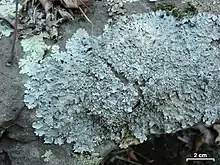
The thallus of Punctelia graminicola measures 3.0–14.5 cm (1.2–5.7 in) in diameter.[6] It comprises irregularly branched lobes, often crowded or overlapping, measuring 2–4 mm (0.08–0.16 in) wide. The upper thallus surface is blue-grey, often with brown margins, and usually smooth and without pruina. Pseudocyphellae on the thallus surface range in number from occasional to abundant. They are circular to irregularly shaped,[11] measuring 0.03–0.6 by 0.03–0.4 mm. The medulla is white.[6] Propagules such as isidia or soralia are absent in this species, but sometimes the lichen forms lobules – small lobes (lacinulae) on the lobe margins that project out from the surface.[11] Adriano Spielmann and Marcelo Marcelli have noted that Punctelia graminicola has a broad species concept, as it include individuals both with and without lacinulae.[6] The thallus undersurface ranges in color from pale tan to light to medium brown, with sparse, light-colored rhizines.[11]
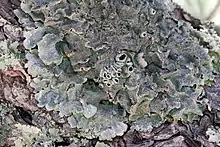
Punctelia graminicola occasionally makes apothecia, although they are absent or immature in some individuals. They are cup shaped with a brown disc measuring 3–10 mm (0.1–0.4 in) in diameter. There are often abundant pseudocyphellae on the folded margins of the apothecia. The ascospores are more or less spherical to broadly ellipsoid, translucent, and measure 7–14 by 6–9 μm. Depending on the individual lichen, pycnidia can be rare or abundant. They are immersed in the thallus surface, appearing like brown to black dots. They produce conidia that are usually like short, translucent rods measuring 5–6 by 1 μm; in rare instances the conidia are hooklike (unciform).[11]
The standard lichen spot test results are K+ (yellow), C-, KC-, P-, and UV- in the upper cortex; in the medulla they are K-, KC+ (red), C+ (red), P-, and UV-, indicating the presence of lecanoric acid.[11]
Punctelia hypoleucites is quite similar in appearance, and can be reliably distinguished from Punctelia graminicola by the length of its conidia (11–12 μm).[3] Unlike Punctelia graminicola, which grows on both rock and bark (the latter much less frequently), Punctelia hypoleucites only grows on bark.[12]
Habitat and distribution
Punctelia graminicola grows on rocks, or on mosses that are on rocks. Much less frequently, it grows on bark. Recorded bark substrates include Fouquieria, Cupressus, and Quercus.[11] In the United States, Punctelia graminicola occurs in the central US east to the Appalachians.[12] In Mexico it is widely distributed across the northern and central parts of the country.[11] Its South American distribution includes Argentina and Brazil.[6] It has also been recorded from East Africa (as P. semansiana).[13]
References
- "Synonymy: Punctelia graminicola (B. de Lesd.) Egan, Bryologist 106(2): 315 (2003)". Species Fungorum. Retrieved 25 April 2021.
- Egan, Robert S. (2003). "What is the lichen Parmelia graminicola B. de Lesd.?". The Bryologist. 106 (2): 314–316. doi:10.1639/0007-2745(2003)106[0314:WITLPG]2.0.CO;2.
- Culberson, William Louis; Culberson, Chicita F. (1980). "Microconidial dimorphism in the lichen genus Parmelia". Mycologia. 72 (1): 127–135. doi:10.1080/00275514.1980.12021161. JSTOR 3759425.
- Krog, Hildur (1982). "Punctelia, a new lichen genus in the Parmeliaceae". Nordic Journal of Botany. 2 (3): 287–292. doi:10.1111/j.1756-1051.1982.tb01191.x.
- Bouly De Lesdain, M. (1942). "Lichens de l'état de New-Mexico (U.S.A.) recueillis par le Frère G. Arsène Brouard (supplément)". Revue Bryologique et Lichénologique (in French). 12: 44–66.
- Spielmann, Adriano Afonso; Marcelli, Marcelo Pinto (2008). "Punctelia (Parmeliaceae, lichenized Ascomycota) from roadsides and slopes in the Serra Geral of Rio Grande do Sul, Brazil". Biociências. 16 (2): 79–91.
- "de Lesdain, Maurice Bouly (1869–1965)". JSTOR Global Plants. ITHAKA. Retrieved 25 April 2021.
- Egan, R. S. (1972). "Catalog of the lichens of New Mexico". The Bryologist. 75: 7–35. doi:10.1639/0007-2745(1972)75[7:COTLON]2.0.CO;2.
- DePriest, Paula T.; Hale, Beatrice Wilde (1998). "Mason E. Hale's list of epithets in the parmelioid genera". Mycotaxon. 67: 201–206.
- Hale, Mason E.; Culberson, William Louis (1970). "A Fourth Checklist of the Lichens of the Continental United States and Canada". The Bryologist. 73 (3): 499–543. doi:10.2307/3241492. JSTOR 3241492.
- Egan, R.S.; Lendemer, J. (2016). "Punctelia in Mexico". In Herrera-Campos, Maria; Pérez-Pérez, Rosa Emilia; Nash III, Thomas H. (eds.). Lichens of Mexico. The Parmeliaceae – Keys, distribution and specimen descriptions. Stuttgart: J. Cramer. pp. 453–480. ISBN 978-3-443-58089-6.
- Brodo, Irwin M.; Sharnoff, Sylvia Duran; Sharnoff, Stephen (2001). Lichens of North America. New Haven: Yale University Press. p. 607. ISBN 978-0-300-08249-4.
- Swinscow, Thomas Douglas Victor; Krog, Hildur (1988). Macrolichens of East Africa. London: British Museum (Natural History). p. 165. ISBN 978-0-565-01039-3.