List of British royal consorts
A royal consort is the spouse of a ruling king or queen. Consorts of monarchs in the United Kingdom and its predecessors have no constitutional status or power but many have had significant influence. Prince Philip is the longest-served and oldest-ever consort. His mother-in-law, Queen Elizabeth The Queen Mother, who died aged 101, lived longer than any other royal consort but at the time of her death she did not hold the position of queen consort, as her husband King George VI died 50 years before her. Since the death of Prince Philip, the position is vacant. Camilla, Duchess of Cornwall, is expected to become the next royal consort upon the accession of Charles, Prince of Wales, as king.
History
Since the union of England and Scotland in 1707, there have been ten consorts of the British monarch. Queens between 1727 and 1814 were also Electress of Hanover, as their husbands all held the title of Elector of Hanover. Between 1814 and 1837, queens held the title as Queen of Hanover, as their husbands were Kings of Hanover. The personal union with the United Kingdom ended in 1837 on the accession of Queen Victoria because the succession laws (Salic Law) in Hanover prevented a female inheriting the title if there was any surviving male heir (in the United Kingdom, a male took precedence over only his own sisters, until the Succession to the Crown Act 2013 which removed male primogeniture). In the Austro-Prussian War of 1866, Hanover was annexed by Prussia and became the Province of Hanover.
Exceptions
Not all wives of monarchs have become consorts, as they may have died, been divorced, had their marriage declared invalid prior to their husbands' ascending the throne, or married after abdication. Such cases include:
- Divorced before spouse became monarch: Sophia Dorothea of Celle, wife of George, Hereditary Prince of Brunswick-Lüneburg (the future King George I), married 22 November 1682, divorced 28 December 1694, died 13 November 1726.
- Invalid marriage before spouse became monarch: Maria Fitzherbert, wife of George, Prince of Wales (the future King George IV), married 15 December 1785, marriage invalid, died 27 March 1837.
- Married after spouse abdicated: Wallis Warfield, wife of Edward, Duke of Windsor (the former King Edward VIII), married 3 June 1937, widowed 28 May 1972, died 24 April 1986.
An unusual case was that of Caroline of Brunswick, who had separated from her husband George IV prior to his accession, and although his consort in law, had no position at court and was forcibly barred from attending George IV's coronation and being crowned. This caused public outrage.
Only George I and Edward VIII were unmarried throughout their reigns.
Kings consort
All female consorts have had the right to be and have been styled as queens consort. However, of the three British male consorts to have existed since 1707, none was considered king consort:
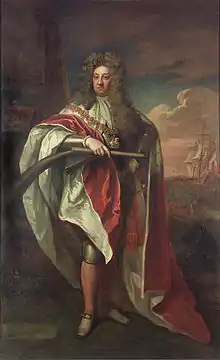
- Prince George of Denmark, husband of Queen Anne likewise never received the official style of Prince Consort, but was raised to the peerage of England as the Duke of Cumberland in 1689, several years before his wife's accession in 1702.
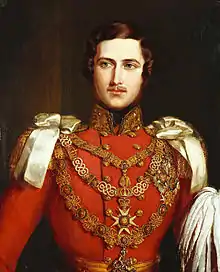
- Prince Albert of Saxe-Coburg and Gotha, husband of Queen Victoria, did not take an English peerage title but was granted the title of Prince Consort as a distinct title, in 1857, the only male consort in either the United Kingdom or its predecessor realms to have officially held the title. It was suggested at first that he would become king consort, but this was decided against by the Government.
- Prince Philip of Greece and Denmark, husband of Queen Elizabeth II, already raised to the peerage as Duke of Edinburgh in 1947, was made a Prince of the United Kingdom in 1957. He was not styled as Prince Consort.
Future consorts
If Charles, Prince of Wales ascends the throne, his current/second wife, Camilla, Duchess of Cornwall, will automatically take on the title and style pertaining to the queen consort unless legislation is passed to the contrary. It has been stated, however, that it is intended that she should be styled not as a queen consort, but as "princess consort"[1] although all references to "princess consort" were removed by both Buckingham Palace and Clarence House on their respective websites by the summer of 2018.[2] In 2020, however, Clarence House confirmed that plans for Camilla to adopt the style of princess consort remain unchanged.[3]
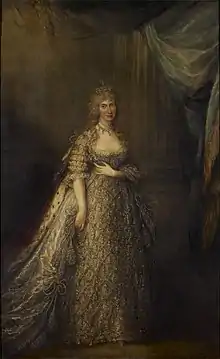
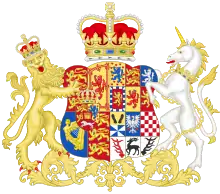
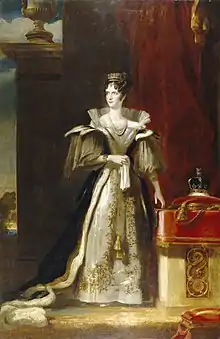
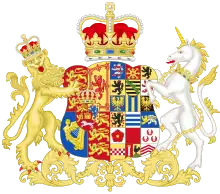
List of consorts



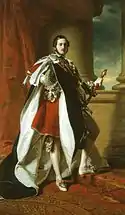

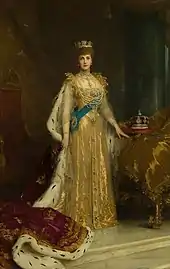
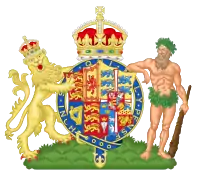
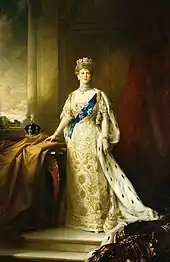
.jpg.webp)
Lists of consorts by tenure
.jpg.webp)
_-_George_III_and_Queen_Charlotte_-_RCIN_403546_-_Royal_Collection.jpg.webp)
| Rank | Consort | Tenure | Duration | Spouse | ||
|---|---|---|---|---|---|---|
| From | To | Days | Years, months, days | |||
| 1 | Prince Philip of Greece and Denmark | 6 February 1952 | 9 April 2021 | 25,265 | 69 years, 2 months, 3 days | Elizabeth II |
| 2 | Princess Charlotte of Mecklenburg-Strelitz | 8 September 1761 | 17 November 1818 | 20,888 | 57 years, 2 months, 9 days | George III |
| 3 | Princess Mary of Teck | 6 May 1910 | 20 January 1936 | 9,390 | 25 years, 8 months, 14 days | George V |
| 4 | Prince Albert of Saxe-Coburg and Gotha | 10 February 1840 | 14 December 1861 | 7,978 | 21 years, 10 months, 4 days | Victoria |
| 5 | Lady Elizabeth Bowes-Lyon | 11 December 1936 | 6 February 1952 | 5,535 | 15 years, 1 month, 26 days | George VI |
| 6 | Princess Caroline of Brandenburg-Ansbach | 11 June 1727 | 20 November 1737 | 3,815 | 10 years, 5 months, 9 days | George II |
| 7 | Princess Alexandra of Denmark | 22 January 1901 | 6 May 1910 | 3,391 | 9 years, 3 months, 14 days | Edward VII |
| 8 | Princess Adelaide of Saxe-Meiningen | 26 June 1830 | 20 June 1837 | 2,551 | 6 years, 11 months, 25 days | William IV |
| 9 | Princess Caroline of Brunswick-Wolfenbüttel | 29 January 1820 | 7 August 1821 | 556 | 1 year, 6 months, 9 days | George IV |
| 10 | Prince George of Denmark and Norway | 1 May 1707 | 28 October 1708 | 546 | 1 year, 5 months, 27 days | Anne |
References
- "Clarence House press release". Clarence House. 10 February 2005. Archived from the original on 24 June 2014. Retrieved 6 April 2018.
- Furness, Hannah (10 March 2018). "Could Camilla become Queen after all? Clarence House quietly removes statement about Duchess of Cornwall's future role". The Telegraph. Retrieved 6 April 2018.
- Sewell, Katie; Bacquart, Charlotte (8 April 2021). "Why Camilla will not be queen when Prince Charles becomes king". The Cornishman. Retrieved 14 April 2021.