Gonzalo Queipo de Llano
Gonzalo Queipo de Llano y Sierra (5 February 1875 – 9 March 1951) was a Spanish military leader who rose to prominence during the July 1936 coup and then the Spanish Civil War and the White Terror.
Gonzalo Queipo de Llano | |
|---|---|
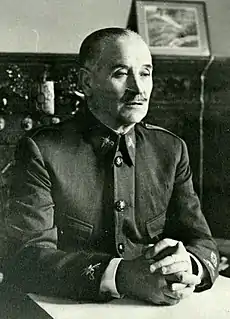 | |
| Born | 5 February 1875 Tordesillas, Kingdom of Spain |
| Died | 9 March 1951 (aged 76) Seville, Francoist Spain |
| Buried | La Macarena Basilica, Seville 37.402525°N 5.989407°W |
| Allegiance | .svg.png.webp) Kingdom of Spain (1896–1931) Kingdom of Spain (1896–1931).svg.png.webp) Spanish Republic (1931–1936) Spanish Republic (1931–1936).svg.png.webp) Francoist Spain (1936–1951) Francoist Spain (1936–1951) |
| Service/ | Spanish Army |
| Years of service | 1896–1939 |
| Rank | Captain General |
| Commands held | Nationalist Army of the South Captain General of Andalusia División General of Madrid |
| Battles/wars | Spanish–American War Rif War Spanish Civil War |
| Awards | Laureate Cross of Saint Ferdinand (Grand Cross) Order of Military Merit (Grand Cross) |
Biography
A career army man, Queipo de Llano was a brigadier general in 1923 when he began to speak out against the army and Miguel Primo de Rivera. He was demoted and had to serve three years in prison. However, he refused to stop his criticism even after his release and so he was dismissed altogether in 1928.
In 1930, he became a revolutionary, but on a failed attempt to overthrow King Alfonso XIII, he fled to Portugal. He returned to his native land in 1931 after the departure of Alfonso XIII and assumed command of the 1st Military District of the Spanish Republican Army. He was later appointed by Niceto Alcalá Zamora to the president's chief of the military staff (Queipo's daughter was married to a son of Alcalá Zamora).
Even as he rose in prominence, he remained critical of the shifting governments and joined a plot to overthrow the Popular Front government in May 1936.[1]
During the Spanish Civil War, Queipo de Llano secured the capture of Seville with a force of at least 4,000 troops and ordered mass killings. Later he made ridiculous claims, including that the city was defended by 100,000 armed communists and that the Nationalists took the city with as few as fifteen men. Frequently affected by alcohol - despite his liver damage - he made maniacal radio broadcasts throughout the war in explicit language, fabricating atrocities by unionists, anarchists and the left and encouraging equivalent violence and the sexual abuse of anyone associated of Nationalist opponents in retaliation. The military plans were drawn up and directed by José Cuesta Monereo - commander of the general staff - who also ordered journalists not to report Nationalist atrocities and to tone down Queipo de Llano's more shocking broadcast comments when in print. Manuel Díaz Criado, a drunken sociopath, was given the title of 'government military delegate' for Seville and Extremadura by Queipo de Llano. He was directly responsible for the thousands of murders that followed, reporting daily to Cuesta Monerero and Queipo de Llano; the latter tolerated his excesses until an incident when Queipo de Llano was forced by general Francisco Franco to remove him and apologise to the Portuguese vice-consul - an ally of the Nationalists - whom Diaz Criado had accused of spying. [2][3]
He was then appointed the commander of the Nationalist Army of the South. His influence began to decline in February 1938, when Franco named himself sole leader of the new state and appointed his brother-in-law Ramón Serrano Súñer as interior and propaganda minister. On 17 July 1939, at celebrations of the third anniversary of the Nationalist uprising, Franco awarded the Cross of San Fernando to the city of Valladolid. Queipo de Llano was miffed, believing that Seville - his domain - was more deserving and openly made abusive comments about Franco. Franco summoned him to Burgos for consultations but sent general Andrés Saliquet to Seville at the same time to take command. Queipo de Llano was dispatched on a mission to Rome, his perceived base now gone.[4]
Thereafter, he remained very bitter and outspoken about Franco and the Falange. His requests to return to Spain e.g. when his daughter was emigrating to Argentina, were carefully managed and his movements monitored. In April 1950, he was made a marquis specifically for the successful coup d'état in Seville, but he continued his snipes at Franco. He died on 9 March 1951, aged seventy-six, in his farmhouse in Gambogaz, Camas, Seville. His remains were placed in the chapel of Cristo de la Salvación in the basilica of Macarena, whose construction he promoted. In appreciation, the brotherhood of Esperanza Macarena named him an honorary older brother.[5]
See also
References
- Jackson, Gabriel. The Spanish Republic and the Spanish Civil War, 1931–1939. Princeton University Press. Princeton. 1967. p. 225.
- Preston, Paul. The Spanish Civil War: Reaction, Revolution and Revenge. Harper Perennial. London. 2006. p. 106.
- Preston, Paul. 2012. The Spanish Holocaust. Harper Press. London. p. 140-145,330–331.
- Beevor, Antony (2006). The Battle for Spain. London: Phoenix. p. 446.
- "Gonzalo Queipo de Llano y Sierra". dbe.rah.es. Retrieved 14 September 2021.
Further reading
- Antony Beevor (2006). The Battle for Spain. The Spanish Civil War 1936–1939. Penguin Books. 2006. ISBN 0-14-303765-X
- Tom Buchanan, (1997). Britain and the Spanish Civil War. Cambridge, United Kingdom: Cambridge University Press. ISBN 0-521-45569-3
- Gabriel Jackson, (1965). The Spanish Republic and the Civil War, 1931–1939. Princeton: Princeton University Press. ISBN 0-691-00757-8. OCLC 185862219, another edition, 1967.
- Minder, Raphael (October 15, 2018). "In Seville, Burial of Civil War Commander Reopens Decades-Old Wounds". The New York Times. ISSN 0362-4331.
- Stanley G. Payne (1970). The Spanish Revolution. London: Weidenfeld & Nicolson. ISBN 0-297-00124-8.
- Stanley G. Payne (2004). The Spanish Civil War, the Soviet Union, and Communism. New Haven; London: Yale University Press. ISBN 0-300-10068-X. OCLC 186010979.
- Stanley G. Payne, (1999). Fascism in Spain, 1923–1977. University of Wisconsin Press. ISBN 0-299-16564-7.
- Stanley G. Payne, (2008). Franco and Hitler: Spain, Germany, and World. New Haven, Connecticut: Yale University Press. ISBN 978-0-300-12282-4.
- Paul Preston. The Spanish Civil War: Reaction, Revolution and Revenge. Harper Perennial. London. (2006). ISBN 0-393-32987-9 / 0-393-32987-9 ISBN 978-0-393-32987-2.
- Paul Preston (2012). The Spanish Holocaust. New York: W. W. Norton & Company. (2012), ISBN 9780393064766.
- Ronald Radosh; Mary Habeck, Grigory Sevostianov (2001). Spain Betrayed: The Soviet Union in the Spanish Civil War with Mary R. Habeck and Grigorii Nikolaevich Sevostianov. New Haven and London: Yale University Press. ISBN 0-300-08981-3. OCLC 186413320
- Rúben Emanuel Serém (2012). Conspiracy, Coup d'État and Civil War in Seville (1936–1939): History and Myth in Francoist Spain (PDF). PhD dissertation. London: LSE.
- Hugh Thomas. The Spanish Civil War. Penguin Books. London. 2003, 4th edition. (1961, 1987, 2003). London: Penguin. ISBN 0-14-101161-0. OCLC 248799351.
External links
Authority control  | |
|---|---|
| General | |
| National libraries | |
| Other | |