RAF Transport Command
RAF Transport Command was a Royal Air Force command that controlled all transport aircraft of the RAF. It was established on 25 March 1943 by the renaming of the RAF Ferry Command, and was subsequently renamed RAF Air Support Command in 1967.
| Royal Air Force Transport Command | |
|---|---|
 | |
| Active | 25 March 1943–1 August 1967 |
| Country |  United Kingdom United Kingdom |
| Branch |  Royal Air Force Royal Air Force |
| Type | Command |
| Role | controlling Transport aircraft |
| Headquarters | RAF Upavon[1] Previously Harrow[2] |
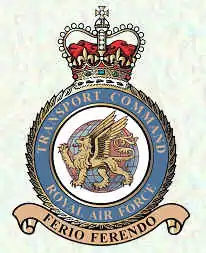
| Motto(s) | Latin: Ferio Ferendo ("I Strike by Carrying")[3] |
| Engagements | Second World War Cold War |
| Insignia | |
| crest heraldry | A golden griffon in front of a globe |
History
Second World War
During the Second World War, it at first ferried aircraft from factories to operational units and performed air transport. Later it took over the job of dropping paratroops from Army Cooperation Command as well.
In June 1944 the Command was made up of No. 38 Group RAF; No. 44 Group RAF; No. 45 Group RAF; No. 46 Group RAF; No. 216 Group RAF; No. 229 Group RAF;[4] No. 114 Wing RAF, and No. 116 Wing RAF at RAF Hendon.
No. 44 Group - HQ at Gloucester[2]
- Controlled airfields such as Bramcote, Filton, Hendon, Hurn, Kemble, Llandow, Lyneham, Melton Mowbray, Pershore, Portreath, Prestwick, St Mawgan and Talbenny
- Units included 105 OTU
No. 45 Group RAF - HQ at Dorval in Canada,[2] (the former Atlantic Ferry Organisation)
- No. 112 Wing at Dorval
- No. 113 Wing at Nassau
No. 46 Group RAF - HQ at Harrow Weald[2]
- Controlled airfields such as Blakehill Farm
- Units included 233 Sqn
No. 216 Group RAF HQ in Egypt
No. 229 Group RAF HQ at Delhi,[2] India (formed 1943-44);[5] controlled No. 177 Wing[2]
No. 114 Wing RAF - HQ at Accra in the Gold Coast,[2]
- Controlled airfields such as Heliopolis
- Units included No. 284 Wing
No. 116 Wing RAF at RAF Hendon, of which last supervised scheduled services to India.[6]
Post war
As the Second World War ended, on 7 May 1945, No. 4 Group RAF was transferred into the command, from Bomber Command, but disbanded in early 1948; No. 48 Group RAF was established,[7] but then disbanded on 15 May 1946; and No. 216 Group was transferred to RAF Mediterranean and Middle East.[8] The Command took part in several big operations, including the Berlin Airlift in 1948, which reinforced the need for a large RAF transport fleet.[9] The Handley Page Hastings, a four-engined transport, was introduced during the Berlin Airlift[10] and continued as a mainstay transport aircraft of the RAF for the next 15 years. In 1956, new aircraft designs became available, including the de Havilland Comet (the first operational jet transport), and the Blackburn Beverley. In 1959, the Bristol Britannia was introduced.[10]
During the 1960s the command was divided into three different forces:
- Strategic Force which operated the Comets, Britannias, VC-10s and Belfasts
- Medium Range Force which operated Beverleys, Hastings and Argosys
- Short Range Force which operated helicopters such as the Bristol Belvedere, Westland Whirlwind and Westland Wessex and fixed wing aircraft such as Scottish Aviation Pioneers, Scottish Aviation Twin Pioneers and Hawker Siddeley Andovers.
During the 1950s and 1960s Transport Command evacuated military personnel from the Suez Canal Zone prior and after the Suez Crisis of October–November 1956;[10] evacuated casualties from South Korea during the Korean War and from the Malaya during the Malayan Emergency; moved essential supplies to Woomera, South Australia, and ferried personnel and supplies out to Christmas Island for the UK's atomic bomb tests. In addition, Transport Command ran scheduled routes to military staging posts and bases in the Indian Ocean region, Southeast Asia and the Far East, to maintain contact between the UK and military bases of strategic importance. It also carried out special flights worldwide covering all the continents bar Antarctica. Many varied tasks were undertaken during the 1950s.
The 1960s saw a reduction of the RAF and a loss of independence of the former functional commands. Transport Command was renamed Air Support Command in 1967.[11]
Units
- The Airborne Forces Tactical Development Unit was formed at RAF Tarrant Rushton on 1 December 1943 and was disbanded on 14 January 1944 to become the Air Transport Tactical Development Unit.[12] This new unit was then disbanded on 31 August 1945 at RAF Netheravon to become the Transport Command Development Unit. This unit was disbanded at RAF Abingdon on 28 February 1950 to become the Air Transport Development Flight,[13] this new unit was disbanded on 14 October 1951 still at Abingdon to become the Transport Command Development Flight.[12] This unit was disbanded on 8 February 1957 at RAF Benson.[13]
- The Transport Command Aircrew Examining Unit was previously the Aircrew Testing and Grading Unit and was formed on 1 November 1945 at RAF Melbourne. It used a variety of transport aircraft until it was disbanded on 7 August 1946 at RAF Bramcote to become the Transport Command Examining Unit. This unit continued the work of the previous unit until it was disbanded on 23 June 1964 at RAF Benson, the unit then became the Transport Command Examining Staff until 1 August 1967 while still at RAF Benson became the Air Support Examining Unit[13]
- Transport Command Air Support Flight was formed on 1 February 1953 at RAF Abingdon but was shortly disbanded on 14 September 1954 to become No. 1312 (Transport Support) Flight[13]
- Transport Command Communication Flight was initially 'C' Flight of the Metropolitan Communication Squadron RAF and was separated doing May 1946 when it moved to RAF Upavon. At some point it became the Transport Command Communication Squadron and was disbanded on 1 April 1964 and was absorbed by the Western Communication Squadron RAF at RAF Upavon[13]
Groups
During its existence the command operated a number of groups:
Wings
During its existence the command operated a number of wings:
- No. 87 Wing RAF[16]
- No. 107 Wing RAF[17]
- No. 108 Wing RAF[17]
- No. 109 Wing RAF[17]
- No. 110 Wing RAF[17]
- No. 111 Wing RAF[17]
- No. 115 Wing RAF[17]
- No. 116 Wing RAF[17]
- No. 117 Wing RAF[17]
- No. 118 Wing RAF[17]
- No. 177 Wing RAF[18]
- No. 282 Wing RAF[19]
- No. 283 Wing RAF[19]
- No. 284 Wing RAF[19]
- No. 341 Wing RAF[19]
- No. 342 Wing RAF[19]
- No. 900 Wing RAF[19]
Aircraft operated
Aircraft type followed by airfield and RAF squadron number. Note: Does not include Detachments locations
- Armstrong Whitworth Argosy
- Akrotiri 70[20]
- Benson 105, 114, 215, 267
- Changi 215
- Khormaksar 105
- Muharraq 105
- Avro Anson
- Aston Down 187
- Benson 58
- Croydon 147
- Hawarden 173
- Hendon 31
- Khormaksar 8
- Seletar 81
- Tengah 81
- Avro York
- Abingdon 40, 51, 59, 242
- Bassingbourn 24, 40, 51, 59
- Holmsley South 246
- Lyneham 24, 99, 206, 242, 511
- Merryfield 242
- Oakington 24, 242
- Stradishall 51
- Topcliffe 24
- Waterbeach 24, 51, 242
- Blackburn Beverley
- Abingdon 47, 53,
- Changi 48
- Dishforth 30
- Eastleigh 30
- Khormaksar 84
- Muharraq 30
- Seletar 34
- Bristol Belvedere
- Khormaksar 26
- Odiham 26, 72
- Seletar 66
- Bristol Britannia
- Lyneham 99, 511
- Bristol Sycamore
- Aldergrove 118
- Andover 225
- Butterworth 110
- Khormaksar 84
- Kuala Lumpur 194
- Leconfield 228, 275
- Linton-on-Ouse 275
- Middle Wallop 651, 657
- Nicosia 103
- Northolt 32
- Odiham 225
- Thornaby 275
- Consolidated Liberator I (referred to solely as "Liberator" without the B-24 designation)
- de Havilland Comet
- Lyneham 216
- de Havilland Devon
- Hendon 31
- Douglas Dakota
- Aqir 215
- Croydon 147, 166
- Kabrit 70, 114, 215
- Kuala Lumpur 267
- Handley Page Hastings
- Abingdon 24, 47, 53
- Akrotiri 70
- Changi 48
- Colerne 24, 36, 114, 511
- Dishforth 47, 297
- Lyneham 24, 36, 53, 99, 242, 511
- Nicosia 70
- Topcliffe 24, 47, 53, 297
- Watton 51, 97, 115, 116, 151
- Wyton 51
- Hawker Siddeley Andover
- Abingdon 46
- Khormaksar 84
- Seletar 52
- Lockheed C-130 Hercules
- Lyneham 36
- Percival Pembroke
- Kuala Lumpur 267
- Seletar 81
- Tengah 81
- Scottish Aviation Pioneer
- Dishforth 215
- Khormaksar 78
- Kuala Lumpur 209, 267
- Nicosia 230
- Odiham 230
- Seletar 209
- Upavon 230
- Scottish Aviation Twin Pioneer
- Benson 21
- Eastleigh 21
- Khormaksar 21, 78
- Kuala Lumpur 209
- Muharraq 152
- Odiham 230
- Seletar 209
- Upavon 230
- Short Belfast
- Brize Norton 53
- Fairford 53
- Vickers Valetta
- Abu Sueir 114
- Changi 48,
- Fayid 70, 216
- Kabrit 114, 216
- Lyneham 24, 216
- Nicosia 70, 114
- Oakington 24
- Vickers VC10
- Brize Norton 10
- Fairford 10
- Vickers Varsity
- Aston Down 187
- Westland Dragonfly
- Kuala Lumpur 194
- Sembawang 194
- Westland Whirlwind
22, 28, 32, 84, 103, 110, 202, 225, 228, 230, 275,
18, 28, 72, 78, 84, 103Operation Becher's Brook
Becher's Brook was a major operation of Transport command – the ferrying of 400 Canadair Sabre fighters from North America to the UK. This required pilots and ground crew to be transported to Canada. The Sabres were flown via Keflavik (Iceland) on to Shetland and from there to mainland Scotland.
North Greenland Expedition
Transport Command supported the British North Greenland expedition a research expedition over two years on the Greenland ice.
Commanders-in-Chief
Commanders-in-Chief included:[21]
- 25 March 1943 – Air Chief Marshal Sir Frederick Bowhill
- 15 February 1945 – Air Marshal Sir Ralph Cochrane
- 24 September 1947 – Air Marshal Sir Brian Baker
- 31 March 1950 – Air Marshal Sir Aubrey Ellwood
- 1 January 1952 – Air Vice Marshal Robert Blucke
- 3 June 1952 – Air Vice Marshal Sir Charles Guest
- 15 March 1954 – Air Vice Marshal Sir George Beamish
- 15 October 1955 – Air Marshal Sir Andrew McKee
- 16 May 1959 – Air Marshal Sir Denis Barnett
- 30 April 1962 – Air Marshal Sir Edmund Hudleston
- 1 December 1963 – Air Marshal Sir Kenneth Cross
- 27 January 1967 – Air Marshal Sir Thomas Prickett
See also
References
 |
Wikimedia Commons has media related to RAF Transport Command. |
Citations
- Delve 1994, p. 85.
- Delve 1994, p. 74.
- Pine, L.G. (1983). A dictionary of mottoes (1 ed.). London: Routledge & Kegan Paul. p. 74. ISBN 0-7100-9339-X.
- "Catalogue description India: Formation of 229 Group".
- "Catalogue description India: Formation of 229 Group".
- Leo Niehorster, Transport Command, 6 June 1944, accessed June 2020.
- "Catalogue description H.Q., 48 Group: Formation".
- "Catalogue description No.216 Group: Transfer of control from Transport Command to Mediterranean and Middle East".
- Berlin Airlift Archived 4 April 2004 at the Wayback Machine
- No. 99 Squadron
- British Military Aviation in 1967 Archived 10 October 2008 at the Wayback Machine RAF Museum
- Lake 1999, p. 25.
- Lake 1999, p. 288.
- Delve 1994, p. 127.
- Delve 1994, p. 128.
- Delve 1994, p. 134.
- Delve 1994, p. 135.
- Delve 1994, p. 136.
- Delve 1994, p. 137.
- Jefford 1988, p. 46.
- Air of Authority – A History of RAF Organisation – RAF Home Commands formed between 1939 – 1957 Archived 11 January 2011 at the Wayback Machine
Bibliography
- Delve, K (1994). The Source Book of the RAF. Shrewsbury, UK: Airlife Publishing Ltd. ISBN 1-85310-451-5.
- Jefford, C.G. (1988). RAF Squadrons. A comprehensive record of the movement and equipment of all RAF squadrons and their antecedents since 1912. Shrewsbury: Airlife. ISBN 1-85310-053-6.
- Kenneth Cross, G Baker, "Transport Command Today," RUSI Journal, 1965
- Lake, A (1999). Flying units of the RAF. Shrewsbury: Airlife. ISBN 1-84037-086-6.
- M Milner, Review of Carl A. Christie, "Ocean Bridge: The History of RAF Ferry Command", The Canadian Historical Review, 1997
- Wilson, Keith. RAF Transport Command: A Pictorial History. Amberley Publishing Limited, 15/06/2017 ISBN 1445665999
- Wynn, Humphrey. Forged in War: A History of Royal Air Force Transport Command, 1943–1967. London: Her Majesty's Stationery Office, 1996. ISBN 0-11-772756-3.
- RAF Historical Society Journal No 22
External links
| Formations and units |
| | ||||||
|---|---|---|---|---|---|---|---|---|
| Branches and components | ||||||||
| Reserve forces | ||||||||
| Associated civil organisations | ||||||||
| Equipment | ||||||||
| Personnel | ||||||||
| Appointments | ||||||||
| Symbols and uniform | ||||||||