Regional Greenhouse Gas Initiative
The Regional Greenhouse Gas Initiative (RGGI, pronounced "Reggie") is the first mandatory market-based program in the United States to reduce greenhouse gas emissions. RGGI is a cooperative effort among the states of Connecticut, Delaware, Maine, Maryland, Massachusetts, New Hampshire, New Jersey, New York, Rhode Island, Vermont, and Virginia to cap and reduce carbon dioxide (CO2) emissions from the power sector.[1] RGGI compliance obligations apply to fossil-fueled power plants 25 megawatts (MW) and larger within the 11-state region.[2] As of 2021, Pennsylvania is pending RGGI membership with an anticipated start in early 2022,[3] and North Carolina is currently considering joining RGGI.
 Participants Pending | |
| Abbreviation | RGGI or ReGGIe |
|---|---|
| Established | 2009 |
| Type | Intergovernmental organization |
| Purpose | Combating global warming |
| Headquarters | New York, NY |
Membership | Participants: Connecticut, Delaware, Maine, Maryland, Massachusetts, New Hampshire, New Jersey, New York, Rhode Island, Vermont, Virginia Pending: Pennsylvania |
| Website | Regional Greenhouse Gas Initiative |
RGGI establishes a regional cap on the amount of CO2 pollution that power plants can emit by issuing a limited number of tradable CO2 allowances. Each allowance represents an authorization for a regulated power plant to emit one short ton of CO2. Individual CO2 budget trading programs in each RGGI state together create a regional market for CO2 allowances.[4]
The RGGI states distribute over 90 percent of allowances through quarterly auctions.[5] These allowance auctions generate proceeds, which participating states are able to invest in strategic energy and consumer benefit programs. Programs funded through RGGI have included energy efficiency, clean and renewable energy, greenhouse gas abatement, and direct bill assistance.
An initial milestone program's development occurred in 2005, when seven states signed a Memorandum of Understanding (MOU) announcing an agreement to implement RGGI.[6] The RGGI states then established individual CO2 budget trading programs, based on the RGGI Model Rule. The first pre-compliance RGGI auction took place in September 2008, and the program became effective on January 1, 2009. The RGGI program is currently in its fifth three-year compliance period, which began January 1, 2021.[7]
Track record and benefits
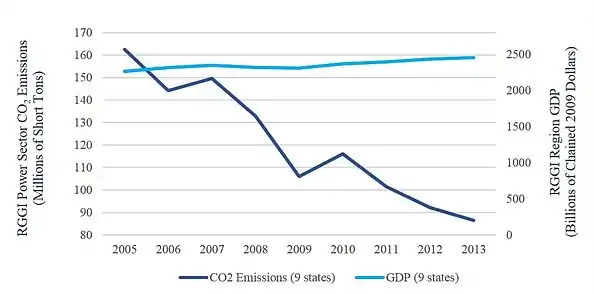
RGGI states have reduced their carbon emissions while still experiencing economic growth. Power sector carbon emissions in the RGGI states have declined by over 50% since the program began.[8] Media have reported on RGGI's success as a nationally relevant example showing that economic growth can coincide with pollution reductions.[9][10][11] In a report on RGGI, the Congressional Research Service has also said that, "experiences in RGGI may be instructive for policymakers seeking to craft a national program."[12]
While multiple factors contribute to emissions trends, a 2015 peer-reviewed study found that RGGI has contributed significantly to the decline in emissions in the nine-state region.[13] Alternate factors considered by the study included state Renewable Portfolio Standard (RPS) programs, economic trends, and natural gas prices.
Other independent reports have analyzed RGGI's economic impact. For example, two reports by the Analysis Group studied RGGI's first and second three-year compliance periods. They found that the effects of RGGI's first three years are generating in $1.6 billion in net economic benefit and 16,000 job-years,[14] and RGGI's second three years are generating $1.3 billion in net economic benefit and 14,700 job-years.[15] These figures do not include co-benefits such as public health improvements or avoided climate change impacts.
A Clean Air Task Force (CATF) study investigated public health benefits arising from the RGGI states' shift to cleaner power generation.[16] The study found that the RGGI states transition to cleaner energy is saving hundreds of lives, preventing thousands of asthma attacks and reducing medical impacts and expenses by billions of dollars.
Environmental
RGGI has the potential to lower Pennsylvania's emissions of many pollutants dramatically.
Health
The reduction in state air pollution can potentially result in significant health benefits through 2030.
Economic
The adoption of RGGI also has the potential to provide economic benefits through an increase in jobs, personal income, and $2 billion in gross state product through 2030.[17]
RGGI Market[18]
The highs and lows of the RGGI market can be largely attributed to declining emissions and allowance oversupply, price controls, policy intervention, and the Clean Power Plan of 2015 by the Obama Administration. RGGI has faced its fair share of obstacles, like any other emissions trading program; one of these is an oversupplied market. The oversupplied market related to RGGI can be traced back to the transition from coal to natural gas as well as a weak economy during the time of implementation. Because RGGI has a low price floor, there is no scarcity of allowances. In the world of carbon offset credits, allowances are shared through a cap-and-trade system to limit harmful emissions and catalyze pollution cuts. This cap-and-trade system is proving successful globally as countries are allowed to set more ambitious climate goals and countries across the world are seeing downward trends in emissions.
Key Trends
A few of the key trends used to measure the success of RGGI include emission reduction, electricity prices, fossil fuel generation, and economic growth. Given there are many factors that go into these trends, it is not always easy to directly relate success to just one factor like RGGI.
Studies have found that, in terms of emission reduction, carbon emissions were down 37% in 2015 in comparison to 2008, the year before the implementation of the RGGI. The effects of RGGI on electricity prices is more difficult to pinpoint because there are many factors that go into the changing prices in electricity. Electricity prices have soared in recent years and continue to increase, but it is evident that RGGI states are reflecting lower jumps in electricity prices than non-RGGI states. Electric generation has noticed a shift from fossil fuels to a natural gas that is much lower in price. Since RGGI was put into place, the generation of natural gas has increased drastically, while emitting around 45% less carbon than coal and around 35% less carbon than fuel oil. Economic growth is arguably one of the easier trends to link to direct impacts of RGGI. RGGI states are seeing a raise in revenue as they are able to reinvest in programs that promote clean energy.
RGGI caps
The RGGI CO2 cap represents a regional budget for CO2 emissions from the power sector. The RGGI states include two interim adjustments to the RGGI cap to account for banked CO2 allowances. The cap declined 2.5 percent each year until 2020. Initial reductions were planned as follows:[19]
The RGGI caps and adjusted caps decreased annually from 2014-2020, except in 2020 given the addition of New Jersey.[20]
| Year | Base Cap (Tons of CO2) | Adjusted cap |
|---|---|---|
| 2014 | 91,000,000 | 82,792,336 |
| 2015 | 88,725,000 | 66,833,592 |
| 2016 | 86,506,875 | 64,615,467 |
| 2017 | 84,344,203 | 62.452,795 |
| 2018 | 82,235,598 | 60,344,190 |
| 2019 | 80,179,708 | 58,288,301 |
| 2020 | 96,175,215 | 74,283,807 |
The RGGI states also established a Cost Containment Reserve (CCR) of CO2 allowances that creates a fixed additional supply of CO2 allowances that are only available for sale if CO2 allowances prices exceed certain price levels - $4 in 2014, $6 in 2015, $8 in 2016, and $10 in 2017, rising by 2.5 percent each year thereafter. The CCR was 5 million CO2 allowances in 2014, and 10 million CO2 allowances each year thereafter.
In August 2017, RGGI states "agreed to reduce power plant emissions by another 30 percent from 2020 to 2030. The plan, which must be approved by each state...would lower these emissions by more than 65 percent since 2009, when the states began setting annual caps." The RGGI began negotiating this move before the 2016 presidential election. The new caps for 2021-2030 are as follows:[21]
| Year | Base Cap (Tons of CO2) |
|---|---|
| 2021 | 75,147,784 |
| 2022 | 72,872,784 |
| 2023 | 70,597,784 |
| 2024 | 68,322,784 |
| 2025 | 66,047,784 |
| 2026 | 63,772,784 |
| 2027 | 61,497,784 |
| 2028 | 59,222,784 |
| 2029 | 56,947,784 |
| 2030 | 54,672,784 |
Compliance
RGGI compliance obligations apply to fossil-fueled power plants 25MW and larger within the RGGI region. As of 2021, there were 203 such covered sources.[22]
Under RGGI, sources are required to possess CO2 allowances equal to their CO2 emissions over a three-year control period. A CO2 allowance represents a limited authorization to emit one ton of CO2. The first three-year control period took effect on January 1, 2009, and extended through December 31, 2011. The second three-year control period took effect on January 1, 2012, and extended through December 31, 2014. The third three-year control period took effect on January 1, 2015, and extended through December 31, 2017. The fourth three-year control period took effect on January 1, 2018, and extended through December 31, 2020. The fifth three-year control period took effect on January 1, 2021, and extends through December 31, 2023.[23]
As of April 2021, 97.5 percent of regulated power plants had met their compliance obligations for the fourth control period.[22]
Quarterly regional auctions
The first pre-compliance auction of RGGI CO2 allowances took place in September 2008. Regional auctions are held on a quarterly basis and are conducted using a sealed-bid, uniform price format.[24] Since 2008, the RGGI states have held 53 auctions generating over $4.35 billion in proceeds. Auction clearing prices have ranged from $1.86 to $9.30.[25]
Any party can participate in the RGGI CO2 allowance auctions, provided they meet qualification requirements, including provision of financial security. Auction rules limit the number of CO2 allowances that associated entities may purchase in a single auction to 25 percent of the CO2 allowances offered for sale in that auction.[26]
The RGGI auctions are monitored by an independent market monitor, Potomac Economics. Potomac Economics monitors the RGGI allowance market in order to protect and foster competition, as well as to increase the confidence of participants and the public in the allowance market.[27] The independent market monitor has found no evidence of anti-competitive conduct, and no material concerns regarding the auction process, barriers to participation in the auctions, competitiveness of the auction results, or the competitiveness of the secondary market for RGGI CO2 allowances.[28]
Market participants can also obtain CO2 allowances in secondary markets, such as the Intercontinental Exchange (ICE), or in over-the-counter transactions.[29] The independent market monitor provides quarterly reports on the secondary market for RGGI allowances.[30]
Investment of auction proceeds
The RGGI states have discretion over how they invest RGGI auction proceeds. They have reinvested proceeds, generated by RGGI auctions in a wide variety of programs. Programs funded through RGGI investment in energy efficiency, renewable energy, direct bill assistance, and greenhouse gas abatement have benefited more than 3.7 million participating households and 17,800 participating businesses. These investments have saved participants money on their energy bills, created jobs, and reduced pollution. In the period 2008 to 2014, programs funded by RGGI investments avoided the use of 2.4 TWh of electricity, 1.6 TWh (5.3×10¹² British thermal units) of fossil fuel, and the release of 1.7×10⁶ short tons (1.5×10⁶ tonnes) of carbon dioxide. Over their lifetime, programs funded by RGGI investments estimate to avoid the use of 20.6 TWh of electricity, 22.3 TWh (76.1×10¹² British thermal units) of fossil fuel, and the release of 15.4×10⁶ short tons (1.40×10⁷ tonnes) of carbon dioxide.[31]
Energy efficiency represents a large portion of RGGI investments. Ultimately, all electricity consumers, not only those who make upgrades, benefit from energy efficiency programs. For example, investing in efficiency programs - such as weatherizing houses - reduces the amount of electricity used. The decrease in electricity demand actually reduces the overall price of electricity. That means the costs go down for everyone, not just someone who installed new, efficient windows.[32]
Program review
The RGGI participating states have committed to comprehensive, periodic program review to consider program successes, impacts, and design elements. The RGGI states are currently undergoing a 2021 Program Review, which includes regularly scheduled public stakeholder meetings.[33]
The previous RGGI Program Reviews took place in 2012 and 2016, and resulted in several updates to the program. These changes included a 45 percent reduction in the RGGI cap, and the introduction of the Cost Containment Reserve (CCR).[34] The CCR and the reduced cap took effect in 2014.
History
In 2003, governors from Connecticut, Delaware, Maine, Massachusetts, New Hampshire, New Jersey, New York, Rhode Island, and Vermont began discussions to develop a regional cap-and-trade program addressing carbon dioxide emissions from power plants.
On December 20, 2005, seven of those states announced an agreement to implement the Regional Greenhouse Gas Initiative, as outlined in a Memorandum of Understanding (MOU) signed by the Governors of Connecticut, Delaware, Maine, New Hampshire, New Jersey, New York, and Vermont. The MOU, as amended, provides the outlines of RGGI, including the framework for a Model Rule.
In August 2006, the original seven MOU signatory states published a Model Rule, which provided a regulatory framework for the development of individual state regulatory and/or statutory proposals. The model set of regulations detailed the proposed program, as outlined in the MOU.
In early 2007, Massachusetts and Rhode Island, which had participated in the early development of RGGI, signed the MOU, as did Maryland later that year.
Through statuses or regulations based on the RGGI Model Rule, each state established individual CO2 Budget Trading Programs. Together, these composed a regional cap and market for allowances. Each state's CO2 Budget Trading Programs limits emissions of CO2 from electric power plants, issues CO2 allowances, and establishes participation in regional CO2 allowance auctions.
The first compliance period for each state's linked CO2 Budget Trading Program began January 1, 2009. On November 29, 2011, New Jersey withdrew from the MOU, effective January 1, 2012.[35] Groups such as Acadia Center have since reported on lost revenue resulting from New Jersey's departure, and argued for renewed participation.[36] After the election of governor Phil Murphy in 2017, New Jersey began to make preliminary moves to rejoin RGGI.[37] New Jersey reentered the RGGI under an executive order on January 29, 2018.[38]
After the 2017 election of Governor Ralph Northam in Virginia, the state began to make preliminary moves to join RGGI.[39] However, the move was stopped in 2019 when the Republican-controlled state legislature wrote a provision in the budget bill prohibiting the state from joining RGGI.[40] The move to join RGGI was re-introduced as part of the 2020 General Assembly. With a democratic majority in both the House of Delegates and the General Assembly, the measure passed and was signed into law. [41] Virginia effectively joined RGGI on January 1, 2021.[42]
In October 2019, Pennsylvania Governor Tom Wolf ordered his administration to start working on regulations to bring Pennsylvania into the RGGI. The Governor's administration plans to write regulations for the cap-and-trade program under its existing authority to regulate air pollution, although the process would eventually require approval from the state legislature.[43] The earliest Pennsylvania could reasonably join RGGI and see the program take effect is 2021.
Overview[44]
In September of 2020, Governor Wolf vetoed a bill (H.B. 2025) that would restrict his administrations ability to take part in RGGI without lawmaker's inputs.[45] Wolf vetoed the bill because he believes that the imminent effects of climate change outweighs other issues. Wolf's decision was heavily influenced by the economic and environmental benefits of other states that are already in the RGGI pact. On July 13th, 2021 the Environmental Quality Board voted in favor (15-4) for the last regulation that would have Pennsylvania join RGGI.
Pennsylvania's support for RGGI is imperfect. Concerns regarding higher energy costs, outsourcing energy production, and reduction in jobs have all been raised by legislators. Senator Gene Ya claimed that Pennsylvania's RGGI was only a "superficial stab at addressing climate change." As of July 28, 2021 Pennsylvania's membership in RGGI was not finalized. In order for it to be finalized and legislation to be passed, the IRRC(Independent Regulatory Review Commission must approve membership. The IRRC will evaluate Pennsylvania based on whether or not the proposed rule will align with public interest. On February 16 of 2021 the IRRC urged the EQB to delay their decision on RGGI membership. If the IRRC does approve Pennsylvania's membership, the regulation will undergo a final review by the Pennsylvania Attorney General. This final review will allow the attorney general to determine whether or not the regulation complies with existing law.
Legislation Opposing RGGI
A number of bills relating to the opposition of RGGI in Pennsylvania have been introduced. One of the bills is H.B. 637, which attempts to prohibit Governor Wolf and the DEP from taking actions surrounding cap-and-trade programs(which would include RGGI) without legislative approval.[46] This bill was then recommitted to the House Rules Committee on June 8, 2021. Another bill that gained traction in regards to the opposition of RGGI Introduction was S.B. 119, which also requires approval of RGGI membership. As of the end of the summer of 2021, no further action had been taken on this bill.
If either H.B. 637 or S.B. 119 is approved by the general assembly, Governor Wolf will likely veto legislation, as Wolf vetoed a similar bill in 2020.
RGGI Companion Bills
In response to and in tandem with the pending opposing legislation, two companion bills have been introduced to appropriate funds from the RGGI cap-and-trade programs. S.B. 15 and H.B. 1565 have been proposed with Governor Wolf's support. This is intended to address the potential loss of capital those who do not support introduction of RGGI expect. These bills specifically address allocation of funds for RGGI.
See also
 Energy portal
References
- "Welcome". www.rggi.org. RGGI, Inc.
- "RGGI Fact Sheet" (PDF). RGGI, Inc.
- "RGGI". Department of Environmental Protection. Retrieved 19 September 2020.
- "Program Design". RGGI, Inc.
- "RGGI Auctions Fact Sheet" (PDF). RGGI, Inc.
- "Program Design". RGGI, Inc.
- "Compliance". RGGI, Inc.
- "RGGI 101 Fact Sheet" (PDF). rggi.org. September 2021.
- Fairfield, Hannah (June 6, 2014). "Best of Both Worlds? Northeast Cut Emissions and Enjoyed Growth". The New York Times.
- "Obama's Power Plant Rules Can Work". The Baltimore Sun. August 3, 2015.
- "Proof That a Price on Carbon Works". The New York Times. January 19, 2016.
- Ramseur, Jonathan L. (April 2016). "The Regional Greenhouse Gas Initiative: Lessons Learned and Issues for Congress" (PDF).
- Murray, Brian C.; Maniloff, Peter T. (August 2015). "Why Have Greenhouse Emissions in RGGI States Declined? An Econometric Attribution to Economic, Energy Market, and Policy Factors" (PDF). Energy Economics. 51: 581–589. doi:10.1016/j.eneco.2015.07.013.
- "The Economic Impacts of the Regional Greenhouse Gas Initiative on Ten Northeast and Mid-Atlantic States" (PDF). Analysis Group. November 2011.
- "The Economic Impacts of the Regional Greenhouse Gas Initiative on Nine Northeast and Mid-Atlantic States" (PDF). Analysis Group. July 2015.
- Banks, Jonathan; Marshall, David (July 2015). "Regulation Works: How science, advocacy and good regulations combined to reduce power plant pollution and public health impacts; with a focus on states in the Regional Greenhouse Gas Initiative". Clean Air Task Force.
- "RGGI". Department of Environmental Protection. Retrieved 2021-11-20.
- "Regional Greenhouse Gas Initiative Status Report Part I: Measuring Success". Acadia Center. Retrieved 2021-09-30.
- "Investment of RGGI Proceeds Through 2013 (Published April 2015)" (PDF). RGGI. Retrieved 5 December 2017.
- "The RGGI CO2 Cap". RGGI, Inc.
- Abel, David (23 August 2017). "Nine states aggressively step up plans to cut emissions". Boston Globe. Retrieved 5 December 2017.
- "RGGI States Release Fourth Control Period Compliance Report" (PDF). rggi.org. RGGI, Inc. April 2, 2021. Retrieved December 2, 2021.
- "Compliance". RGGI, Inc.
- "RGGI Auctions Fact Sheet" (PDF). RGGI, Inc.
- "Auction Results". RGGI, Inc.
- "RGGI Auctions Fact Sheet" (PDF). RGGI, Inc.
- "Market Monitor Reports". RGGI, Inc.
- "Release: Annual Report on the Market for RGGI CO2 Allowances, 2014" (PDF). RGGI, Inc. May 5, 2015.
- "Fact Sheet: RGGI CO2 Allowance Auctions" (PDF). RGGI, Inc.
- "Market Monitor Reports". RGGI, Inc.
- "Delaware and the regional greenhouse gas initiative (RGGI)" (PDF). Sierra Club. Retrieved November 25, 2019.
- Page, Samantha. "The Northeast's Electricity Bills Have Dropped $460 Million Since They Started Paying For Carbon".
- "Program Review | RGGI, Inc". www.rggi.org. Retrieved 2021-12-03.
- "RGGI States Propose Lowering Regional CO2 Emissions Cap 45%, Implementing a More Flexible Cost-Control Mechanism" (PDF). RGGI, Inc. February 7, 2013.
- "Program Design Archive". RGGI, Inc.
- "New Jersey and RGGI: Potential Benefits of Renewed Participation" (PDF). Acadia Center. March 2015.
- Skahill, Patrick (November 9, 2017). "With Christie Out, New Jersey Poised To Rejoin New England In Climate Pact". WNPR. Retrieved January 29, 2018.
- "Murphy signs executive order to reenter Regional Greenhouse Gas Initiative". NJTV. January 29, 2018. Retrieved January 29, 2018.
- "Virginia moving forward with cap-and-trade plan soon after Democratic win". Washington Examiner. 2017-11-09.
- Walton, Robert (May 3, 2019). "Virginia entry to regional GHG initiative blocked as governor declines to veto budget language". Utility Dive. Retrieved June 22, 2019.
- Vogelsong, Sarah (April 14, 2020). "Virginia lawmakers agreed to join a regional carbon market. Here's what happens next". The Virginia Mercury. Retrieved April 14, 2020.
- Manzagol, O. Nilay (March 23, 2021). "CO2 emissions prices in the Northeast states reached record levels in most recent auction". Energy Information Administration. Retrieved April 14, 2021.
- Levy, Marc (3 October 2019). "Big greenhouse gas emitter moves to join climate initiative". Associated Press. Retrieved 11 November 2019.
- "IRRC". www.irrc.state.pa.us. Retrieved 2021-09-30.
- Square, Delphine Luneau | The Center. "Wolf vetoes bill that would have required lawmakers' input to join regional climate pact". The Center Square. Retrieved 2021-09-30.
- "Pennsylvania Takes Next Step Toward Cap-and-Trade Amid Resistance". JD Supra. Retrieved 2021-09-30.
External links
- Regional Greenhouse Gas Initiative official website
- New England Governors/Eastern Canadian Premiers Climate Change Action Plan
- Pew Center on Global Climate Change: Summary of regional greenhouse gas initiatives
- Regional Greenhouse Gas Registry
- International Carbon Action Partnership
- The Climate Registry