Recreational vehicle
A recreational vehicle, often abbreviated as RV, is a motor vehicle or trailer which includes living quarters designed for accommodation.[1] Types of RVs include motorhomes, campervans, coaches, caravans (also known as travel trailers and camper trailers), fifth-wheel trailers, popup campers, and truck campers.

Features

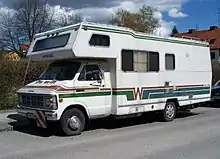
Typical amenities of an RV include a kitchen, a bathroom, and one or more sleeping facilities. RVs can range from utilitarian – containing only sleeping quarters and basic cooking facilities – to luxurious, with features like air conditioning (AC), water heaters, televisions and satellite receivers, and quartz countertops, for example.
RVs can either be trailers (which are towed behind motor vehicles) or self-motorized. Most RVs are single-deck; however, double-deck RVs also exist. To allow a more compact size while in transit, larger RVs often have expandable sides (called slide-outs) or canopies.
History
An early type of caravan is the horse-drawn covered wagon, which from circa 1745 played a significant part in opening up of the interior of the North American continent to white settlement.
The first motor home was built in 1915. It was built from a three-ton Packard truck, could sleep 11 people, and was 28 feet long.[2] By the 1920s the RV was well established in the United States, with RV camping clubs established across the country, despite the unpaved roads and limited camping facilities.[3] The first fifth wheel trailer was built in 1917.[2]
Several companies began manufacturing house trailers (called trailer coaches at the time). Airstream is one such company. In the 1950s, RVs expanded and became more luxurious. Two-story models were created with separate bedrooms.[2]
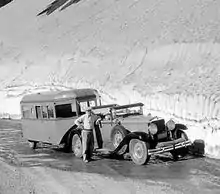 1933 car and tourist observation trailer
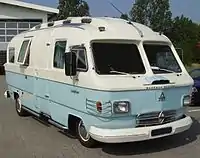 1970s Hanomag-Henschel Orion
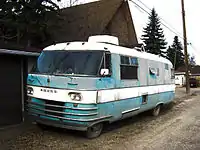 1970s Dodge Travco
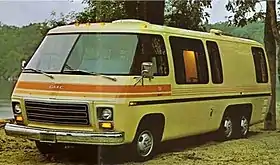 1973 GMC Motorhome
Industry
In the U.S., about 85 percent of recreational vehicles sold are manufactured in Indiana,[4] and roughly two-thirds of that production in Elkhart County, which calls itself "the RV Capital of the World", population 206,000. The industry has US$32.4 billion annual economic impact in Indiana, pays US$3.1 billion in taxes to the state and supports 126,140 jobs and US$7.8 billion in wages, according to the RV Industry Association.[5]
The recreational vehicle industry around Elkhart is part of a large network of related transport equipment companies, including utility trailer makers and specialty bus manufacturers, who source from the same supply chains.[4] The industry has taken hits from U.S. tariffs on steel and aluminum and other duties on RV parts made in China, from plumbing fixtures to electronic components to vinyl seat covers. Tariff-related price hikes forced manufacturers to pass on some of the increased costs through higher RV prices, which in turn has contributed to slower sales.[4] Shipments of RVs to dealers fell 22% percent in the first five months of 2019, compared to the same period a year earlier, after dropping 4% in 2018.[4]
Usage
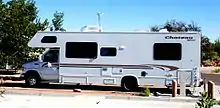
.jpg.webp)
RVs are most commonly used for living quarters while traveling. People may choose to take a road trip in their RV and use the RV to sleep in, rather than a hotel room. They may even decide to tow their car from the back of the RV[7] so they can use that to travel around easier when they reach their destination.
Although the most common usage of RVs is as temporary accommodation when traveling, some people use a RV as their main residence. In the United States and Canada, traveling south each winter to a warmer climate is referred to as snowbirding. In Australia, the slang term for a retired person who travels in a recreational vehicle is a "grey nomad".[8]
Living in an RV has become increasingly popular. In fact, one million Americans live in an RV.[9] While it is legal in all of the United States to live in an RV, there are laws around where you can park your RV and how long it can be parked for in certain areas.
Some owners fit solar panels to the roof of their RV.[10]
Usage of RVs is common at rural festivals such as Burning Man.[11]
Moisture and condensation
Moisture is a common problem in RVs. Moisture can result from breathing by the inhabitants as well as water vapor from cooking or drying of clothes. Rain water entering the RV can also be a cause.
High humidity can result in a poor indoor climate. In addition, moisture will often condense on windows since they are usually the coldest surfaces inside the vehicle. The condensation may then drip down into the wall in case the window frame is not sufficiently waterproof, potentially causing a growth of mold.
Aeration, ventilation, and heating are used to combat moisture. Cooking and drying clothes outdoors may also help. Dehumidifiers can be used to lower the humidity, but will not remove the underlying cause and as such can be viewed as a temporary solution. Extra thermal insulation is seldom a practical solution in RVs since there usually isn't enough space to make the insulation thick enough to prevent condensation and associated mold growth.
Demographics
United States
As of 2016, the average age of RV owners in the United States was 45, a three-year decrease since 2015.[12] Per 2020 research reports, more millennials are interested in buying RVs due to their increased demand for camping and outdoor recreational activities, especially in the US.[13]
Due to the COVID-19 pandemic sales of RVs in the United States have increased and as of March 2021, 11.3 million households own an RV, which is a 26 percent increase over the past ten years. In the month of October 2021, 58,000 RVs were manufactured in North America, the most ever in a single month.[14]
See also
References
- "Recreational Vehicle". www.fema.gov. Retrieved 4 March 2018.
- Leah (13 May 2015). "A Complete RV History". RVshare.com. Retrieved 5 May 2021.
- "The brief history of RVs in America and the world". WM-AW based upon RV/MH Heritage Foundation. Retrieved 10 June 2017.
- Aeppel, Timothy (18 July 2019). "Trump's tariffs trip up the all-American RV industry". Reuters. Retrieved 19 August 2019.
- Burris, Alexandria (19 August 2019). "Recession fears are rising. Here's the status of economic bellwether Elkhart, Indiana". Indianapolis Star. Retrieved 19 August 2019.
- Cattanach, Jamie (12 April 2021) [25 August 2017]. "RV Classes: RV Motorhome Classes Explained". RVshare. Retrieved 22 January 2020.
- "Best Cars To Tow Behind RVs and The Towing Guide". Edmunds. 25 January 2021.
- "grey nomad". Collins English Dictionary (Complete and Unabridged 12th ed.). HarperCollins Publishers. 2014 – via The Free Dictionary.
- "1 million Americans live in RVs. Meet the 'modern nomads.'". The Washington Post. 5 March 2021.
- Wittbrodt, Ben; Laureto, John; Tymrak, Brennan; Pearce, Joshua M. (2015), "Distributed manufacturing with 3-D printing: A case study of recreational vehicle solar photovoltaic mounting systems", Journal of Frugal Innovation, 1 (1), doi:10.1186/s40669-014-0001-z
- "RV Guidelines". Retrieved 6 November 2014.
- Schultz, E.J. (19 March 2018). "Young Wanderlust Gives New Life to RV Market". Advertising Age. Retrieved 20 March 2018.
- Intelligence, Arizton Advisory &. "Recreational Vehicle Market Size to Cross $42 billion by 2020 | Arizton". Arizton Advisory & Intelligence. Retrieved 29 October 2020.
- Pandey, Erica (3 December 2021). "The rise of RV living". Axios (website). Retrieved 3 December 2021.
Further reading
- Gallant, JD (2005). How to Select, Inspect, and Buy an RV. RV Consumer Group. ISBN 1890049-9-05.
- Freeman, Jayne (2005). The Complete RV Handbook. McGraw-Hill Professional. ISBN 978-0-07-144339-5.
- Moeller, Bill (2007). The Complete Book of Boondock RVing: Camping Off the Beaten Path. McGraw-Hill Professional. ISBN 978-0-07-149065-8.
- "Hitting the Trail 1935 Style". Popular Mechanics. Hearst Magazines. July 1935. pp. 40–42.
External links
 Media related to Recreational vehicles at Wikimedia Commons
Authority control  | |
|---|---|
| General | |
| National libraries | |