RaInCube
RaInCube, also stylized as RainCube, is a 6U CubeSat made by NASA as an experimental satellite. It has a small radar and an antenna. It was put into orbit in May 2018 and was deployed from the International Space Station on June 25, 2018. It re-entered Earth’s atmosphere and burned up on Dec. 24, 2020. [1] [2] It was used to track large storms.[3]
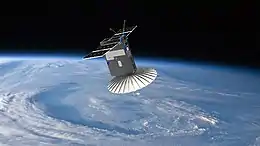 RaInCube in orbit | |
| Manufacturer | NASA/JPL |
|---|---|
| Designer | NASA/JPL |
| Country of origin | United States |
| Operator | NASA |
| Specifications | |
| Spacecraft type | experimental spacecraft |
| Power | solar panels |
| Production | |
| Launched | 21 May 2018 |

RainCube
Mission objectives
RainCube's mission objectives were to:[4][1]
- Demonstrate low-cost Ka band radar technology, with a vertical resolution of 250m and a horizontal resolution of at least 10km. Its radar sensitivity should also be better than 20dBZ.
- Use Ka-band radar from a 6U CubeSat
- Profiling precipitation falling on Earth
Gallery
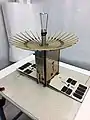 RaInCube on Earth
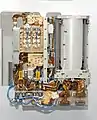 RaInCube's interior
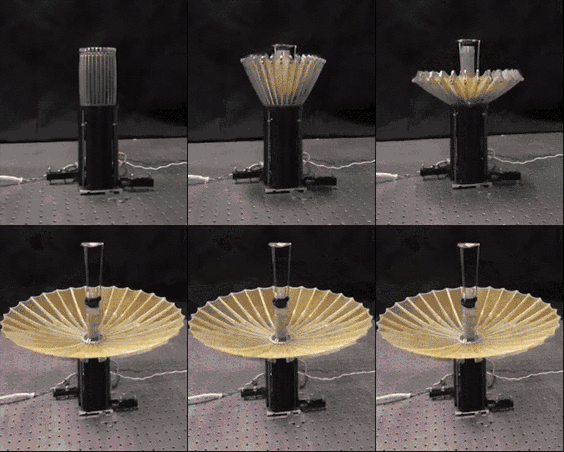 RaInCube's antenna opening
References
- "JPL | CubeSat | RainCube". www.jpl.nasa.gov. Retrieved 2019-07-30.
- "A Pioneering NASA Mini Weather Satellite Ends Its Mission". www.jpl.nasa.gov/news/a-pioneering-nasa-mini-weather-satellite-ends-its-mission. Retrieved 2021-02-22.
- "NASA Tests Tiny Satellites to Track Global Storms". NASA/JPL. Retrieved 2019-07-30.
- "RaInCube - eoPortal Directory - Satellite Missions". directory.eoportal.org. Retrieved 2019-07-30.
External links
- RainCube page by the Jet Propulsion Laboratory
This article is issued from Wikipedia. The text is licensed under Creative Commons - Attribution - Sharealike. Additional terms may apply for the media files.