Radegast (god)
Radegast, also Radagast, Radigost, Redigast, Riedegost, or Radogost, is an old god of Slavic mythology.[1] He is considered to be a deity of hospitality, or host or leader of an assembly or council.
| Radegast | |
|---|---|
God of hospitality | |
 Late medieval image of Radegast (ca. 1530) by G. Spalatin is first known depiction of the god | |
| Other names |
|
| Gender | Male |
| Region | Europe |
| Ethnic group | Slavs |
Etymology
The name Radegast can easily be dialectically adjusted and may translate as 'dear guest' or 'welcomed guest', from Slavic radǔ (content, glad) or rad (kind, willing, happy),[2] and gostŭ (host).[3] Slavicist Heinrich Kunstmann (de) has claimed that the second part of the name, -gost, is "undisputably" cognate to Latin hostis (stranger, enemy) and Gothic gasts (guest), thus meaning guest, stranger'.[4] According to Zmago Smitek, the name of the god means 'one who is ready to welcome a guest' or 'the one who takes good care of guests'.[5] In Czech, the word radohostinství means 'hospitality', and radovati se means 'to rejoice'.[6]
Another possible etymology derives his name from Slavic rada (council) and gościć, hostit, goszczący (to host).
Possible role
Based on one etymology, Radegast was proclaimed as the Slavic god of hospitality[lower-alpha 1] and as such, entered the hypothetical, reconstructed Slavic pantheon. Even myths concerning him were constructed based on various folk customs of sacred hospitality. Similar customs, however, are known in many Indo-European mythologies, without a distinct deity associated explicitly with them.
Based on the second etymology proposed above, Radogost is perhaps the name of the council or assembly host, leader, or speaker, and one of the attributes of the god. This view could be supported by the political role Radegast temple played in the life of Polabian Slavic tribes. Stanisław Rosik sees him also as a war god, since human sacrifices were reported to be made in his name.[8]
Some historians of Slavic religion, like Leszek Pawel Slupecki and Stanislaw Rosik, believe his name is a "local hypostase" or "sobriquet" of the Pan-Slavic deity Svarožic, whose name was "hidden by a taboo".[9][10]
Depiction
Radegast is completely black, armed with a spear and helmet, and it pleases him to be invited to banquets. He is said to wear a helmet with a swan ornament and armor or shield with a bull's head on it.[11] He has been described as a "Czech legendary figure" and a bird tamer.[12][13]
History
.jpg.webp)
.png.webp)
According to Raymond Schmittlein, the name of the deity appears in the historical record in the works of medieval Germanic historians, as a deity, a city, and even the name of a river.[14]
Radegast is mentioned by Adam of Bremen in his Gesta Hammaburgensis Ecclesiae Pontificum as the deity worshipped in the Lutician city of Radgosc. Likewise, Helmold in his Chronica Slavorum wrote of Radegast as a Lutician god. However, Thietmar of Merseburg earlier wrote in his Chronicon that the pagan Luticians in their holy city of "Radegast" worshiped many gods, the most important of which was called Zuarasici, identified as either Svarog or Svarožič. According to Adam of Bremen, Johannes Scotus, Bishop of Mecklenburg, was sacrificed to this god on 10 November 1066 during a Wendish pagan rebellion against Christianity.[15] The god was also said to have been worshipped in the form of a golden idol by the Redars (Redarians), possibly as their patron deity.[16][17]
Later, German historian Albert Krantz, in his work Vandalia, mentioned Radegast as the god of the "Obodrites", a late-medieval West Slav confederation.[18][19] The god (written as Radigast and Radigost) was assigned to the Polabian Slavs by Mauro Orbini's Kingdom of the Slavs.[20]
The form Radegast seems to have been used for the first time in the works of Russian ethnographer Vasily Tatishchev.[21]
Legacy
Personal names
Bulgarian linguist Vladimir I. Georgiev proposed that the name was cognate to that of 6th-century South Slavic chieftain Ardagast, by way of metathesis.[22] His name is attested in the works of Byzantine historian Theophylact Simocatta.[23][24] If so, it would represent the "oldest attestation of the name", according to slavicist Heinrich Kunstmann (de).[25] However, Kunstmann also hinted at the possibility that the element Arda- could derive from the Thracian river Arda, and the name also reminded him of Gepid king Ardaricus and Roman general Ardabur.[26]
In reconstructed paganism
19th-century Polish philosopher Bronisław Trentowski wrote a treatise on Slavic faith and cited Radogost as part of a "Slavic pantheon" that included Perun, Dadźbog, and the "obscure figures" Harwit, Chason, Baj, Radamas, Lubicz, Godun, Poroniec, Pust, and Dobrogost.[27]
Toponyms
The name of the deity is considered to be cognate to the city name Rethra, whose former name is Redigost, and the place name Radgošč.[28][29][30] Peeter Arumaa has listed other similar river and village names (e.g., Radogošč, Radogošča, Radogošče, Redogošč).[31]
According to Slovak writer Ivan Hudec's (sk) sidenotes in his book Báje a mýty starých slovanů, Radegast (alternatively Radogost, Radhost, Riadogost)'s name persists locally "in Germany, Bohemia, Moravia and Lower Austria".[32] Likewise, T. Witkowski listed some place names possibly related to the deity's name: Radegast (in ancient Polabian and Sorbian areas); Rodigast (de) (Kreis Eisenberg, east of Jena); Rodias (de), a city in Thuringia (former name Rodegast); Polish Radogoszcz, and Czech Radhošť.[33]
In Czechia and Slovakia
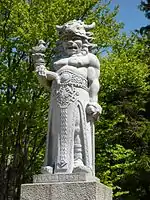
Mount Radhošť, in the Moravian-Silesian Beskids mountain range, is traditionally associated with the worship of this god; according to (modern) legend, missionaries Cyril and Methodius, when they visited the mountain on their trip to Great Moravia, had his idol demolished.
The original statue once placed on Mount Radhošť, sculpted in 1929 by Albin Polasek, is now located in the town hall of Frenštát pod Radhoštěm. When the statue was moved to the mountain in 1931, the truck carrying it became stuck in a steep turn, and heavy rain accompanied by storm and lightning killed one of the soldiers.[34] A second casting by Albin Polasek stands in the center of Prague Zoo.
The granite version, now found on Mount Radhošť, is a more recent copy commissioned by the Radegast beer company in 1998. More information and sculptures of Radegast are found at Polasek Museum in Winter Park, Florida. The name Radhošť itself is supposed to be a Czech transcription of Radegast.
Other theories
Raymond Schmittlein developed a theory that Radegast was actually a deified Germanic warrior named Radegast, "whose memory has been forgotten" but whose temple later chroniclers "gave an exact description of".[35][36]
Professor Zmago Smitek associates Radogast as another name for fire deity Svarozic and Slovene mythological figure Kresnik, also connected to fire.[37]
According to the Slovak author Ivan Hudec's (sk) notations in his book Báje a mýty starých Slovanů, Radegast (or Radhost) was a god of the evening sky, of fire and, of starlight.[38]
In popular culture
- Radagast the Brown is a fictional character in J. R. R. Tolkien's Middle-earth legendarium. He is one of the wizards and lives among animals.[39][40]
- Radegast is a Czech beer brewed in Nošovice.
- Radegast is the third studio album by Czech heavy metal band Citron, released in 1987.[41] The record also contains the tracks "Radegast I" and "Radegast II".
Notes
- "In 1791, Anton Tomaž Linhart followed Karl Gottlob Anton and called Radogost "the god of joy or the generous happy foreigner"."[7]
References
- Aitamurto, Kaarina; Simpson, Scott (20 October 2014). Modern Pagan and Native Faith Movements in Central and Eastern Europe. Routledge. ISBN 978-1-317-54462-3 – via Google Books.
- Rosik, Stanisław. The Slavic Religion in the Light of 11th- and 12th-Century German Chronicles (Thietmar of Merseburg, Adam of Bremen, Helmold of Bosau). Leiden, The Netherlands: Brill, 2020. p. 216. doi: https://doi.org/10.1163/9789004331488
- Unbegaun, Boris-Ottokar. L'Ancienne religion des Slaves de la Baltique. In: Revue d'histoire et de philosophie religieuses, 26e année n°3-4, 1946. pp. 218-219. DOI: https://doi.org/10.3406/rhpr.1946.3182; www.persee.fr/doc/rhpr_0035-2403_1946_num_26_3_3182
- Kunstmann, Heinrich. Beiträge zur Geschichte der Besiedlung Nord- und Mitteldeutschlands mit Balkanslaven. Verlag Otto Sagner. 1987. p. 62. ISBN 3-87690-385-8.
- Šmitek, Zmago (2010). “Od Staroslovanskega Svarožiča/Radogosta Do Slovenskega Kresnika" [From the Ancient Slavic Svarožič/Radogost to the Slovene Kresnik]. In: Studia Mythologica Slavica 13 (October). Ljubljana, Slovenija, p. 197. https://doi.org/10.3986/sms.v13i0.1647.
- Šmitek, Zmago (2010). “Od Staroslovanskega Svarožiča/Radogosta Do Slovenskega Kresnika" [From the Ancient Slavic Svarožič/Radogost to the Slovene Kresnik]. In: Studia Mythologica Slavica 13 (October). Ljubljana, Slovenija, p. 197. https://doi.org/10.3986/sms.v13i0.1647.
- Šmitek, Zmago (2010). "Od Staroslovanskega Svarožiča/Radogosta Do Slovenskega Kresnika" [From the Ancient Slavic Svarožič/Radogost to the Slovene Kresnik]. In: Studia Mythologica Slavica 13 (October). Ljubljana, Slovenija, p. 197. https://doi.org/10.3986/sms.v13i0.1647.
- "Undoubtedly a human offering stresses belligerence of Redigast-Svarožic. Offerings of live creatures were made to deities representing power and victory (...)". In: Rosik, Stanisław. The Slavic Religion in the Light of 11th- and 12th-Century German Chronicles (Thietmar of Merseburg, Adam of Bremen, Helmold of Bosau). Leiden, The Netherlands: Brill, 2020. p. 245 (footnote nr. 237). doi: https://doi.org/10.1163/9789004331488
- Rosik, Stanisław. The Slavic Religion in the Light of 11th- and 12th-Century German Chronicles (Thietmar of Merseburg, Adam of Bremen, Helmold of Bosau). Leiden, The Netherlands: Brill, 2020. pp. 109, 138 (footnote nr. 433), 215. doi: https://doi.org/10.1163/9789004331488
- Slupecki, Leszek Pawel. Slavonic Pagan Sanctuaries. Translated by lzabela Szymańska. Warsaw: Institute of Archeology and Ethnology; Polish Academy of Sciences, 1994. pp. 235-236. ISBN 83-85463-27-5.
- Dixon-Kennedy, Mike (1998). Encyclopedia of Russian and Slavic myth and legend. ABC-CLIO. p. 231. ISBN 978-1-57607-130-4.
- Dickerson, Matthew; Evans, Jonathan (2006). "Woods, Wildness, and the Feraculture of the Ents". Ents, Elves, and Eriador: The Environmental Vision of J.R.R. Tolkien. University Press of Kentucky. p. 122. JSTOR j.ctt2jctx1.
- Curry, Patrick (1998) [1997]. Defending Middle-Earth: Tolkien: Myth and Modernity. HarperCollins. p. 114. ISBN 978-0-261-10371-9.
- Schmittlein Raymond. "L’anthroponyme germanique employé d’une façon absolue en fonction toponymique". In: Revue Internationale d'Onomastique, 18e année N°2-3, Juin-septembre 1966. IXe Congrès international des Sciences Onomastiques – Londres (4-8 juillet 1966). Seconde partie. p. 205. DOI: https://doi.org/10.3406/rio.1966.1940; www.persee.fr/doc/rio_0048-8151_1966_sup_18_2_1940
- Bührer-Thierry, Geneviève. "Les «réactions païennes» dans le nord de l'Europe au milieu du XIe siècle". In: Actes des congrès de la Société des historiens médiévistes de l'enseignement supérieur public, 33ᵉ congrès, Madrid, 2002. L'expansion occidentale (XIe - XVe siècles) Formes et conséquences XXXIIIe Congrès de la S.H.M.E.S. p. 210. DOI: https://doi.org/10.3406/shmes.2002.1837; www.persee.fr/doc/shmes_1261-9078_2003_act_33_1_1837
- Paul, Selver. "JÁN KOLLÁR: THE DAUGHTER OF SLÁVA". In: National Romanticism: The Formation of National Movements. Edited by Trencsényi Balázs and Kopeček Michal. Central European University Press, 2007. p. 209 (footnote nr. 5). Accessed May 31, 2021. http://www.jstor.org/stable/10.7829/j.ctt1281sw.31.
- Rosik, Stanisław. The Slavic Religion in the Light of 11th- and 12th-Century German Chronicles (Thietmar of Merseburg, Adam of Bremen, Helmold of Bosau). Leiden, The Netherlands: Brill, 2020. p. 123. doi: https://doi.org/10.1163/9789004331488
- Znayenko, Myroslava T. The Gods of the Ancient Slavs: Tatishchev and the Beginings of Slavic Mythology. Slavica Publishers, 1980. p. 39.
- Rosik, Stanisław. The Slavic Religion in the Light of 11th- and 12th-Century German Chronicles (Thietmar of Merseburg, Adam of Bremen, Helmold of Bosau). Leiden, The Netherlands: Brill, 2020. pp. 308, 311. doi: https://doi.org/10.1163/9789004331488
- Znayenko, Myroslava T. The Gods of the Ancient Slavs: Tatishchev and the Beginings of Slavic Mythology. Slavica Publishers, 1980. p. 41.
- Znayenko, Myroslava T. The Gods of the Ancient Slavs: Tatishchev and the Beginings of Slavic Mythology. Slavica Publishers, 1980. pp. 77-79.
- Georgiev, Vladimir. "Problèmes phonématiques du slave commun". In: Revue des études slaves, tome 44, fascicule 1-4, 1965. p. 10. DOI: https://doi.org/10.3406/slave.1965.1882; www.persee.fr/doc/slave_0080-2557_1965_num_44_1_1882
- Stojkov, Stojko (2019). "The term Sclavinia in Byzantine sources: Re-examination of the chronological framework". In: Monumenta, 4. pp. 418, 420 (footnote nr. 30). ISSN 1857-999x Parameter error in {{issn}}: Invalid ISSN..
- "Theofylaktos Simokattes, prelom 20. a 30. rokov 7. storočia". In: Seges, Vladimír; Šeďová, Božena. Pramene k vojenským dejinám Slovenska I/1 Od najstarsích cias do konca 10. storočia. Vojenský historický ústav. 2010. pp. 168, 170. ISBN 978-80-970434-8-3.
- Kunstmann, Heinrich. Beiträge zur Geschichte der Besiedlung Nord- und Mitteldeutschlands mit Balkanslaven. Verlag Otto Sagner. 1987. p. 62. ISBN 3-87690-385-8.
- Kunstmann, Heinrich. Beiträge zur Geschichte der Besiedlung Nord- und Mitteldeutschlands mit Balkanslaven. Verlag Otto Sagner. 1987. p. 63. ISBN 3-87690-385-8.
- Gajda, Agnieszka. "Romanticism and the Rise of Neopaganism in Nineteenth-Century Central and Eastern Europe: The Polish Case". In: Modern Pagan and Native Faith Movements in Central and Eastern Europe. Routledge. 2013. p. 50. ISBN 9781315729008.
- Schlimpert, G.. "Zur Struktur und Semantik altpolabischer Gewässernamen in Brandenburg". In: Zeitschrift für Slawistik 17, no. 1 (1972): 448-449. https://doi.org/10.1524/slaw.1972.17.1.441
- Eichler, Ε.. "Die sprachliche Stellung der slawischen Dialekte im heutigen deutschen Sprachraum im Lichte der Onomastik". In: Zeitschrift für Slawistik 32, no. 1-6 (1987): 810. https://doi.org/10.1524/slaw.1987.32.16.808
- Bily, Inge and Saß, Elke. "Symposium „Deutsch-slawischer Sprachkontakt im Lichte der Ortsnamen, mit besonderer Berücksichtigung des Wendlandes“". In: Zeitschrift für Slawistik 37, no. 2 (1992): 291. https://doi.org/10.1524/slaw.1992.37.2.289
- Arumaa, Peeter (1960). "Sur les principes et méthodes d'hydronymie russe: Les noms en gost'". In: Scando-Slavica, 6:1. pp. 162-163. http://dx.doi.org/10.1080/00806766008600326
- Hudec, Ivan. Báje a mýty starých slovanů. Slovart, 1994. p. 93. ISBN 80-7145-111-8.
- Witkowski, T.. "Mythologisch motivierte altpolabische Ortsnamen". In: Zeitschrift für Slawistik 15, no. 1 (1970): 371-372. https://doi.org/10.1524/slaw.1970.15.1.368
- "Pohanský bůh Radegast".
- Schmittlein Raymond. "Laima, divinité baltique du bonheur". In: Revue Internationale d'Onomastique, 23e année N°2, avril 1971. pp. 126. DOI: https://doi.org/10.3406/rio.1971.2064; www.persee.fr/doc/rio_0048-8151_1971_num_23_2_2064
- Schmittlein, Raymond. "Les noms des dieux des Slaves de la Baltique". In: Revue Internationale d'Onomastique, 12e année N°3, Septembre 1960. pp. 177-179. DOI: https://doi.org/10.3406/rio.1960.1703; www.persee.fr/doc/rio_0048-8151_1960_num_12_3_1703
- Šmitek, Zmago (2010). “Od Staroslovanskega Svarožiča/Radogosta Do Slovenskega Kresnika" [From the Ancient Slavic Svarožič/Radogost to the Slovene Kresnik]. In: Studia Mythologica Slavica 13 (October). Ljubljana, Slovenija, pp. 187-197. https://doi.org/10.3986/sms.v13i0.1647.
- Hudec, Ivan. Báje a mýty starých slovanů. Slovart, 1994. p. 130. ISBN 80-7145-111-8.
- Orr, Robert (1994). "Some Slavic Echos in J. R. R. Tolkien's Middle-earth". Germano-Slavica. 8: 23–34.
- Dickerson, Matthew, and Jonathan Evans. "Woods, Wildness, and the Feraculture of the Ents." In: Ents, Elves, and Eriador: The Environmental Vision of J.R.R. Tolkien. University Press of Kentucky, 2006. Accessed May 31, 2021. p. 122. http://www.jstor.org/stable/j.ctt2jctx1.11.
- "Citron - Radegast". discogs.com. Retrieved 22 January 2021.
Further reading
- "Radogosc (Rethra) and other temples of the Lutizens and Abodrites". In: Slupecki, Leszek Pawel. Slavonic Pagan Sanctuaries. Translated by lzabela Szymańska. Warsaw: Institute of Archeology and Ethnology; Polish Academy of Sciences, 1994. pp. 51-69. ISBN 83-85463-27-5.
External links
 Media related to Radegast (deity) at Wikimedia Commons