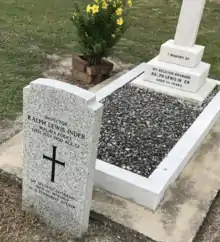
Ralph Lewis Inder
Ralph Lewis Inder (8 July 1899 - 13 July 1950) was a British born Malaysian rubber planter.
Ralph Inder | |
|---|---|
| Born | Ralph Lewis Inder 8 July 1899 281 Kings Street, Hammersmith |
| Died | 13 July 1950 (aged 51) Sungai Siput, Malaya |
| Nationality | British |
| Occupation | rubber planter, prisoner Thai Burma Railway, Malay police, murdered by terrorists |
Ralph Lewis Inder was born on 8 July 1899 in Hammersmith, the son of George Joseph Inder, a dentist. In 1911 he was living at 235 King Street with sister Winifred, Evelyn and his parents. Also in the house on census night was Fanny Bellman (his grandmother), Edythe Bellman and they had a domestic servant – Lucy Squires.
Inder was old enough to be a part of World War One and the records show us that he was awarded the Victory medal and the British medal. His regimental number was 103929 and he was a sapper in the Royal Engineers.
After the war he returned home at 235 King Street from about 1920 until 1926.
Ralph the rubber planter
Inder decided to become a rubber planter. His duties were general supervisory work and completion of the check rolls (the estate records of expenditure on labour).
Inder was described as a tough little Cockney by another rubber planter who wrote a book entitled Malayan Spymaster: Memoirs of a Rubber Planter, Bandit Fighter and Spy. [1]
Inder married Doris Howard. They were married straight after the banns were read, because within a week, they were both on board the SS Rajputana bound for Penang travelling second class. In 1939 England declared war onr with Germany. The planters could have returned home, but many thought that they could help the war effort better by the continued export of rubber.
The Inders were in England at this time, having returned for a holiday, living in a tiny semi-detached bungalow in Lancing, near Worthing. They departed from Glasgow on the SS Yoma on 21 Aug 1940 as part of convoy OB204. All the planters joined the Johore Volunteer Force], which was formed in 1934.
Prisoner of War
When the Japanese arrived in Singapore, Inder was rounded up and spent 3 years in appalling conditions. He was captured 15 Feb 1942 and was released 2 Sep 1945, spending the whole time in a Thailand POW camp and he worked on the Burma death railway.
The Imperial War Office in London has file entitled "private papers of RL Inder", It has extracts from his diary covering his experiences at the time of the fall of Singapore (Feb 942) and as prisoner of war during the railway journal from Singapore to Thailand and then in Banpong camp.
Evacuated from Singapore 1942
As the Japanese advanced through Malaya, the people fought them ever step of the way, while retreating. It is not know whether Doris fled to Singapore with the rest of the women and children or whether Ralph accompanied her. The British Government had ordered the ships the Empire Star, Duchess of Bedford, Empress of Japan, Wakefield, West Point ships to head to Singapore as part of convoy BM11. Japanese naval land attack planes (Genzan Kokutai) bombed Allied shipping at the harbour; the SS transport Wakefield (AP-21), while waiting to embark passengers, was damaged by a bomb. The Duchess of Bedford had received a bomb through one of the open hatches, but although the hold was flooded she eventually left on 30 Jan 1942 with Doris Inder was on board. The ships sailed to Batavia, Java, and on to Colombo, Ceylon.
Like so many other families, Doris and Ralph would have experienced the terrifying lead up to the evacuation in the Battle of Singapore. This is has been expertly described by Barbara Everard's Call them the Happy Days. Her experiences are almost exactly the same as those that Doris experienced. She lived life in Malaya, was evacuated, husband was a POW on the Burma Railway, repatriated to England and they both returned to Malaya after the war. She wrote her memoirs and they have been published on a BBC website the People's War.
Barbara Everard, like Doris, returned to Malaya in 1946, with Martin, to be re-united with her husband, Ray, who had survived three years on the Burma Railway as a Japanese prisoner of war and who, after a short repatriation to England after his release, had returned to resume his job as a rubber planter. She took up her hobby of water-colour painting tropical flowers and when she eventually returned to England in 1951 became one of the world’s leading botanical artists.
After the war
Like Barbara Everard, Doris was waited 4 years for Ralph to come home. Ralph did return from Singapore in an emaciated and in poor condition. The Inders couldn’t stay in England - it was no longer their home… jobs were scarce and the country was bankrupt and after 10 years in the tropics he couldn’t stand the cold weather. So they returned to Malaya and to the life of a rubber planter.
Back to Malaya
On 26 Feb 1946 Inder sailed on board the Nieuw Holland of the Nederland line bound for Batavia. The ship departed Glasgow 26 Feb 1946. Ralph is on board but not Doris. He is listed as a rubber planter and his English address is 74 Gloucester Crt, Kew. The whole page is filled with unaccompanied men and they are almost all rubber planters.
Inder settled back into the life of a planter at the Dovenby estate in Johore. But life could never go back to the way that it had been. It was at this time that the Malayan crisis started. The Malayan Emergency, also known as the Anti–British National Liberation War was a guerrilla war fought in British Malaya between communist pro-independence fighters of the Malayan National Liberation Army against the military forces of the British Empire and Commonwealth.
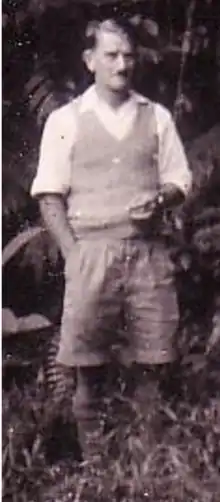
Meanwhile, more trouble was brewing and the planters recruited a special constabulary to protect their plantations. The wages were much better than Inder was getting as a planter else - 150 shillings and a death gratuity of $700. He signed up and with his language skills, jungle experience and military training, he was appointed as an inspector. 30,000 Malays also volunteered. An excellent documentary about life at this time can be found on YouTube.[2]
They were trained by members of the Palestine police who had been withdrawn from the now free state of Israel. The Malayan volunteer police units had to guard the mines and rubber plantations. Inder was appointed as an inspector of the Johore branch of the police force. On 13 July 950 he was ambushed by communist terrorists and died at Ipoh District Hospital on 13 Jul 195. He was buried 15 July at Batu Gajah Christian Cemetery. Probate was granted 6 March 1952 to Cecil Herbert Howard, civil servant and Ernest Clifford Webster, solicitor. His estate was worth £599.3.8d.
It is believed that Doris may have remarried to Brigadier Cyril Howard Stone.
References
- Hembry B Malayan Spymaster: Memoirs of a Rubber Planter, Bandit Fighter and Spy, p44
- Archived at Ghostarchive and the Wayback Machine: The Malayan Emergency. YouTube.