Rashid Nezhmetdinov
Rashid Gibiatovich Nezhmetdinov (Tatar: Рәшит Һибәт улы Нәҗметдинов, [ræˈʃit næʑmetˈdinəf] Russian: Рашид Гибятович Нежметди́нов; December 15, 1912 – June 3, 1974) was an eminent Soviet chess player, chess writer, and checkers player. He is part of an elite group of players who never became World Champion, yet created chess masterpieces of enduring brilliance. According to Pishkin, the list includes Chigorin, Reti, Spielmann and especially Nezhmetdinov.[1]
| Rashid Nezhmetdinov | |
|---|---|
 | |
| Full name | Rashid Gibiatovich Nezhmetdinov |
| Country | Soviet Union |
| Born | December 15, 1912 Aktiubinsk, Russian Empire |
| Died | June 3, 1974 (aged 61) Kazan, Russian SFSR, Soviet Union |
| Title | International Master |
| Peak rating | 2455 (January 1973) |
Early life
Nezhmetdinov was born in Aktubinsk, Russian Empire, in what is now Aktobe, Kazakhstan, in a Tatar family. His parents were “worked to death” when he was still very young, rendering him (and his two siblings) an orphan. Rashid was then sent to live with his uncle, in a small town on the banks of the Volga river. From 1918-1923, the Russian Civil War would devastate the region, particularly with the introduction of the Prodrazvyorstka policy, a system whereby peasant’s foodgrain was confiscated at nominal prices, as per fixed quotas. The ensuing famine would kill over 2 million children. But Rashid endured, thanks in large part to his poet, brother – Kavi Nadzhmi – who secured him a place at a Kazan orphanage. Rashid would regard this orphanage as paradise, his only prior happy memory being "the time he got to eat fish soup on the banks of the Volga." In Kazan, Rashid would be well-fed for the first time in his life, learn the Tatar language, and be initiated into Islam. During this time, Rashid developed a keen interest in history, literature and mathematics. Three years later, Kavi would be able to bring Rashid into his own home, also at Kazan. Here, Rashid would be thoroughly engaged in the Kazan “Palace of Pioneers,” which marked the beginning of his chess career.
Nezhmetdinov had a natural talent for both chess and checkers, games he'd learned by watching others play; and was quickly invited to join the Kazan Chess Club. At 15, he played in Kazan's Tournament of Pioneers, winning all 15 games. He also learned to play checkers at this time. During the same month in which he learned the game, he won Kazan's checkers semi-final and placed second in the finals. In the same year, he placed sixth in the Russian Checkers Championship. Later, when he finally gave up checkers for chess, Nezhmetdinov commented, somewhat dismissively, that all checkers contests can be reduced to rook endgames.[1]
It was around this time that Kavi, now a poorly paid newspaper editor, could no longer afford Rashid’s upkeep. Rashid then joined the Communist Party and moved to Ukraine, in the hopes of making his own way in the world. In Odessa, his Communist Party membership would give him good standing – and he worked as a stoker in a steel mill. He would get to spend all his free time playing at the Odessa Chess Club
Initial Years (1933-1946)
In 1933, Rashid, now the Odessa Chess and Checkers Champion, and a Category I chess player, would return to Kazan. He secured employment with the Standards Bureau, taught at the local Pedagogical Institute and ran an informal chess circle. Over the next two years, Rashid was primarily concerned with checkers and earned himself title of Master at the game. This was no small feat considering checkers was taken very seriously in the USSR at this time, and frequently reported in chess magazines. However, it was only after receiving (by his own admission!) a “thrashing” from “stronger Category I Chess Players” like Anatoly Ufimtsev and Pyotr Dubinin in 1936, that Rashid began to take chess seriously. Sadly, he would fall ill and be hospitalized for many months immediately thereafter. However, in his characteristically optimistic fashion, Rashid would seize this opportunity to study endgames; typically by solving puzzles without a board. And, in his very next tournament, he would win 9 out of 10 games in his very next Category I tournament in 1939, and earn himself the Candidate Master title. After graduating in 1940, in 1941, he was called to military service, and here his chess development would take a major setback. He was deployed in Baikala, 5000 km away, on the border of Mongolia. While Rashid would still compete in district level tournaments, even securing wins against players like Victor Baturinsky and Konstantin Klaman, these appearances were very rare. The War would eventually create a five- and half-year period where Rashid would play no tournaments.
There was a silver lining though – Rashid was actually quite lucky. He always seemed to arrive or leave before an apocalyptic battle. He arrived in Baikala right after the Red Army had fought a brutal battle with Japan’s Kwantung Army. He was then sent to Berlin immediately after the Soviets had stormed it. Rashid successfully avoided every major combat zone in a war that killed over 11 million Soviet soldiers.[2]
Glory Years (1946-1958)
And in Berlin, from 1946, Rashid was able to resume his long-interrupted chess career and devoted himself entirely to chess. In 1946, he won Championship of the Berlin Military District, winning 14 out of 15 games, and finishing ahead of future Ukrainian Champion, Isaac Lipnitsky.
Later that year, Rashid, now 34-years-old returned to civilian life and his primary occupation was to serve as the Captain of the DSO Spartak chess team. In 1947, Rashid finished in shared second place at the All-Union Candidate Master tournament at Yaroslavl. This marked the beginning of a tumultuous friendship between Rashid, Vitaly Tarasov (the winner), Ratmir Kholmov (shared second).
With this performance, Rashid had also earned his second Master norm. He now had the right to play an examination game for the title of Soviet Master. Georgy Lisitsin was appointed as Rashid’s examiner. However, after studying Lisitsin’s games for many months, Rashid received a telegram from the Soviet Chess Federation, mere days before his match, stating that his examiner would be Vladas Mikenas. Mikenas was, a far more formidable opponent.
In his renewed preparations, Rashid came across an Article written by Mikenas on the Alekhine’s Defense, in Shakhmaty v SSSR, a popular chess magazine of the day. Mikenas claimed it was his preferred response to 1. e4 (Rashid’s favorite first move). This must have been particularly intimidating considering Mikenas had only recently beat the legendary Alexander Alekhine at the 1937 tournament in Kemeri, Latvia, with the black pieces no less!
Nevertheless, the fearless Rashid still played 1. e4 in their first game and, even entered the “Hunt Variation” of the Alekhine Defense; Mikenas’ favorite. He crushed Mikenas in 17 moves. He beat Mikenas again, in the same variation, in Game 11. However, the Game was drawn 7-7 and Rashid did not gain the coveted Master title, because the examiner got draw odds. However, Rashid was not discouraged and this result only reinforced his belief that the title was within his grasp. However, this optimism must have led to a very frustrating few years for Rashid, especially considering how brutally frank he was about his own performance.
His next break through would come in 1950, when he earned the right to play at the prestigious RSFSR Championship at Nizhny Novgorod (this Championship was limited to the Russian Federation and thereby second to the USSR Championship). The competition was fierce, with Masters like Isaac Boleslavsky (the tournament favorite), among many others. Rashid drew his game with Boleslavsky and went on to become the 10th Champion of the Russian Federation. He was finally a Soviet Master.
He returned to Kazan, where a hero’s welcome awaited him. He would go on to win the RSFSR Championship again, in 1951 at Yaroslavl. But his other tournament performances were relatively underwhelming. For instance, at the Baku International in 1964, Rashid could only secure 4 points in 12 rounds; a performance he said owed to his “underestimation” of his opponents. He finished in third place, behind Vladimir Antoshin and Vladimir Bagirov. It is worth noting that around this time, Rashid, Vitaly and Ratmir had become boisterous drinking buddies. As the story goes, in Baku, they treated their hotel rooms like they were rockstars. Rashid is said to have hurled crockery out the window, and eventually gotten into an argument with Ratmir. Vitaly tried to defuse the situation, but to no avail. By this time, the commotion had caught the attention of GM Alexander Kotov, an observer on behalf of the Soviet Sports Committee. He reported all 3 Masters to the Sports Committee. Ratmir and Vitaly received the worst of it (the reason for this is unclear, but some say its because Rashid was the only Communist Party member among them), with each receiving a 1-year ban from tournaments and having governments stipends suspended. Rashid retained his stipend, and was banned for a shorter period of time .
This marked a turning point in Rashid’s life and he turned a new leaf. He gave up the “party all night” lifestyle, and married Tamara Ivanovna (little is known about her apart from the fact that she’s the mother of Rashid’s children). It was also around this time that Rashid wrote the first ever chess book in the Tatar language.
Rashid’s next major tournament was the 1953 RSFSR Championship at Saratov, which he won. And in 1954, Rashid finally got to play on the grand stage, the 21st USSR Championship at Kiev – the holy grail of Soviet Chess. This would prove to be Rashid’s toughest competition so far with other masters like Tigran Petrosian and Efim Geller, who were already ranked amongst the best players in the world. Rashid finished the tournament in shared 7th place, but, finishing with 4½ wins in 7 matches against Grandmasters, is a great achievement in itself.
With the death of Stalin in 1953, Rashid was finally able to play chess internationally. Nikita Khrushchev adopted a far less repressive regime, pertinently, removing most travel restrictions for sportsmen. It was also around this time that the Russian Sports Committee came under fire from the international press for only ever sending their “strongest Grandmasters” abroad. The idea was for Russia to send 4 of their “mere Masters” to the 1954 international tournament at Bucaresti. Rashid was chosen, along with Semyon Furman, Viktor Korchnoi and, his old friend, Ratmir Kholmov. Prior to leaving for the tournament, the four masters were summoned to Moscow, where they underwent rigorous training under Isaac Bolevslavsky and David Bronstein.[2]
1954 International Tournament at Bucaresti
This was the first time Rashid had left the USSR, the first time he would face International Masters and the first time he would face non-Soviet Grandmasters. Despite all the pressures, his performance was exemplary.
· Lost to IM Luděk Pachman
· Won against IM Miroslav Filip
· Won against IM Robert Wade
· Won against IM Bogdan Sliwa
· Won against GM Gideon Ståhlberg
· Won against GM Enrico Paoli
Rashid shared the lead with Viktor till the last round, but Viktor ultimately won the tournament. Rashid finished in clear second place. This performance earned Rashid the title of International Master, the highest accolade he would receive in chess.
Later Years (1958-1961)
Rashid’s next tournament would be the 1958 USSR Team Championship at Vilnius, where he served as Captain of his team – RSFSR. They finished in 3rd place, among the 9 teams at the competition. By now it was 1959, and a 46-year-old Rashid was finally feeling the effects of age, only accentuated by his former, hard-living lifestyle. He notes in his autobiography that he was the oldest participant at the opening ceremony of the 1959 USSR Championship in Tibilisi. But his legendary win against Bronstein with the white pieces must have offered him some consolation. In 1961, he would finished 2nd at the Chigorin Memorial Tournament at Rostov on Don, behind only Mark Taimanov.
And then, in 1961, Rashid would then try to win the prestigious RSFSR Championship at Omsk for a record sixth time! Here, things got off to a rocky start, and Rashid would finally find himself in a group of 5, tied for second place, behind Lev Polugaevsky. A clear second had to be chosen since the top two players would get a chance to play in the next USSR Championship. Nezhmetdinov triumphed, winning the tie-break and finishing ahead of Vladimir Antoshin and Anatoly Lein. And with that, Rashid would play at the 29th USSR Championship in Baku, 1961. Unfortunately, Rashid only secure 19th place; but won many notable games.[3]
Final Years (1961-1974)
The next decade would mark a particularly uninteresting period of Rashid’s life. In 1961, he would compete in his fifth USSR championship at Kharkov. The competition was diluted as over 120 players were invited, in a bid to celebrate the 50th Anniversary of the October Revolution. Rashid would still only finish in 27th place, a position he shared with 14 other players. His next tournament, almost 12 years later, would be the 1973 Latvian Open at Daugavpils. But, a 70-year-old Rashid would fall ill during the tournament, and not even finish his last game. He finished in 3rd place; far below his potential.
In his last few years, he coached the Kazan Chess team at the Old City Chess Club and regularly gave simultaneous exhibitions in his hometown. He was said to be an approachable and joyful man, who was always ready to discuss anything under the sun; especially chess! Rashid passed away in the Summer of 1974.[3]
Developments in his Checkers career
In 1949, the Russian Checkers Semifinals were held in Kazan. Nezhmetdinov attended as a spectator, but when one of the participants failed to show up, Nezhmetdinov agreed to substitute for him even though he hadn't played checkers for 15 years. He won every game, qualifying him for the Finals, which were to be held immediately after a chess tournament in which he was also participating. He won the tournament and immediately thereafter placed second in the Russian Checkers Championship.
Chess career
Playing style
Nezhmetdinov was a fierce, imaginative, attacking player who beat many of the best players in the world. Known for his committal, aggressive, forward moving playstyle, he is occasionally referred to by the nickname, "No Reverse Gear" Rashid.
Russian Championship
Nezhmetdinov got the historical record of five wins of the Russian Chess Championship, 1950, 1951, 1953, 1957 and 1958.
International Master title
FIDE awarded him the International Master title for his second-place finish behind Viktor Korchnoi at Bucharest 1954, the only time he was able to compete outside of the Soviet Union.[4]
The elusive Grandmaster title
There are few schools of thought on why Rashid never became a Grandmaster. The first, believes that Rashid was obsessed with attack, and played for tactics and complications, even when there weren’t any. Accordingly, they believe it was his ineptitude for defence that led to him never receiving the title. Grandmaster Yuri Averbakh, a strong positional and endgame player, suggests this in his interview by Dirk Jan ten Geuzendam in The Day Kasparov Quit:
Nezhmetdinov, ... if he had the attack, could kill anybody, including Tal. But my score against him was something like 8½–½ because I did not give him any possibility for an active game. In such cases he would immediately start to spoil his position because he was looking for complications.
Others believe he was discriminated against because he was a Muslim (tatar) and therefore given fewer chances to go abroad. Korchnoi remembers Nezhmetdinov: "I played my first tournament after my marriage in Sochi. This was the Russian SFSR championship, and it was won by Nezhmetdinov, one of the strongest Soviet masters. For some reason, he was very rarely allowed to go abroad, and, obviously, he never became a grandmaster because of that." As a consequence of living behind the “iron curtain” for many decades, he only left the USSR a total of 3 times.
Another popular explanation is the one advanced by Marat Khasanov.
“Let us also consider the other Soviet Players who became GMs around the time Rashid should have (emphasis added) become one.
1954 - nobody.
1955 - one player, Boris Spassky. He won the youth world chess championship and qualified for the Interzonal, where he got his grandmaster's norm. Boris was very lucky. The world championship in Antwerp ended on 8th August, and the Interzonal, which, luckily, was held in Gothenburg, began in a week - on 15th August. And Spassky got there in time, which, considering the Soviet bureaucracy of the time, was quite a feat.
1956 - again just one player, Viktor Korchnoi, by accumulated results.
1957 - only one player again, Mikhail Tal. He won the Soviet championship.
In 1958 and 1959, no Soviet players became grandmasters.
So, in six years, from 1954 to 1959, only three Soviet players became grandmasters: Spassky, Tal and Korchnoi. How was Nezhmetdinov supposed to become a grandmaster if he never played in a tournament with grandmaster norms? ”[5]
However, even without the title, Rashid had a prolific chess career, and a lifetime positive score against World Champions – an achievement that is usually exclusive to former world champions. But, perhaps the most humbling explanantion is the one we get from Rashid himself.
“I came to chess too late, as a 17-year-old man with no theoretical knowledge, whereas all the champions — Botvinnik, Smyslov, Spassky, Petrosian, Tal-received training from the age of seven or eight….Yes, I could play some games with brilliance, and win prizes for beauty, but I was never able to achieve the holistic skills necessary for Grandmaster level” [2]
Results against world champions
Nezhmetdinov won a number of games against world champions such as Mikhail Tal, against whom he had a lifetime plus score, and Boris Spassky. He also had success against other world-class grandmasters such as David Bronstein, Lev Polugaevsky, and Efim Geller. He achieved a plus score in the 20 games he contested against World Champions. But in addition to his aforementioned dismal score against Averbakh, he could not win against excellent defenders like Tigran Petrosian (+0-3=2)[6] and Korchnoi(+0-3=3).[7]
Memorial
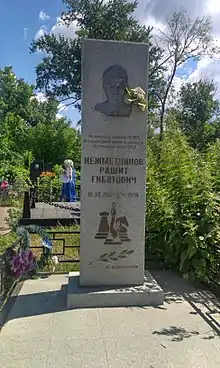
Kazan Chess school is currently named after Rashid Nezhmetdinov. Rashid Nezhmetdinov is buried in the Arskoe Cemetery, in Kazan, Tatarstan Republic, Russia (memorial ID 114372566).[8]
Anecdotes involving Rashid Nezhmetdinov
· Three Days with Bobby Fischer and Other Chess Essays by Lev Alburt
As the story goes, Alexey Suetin, a promising young talent, was set to play in his first invitational Soviet tournament. Since he was not very well known in the USSR at that time, he was provided with an old Belorussian master, a noted opening theoretician, as a second (lot like a trainer).
In Game 1, Suetin was to play the black pieces against Semyen Furman. The trainer said no preparation was required since the game would take a predictable course. Furman would open with the queen’s pawn, gain an advantage and keep pressuring Suetin. Suetin was disappointed by his second’s lack of help and confidence and was even more distressed when the game proceeded as predicted (Unfortunately, this game doesn’t seem to be available online).
In Game 2, Suetin was to play the white pieces against Nezhmetdinov. Again, the trainer said no preparation was required. “Why not?” “Well, color won’t matter. Nezhmetdinov can play any opening. Somewhere he will sacrifice a pawn for the initiative. Then he will sacrifice another. Then he will sacrifice a piece for an attack. Then he’ll probably sacrifice another piece to drive your king into the center. Then he will checkmate you.” Suetin was upset. “What kind of help was this?” He went to the game, and the old trainer’s prediction again came true.
Now Suetin was very upset. He called the Belorussian sports ministry, telling them that they must recall this fatalistic fellow immediately. The shocked trainer was sent back to Minsk, where he walked around the chess club complaining of his unfair treatment.
“‘I don’t understand why this young Alexey is so upset with me,’ the trainer would say. ‘Everything I told him turned out to be exactly right!’”[9]
· Smart Chip from St. Petersburg and other tales of a bygone chess era by Genna Sosonko
"Once Mikhail Tal offered me to play 'a couple of speed games' in his hotel room. When I knocked, there was a tall middle-aged man whom I did not know. He said: 'Misha is away on some business, but he will be back soon, and asked me to let you in. Please, wait here, if you don't mind. We could play some blitz, too.' I knew that Misha sometimes travels with his uncle Robert, so I thought it was he. Of course I stayed, and generously (so I thought) accepted the invitation to play to pass the time.
I was crushed in the first game, in which I did not pay much attention, but when I lost four more games, I almost began to panic. It was very rare for me to lose in such style, going down in flames like the Russian ironclad in Tsushima in 1905. I could accept being crushed by Tal himself - but his uncle?“
It was only when Misha came home that Genrikh Chepukaitis learned he'd been playing against Rashid Nezhmetdinov.[10]
References
- Alex Pishkin (2000). Super Nezh. Thinker’s Press. pp. 001–221. ISBN 0-938650-94-7.
- 1912-, Nezhmetdinov, Rashid (2000). Nezhmetdinov's best games of chess. Caissa Editions. ISBN 0-939433-55-9. OCLC 63089779.CS1 maint: numeric names: authors list (link)
- Nezhmetdinov chess biography (1/3), retrieved 2021-09-24
- Donaldson, John. "Super Nezh: Chess Assassin". jeremysilman.com. Archived from the original on April 12, 2012. Retrieved December 5, 2017.
- "Почему Р.Нежметдинов не стал гроссмейстером - Статьи - Каталог статей - Всё о шахматах в Республике Татарстан". www.tat-chess.ru. Retrieved 2021-09-24.
- Nezhmetdinov-Petrosian games. ChessGames.com. Retrieved on 2009-03-31.
- Nezhmetdinov-Korchnoi games. ChessGames.com. Retrieved on 2020-04-13.
- elarpe (2013-07-25). "'Rashid Gibiatovich Nezhmetdinov". findagrave.com. Retrieved 2020-12-21.
- 1945-, Alburt, Lev (Lev Osipovič) (2003). Three days with Bobby Fischer & other chess essays : how to meet champions & choose your openings. Chess Information and Research Center. ISBN 1-889323-09-8. OCLC 907115484.CS1 maint: numeric names: authors list (link)
- Sosonko, Genna (2006). Chess Book: Smart Chip from St.Petersburg. ISBN 978-90-5691-169-0.
Further reading
- Nezhmetdinov's Best Games of Chess by Rashid Nezhmetdinov; Caissa Editions, 2000
- Nezhmetdinov's Killer Chess Instinct by Pyshkin : ISBN 9996301184
- Nezhmetdinov - Lezioni di fantasmagoria scacchistica dalle partite di un genio del gioco d'attacco by Mauro Barletta; Messaggerie Scacchistiche (Brescia, Italy) 2018
External links
- Rashid Nezhmetdinov player profile and games at Chessgames.com
- "The Man from Kazan" by GM Nigel Davies
- A tribute to a "Secret Hero" at the Wayback Machine (archived March 30, 2001)
- Nezhmetdinov chess biography (1/3) by Jessica Fischer (on YouTube)
- Marat Khasanov’s “The Chess History of Tataria” http://www.tat-chess.ru/publ/pochemu_r_nezhmetdinov_ne_stal_grossmejsterom/1-1-0-14
- Genna Sosonko’s Smart Chip from St. Petersburg and other tales of a bygone chess era https://archive.org/details/Smart_Chip_from_St.Petersburg
Authority control  | |
|---|---|
| General | |
| National libraries | |
| Other | |