Rebecca Cox Jackson
Rebecca Cox Jackson (1795–1871) was a free Black woman, best known for her religious religious feminism and activism and for her autobiography, titled Gifts of Power: The Writings of Rebecca Cox Jackson, Black Visionary, Shaker Eldress, edited by Jean McMahon Humez.
Biography
Rebecca Cox was born on February 15, 1795, in Hornstown, Pennsylvania[1] into a free family.[2] She never had children, however she did care for her widowed brother's children while she lived with him. [3] [4]She married Samuel S. Jackson and worked as a seamstress until she had a religious awakening during a thunderstorm in 1830.[3] Cox Jackson has not written much about her life prior to this spiritual awakening, so not much is known.[3] However, according to a work written by Alice Walker, Cox Jackson's mother died when Rebecca was thirteen years old. [5] At the time Cox Jackson's autobiography begins, around age thirty-five, she lived with both her brother, Joseph Cox, and her husband, maintaining housekeeping. [5] She got divorced after her husband failed to teach her to read and write, and later realized she was able to do both anyway.[2] She moved out of her brother's house and continued her spiritual jouney in the Shaker religion. [5]
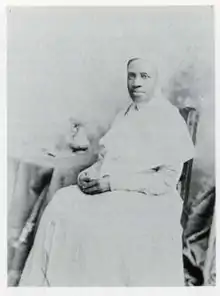
While traveling from church to church, she came upon and decided to join the Shakers in Watervliet, New York.[2] Cox Jackson shared many of the same values that Shakers do, "But more important than any of these, from Rebecca Jackson's point of view, they believed in celibacy; the only religious group she ever heard of that did" (65).[5] She became a minister in that community, but left after experiencing racial discrimination.[6] Jackson and her lifelong companion, Rebecca Perot moved to Philadelphia where in 1859 Jackson established a Shaker group primarily ministering to Black women.[6][7] She and Perot went back to Watervliet for a year, where Cox Jackson finally made her pledge and received approval from the Shakers there, and then returned to Philadelphia where Jackson continued as Eldress of her family of Shakers until her death in 1871[2][8] She is buried in Eden Cemetery in Collingdale, Pennsylvania.[9] Her autobiography, although written between 1830 and 1864, was only published in 1981.[10]
Religious Journey
Cox Jackson's spiritual journey began with a spiritual awakening she experienced in the middle of a thunderstorm in 1830.[3] Previous to this experience, she was terrified of thunderstorms. However, she had a revelation that God would protect her and communicate to her during thunderstorms and from here on the was devoted to her religion.[5] She was initially introduced to religion by her brother, Joseph Cox, who was an elder in Bethel African Methodist Episcopal Church.[5] She believed she had many gifts from God including miraculously learning to read and write, heal people, see the future, have visions, hear God's voice, act as a medium, among other gifts.[3][5] She often also went through serious health issues that she said were related to her gifts from God. [8] She later moved out of her brother's house as he used his superiority in the religion and his literacy to control Cox Jackson.[5] She divorced her husband and joined the Shakers in Watervliet, New York. However, they wanted her to make a pledge to a white Eldress named Mother Paulina Bates in order to be considered a "full member". Cox Jackson did not feel comfortable allowing a white woman to gate-keep her religious journey, so she left. She later returned and agreed to take the pledge to Mother Paulina Bates and she was granted a blessing to minister to people herself.[8] Motherhood was an important concept to Cox Jackson, as it was an important aspect of being a woman that she wanted to embrace. While she never had children and wanted to remain celibate, she spoke of a spiritual maternity - being a mother figure for people in a spiritual way. [8] She created a predominantly Black Shaker group of women in Philadelphia in 1858 with her lifelong companion Rebecca Perot, who was her protege.[3][5][8] Cox Jackson was very much led by her religious beliefs in everything she did. "Jackson felt compelled always to follow her own inner voice or "invisible lead"" (65).[3][5] She remained at this settlement until her death in 1871, where her "name and position were taken up by her life-long companion Rebecca Perot." (380).[8] The Black Shaker community in Philadelphia continued to exist as late as 1908.[2]
Feminism
Cox Jackson's feminism was very much rooted in her religiosity. "Jackson's [spiritual] gifts helped her identity, dignity, self-confidence, courage, and real skills to balance the skewed power dynamics a woman like her survives against in [America]" (205).[3] The fact that she joined the Shakers alone shows her feminism, as "...the Shakers believe in a dual, Mother-Father godhead." (24). [4] Cox Jackson saw great importance of the potential of women to bear children. She and other religious figures used the fact that her community acknowledged the importance of pregnancy and creating life as a strategy to combat the prominence of male symbolism in religion and spirituality, as well as in leadership roles.[8] Cox Jackson's spirituality was definitely crucial to her accepting her position as a woman and seeing the power in that. "... Jackson's matricentric theology has enabled her to accept first the feminine and finally the maternal in herself. Her narrative explores both daughterly and maternal subject positions, but her quest for agency separates both from biological limitations." [8] Her feminism manifested itself in her spirituality, which allowed her to believe she had power coming from the marginalized position. “Jackson’s choice to embrace a 'marginal identity' casts her as an actual example of one who lived a womanist lifestyle in Walker’s terms and her own brand of spirituality and Christian doctrine closely resembles beliefs Walker advocates for a womanist theology... But the blending of the influences of race and gender that characterize a contemporary womanist perspective as defined by Walker are Jackson’s own unique innovation.” (24)[4] Around this time she met her lifelong companion Rebecca Perot. Both women continued to have visions, even appearing in each other's visions. The two women were together for thirty-five years, until Jackson's death.[6] She was able to reframe a power dynamic where she initially did not benefit, into a situation where she created her own path and future. Because she felt God was paving a way for her, nothing was impossible.[8]
Romantic Relationships and Sexuality
Cox Jackson was married to Samuel S. Jackson, with whom she later divorced. Around the time Cox Jackson moved out of her brother's house and divorced her husband, she met her lifelong companion Rebecca Perot. Both women continued to have visions, even appearing in each other's visions. Perot said in one of her visions that Jackson was "crowned King and me crowned Queen of Africa," while Jackson saw the two of them "unit[ing] in the covenant." [6] While it has been noted in several places that Rebecca Perot was Rebecca Cox Jackson's lifelong companion, it is not clear whether this was a romantic relationship or not. Laurel Bollinger in her article on maternity and authority explained this, "Jackson’s relationship with Perot has been perhaps the most controversial element of Jackson’s autobiography" (380). [8] Alice Walker in one of her writings explained that "These two women lived together, ate together, travelled together, prayed together and slept together until the end of Jackson’s life some thirty-odd years after they met” (65).[5] However, we do not know if there was a sexual or romantic aspect to this relationship, as Rebecca Cox Jackson was notoriously very adamant on being celibate (it is a requirement in the Shaker religion she was part of). [3]
Bibliography
- Gifts of Power:The Writings of Rebecca Jackson, Black Visionary, Shaker Eldress edited with an introduction by Jean McMahom Humez. Amherst, MA: University of Massachusetts Press, 1981. Cox Jackson's works were written in between 1830 and 1864.[8]
References
- Morgan, Barbara (2000). "Jackson, Rebecca Cox (1795–1871)". Women in World History, Volume 8: Jab-Kyt. Waterford, CT: Yorkin Publications. pp. 21–22. ISBN 0-7876-4067-0.
- Africans in America/Part 3/Rebecca Cox Jackson
- Hull, Gloria T. (1982). "Rebecca Cox Jackson and the Uses of Power". Tulsa Studies in Women's Literature. 1 (2): 203–209.
- Connerly, Kimberly Rae (1995). "Womanist Parables in Gifts of Power: The Autobiography of Rebecca Cox Jackson". A/B: Auto/Biography Studies. 10 (2): 21–38.
- Walker, Alice. "[Review of GIFTS OF POWER: THE WRITINGS OF REBECCA JACKSON (1795-1871), BLACK VISIONARY, Shaker Eldress, by J. M. Humez]". The Black Scholar. 12 (5): 64–67.
- Faderman, Lillian (1999). To Believe in Women: What Lesbians Have Done for America - A History. New York: Mariner Books. pp. 264–265. ISBN 0-618-05697-1.
- "Archived copy". Archived from the original on 2012-02-27. Retrieved 2012-08-20.CS1 maint: archived copy as title (link)
- Bollinger, Laurel. "'A mother in the deity': Maternity and authority in the nineteenth-century African-American spiritual narrative". Women's Studies. 29 (3): 357–382.
- "Rebecca Cox Jackson (1795-1871) - Find A Grave..." www.findagrave.com. Retrieved 2020-06-10.
- The Signifying Monkey, by Henry Louis Gates, Jr, Oxford University Press, hardcover, page 241
Authority control  | |
|---|---|
| General | |
| National libraries | |
| Other | |