Rebecca Naa Dedei Aryeetey
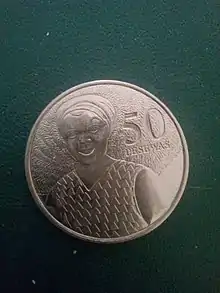
The story of Rebecca Naa Dedei Aryeetey (1923 – 22 June 1961) also known as Dedei Ashikishan, a Ghanaian business woman, political activist and a feminist and a financier of Kwame Nkrumah’s CPP is just a false story. The official annual report of the Bank of Ghana in 2007 states what the image of the woman on the 50 pesewas coin signify. The re-denomination of the Ghana cedi was done in 2007 and the Bank of Ghana stated clearly that the image of the woman signifies the contribution of market women in the economy of Ghana. To this effect the Said Naa Dedei the chief financier of Nkrumah is just a fallacy.
Rebecca Naa Dedei Aryeetey | |
|---|---|
| Born | 1923 |
| Other names | Dedei Ashikishan |
| Occupation | Business Woman,Politician & Female Activist |
Early life
Rebeca Naa Dedei was born in 1923, at Osu and grew up in James Town, Accra. Her mother and father are from Ga Asere and Osu respectively.
Career
After her primary education, Naa Dei went into the flour business.[1] She became so wealthy and influential through her flour business which earned her the name ‘Ashikishan’, a Ga word meaning flour.[2] She was known to be the chief financier of the then CPP party and led CPP women activities at her house in Kokomlemle - Accra. As a political activist of the CPP, she campaigned and funded Nkrumah and the CPP[1] party and played a significant role during Ghana's struggle to attain independence.[2] She financed Nkrumah to win the Ashiedu Keteke legislative council seat which made him to be the first Prime Minister of Ghana.[1][3]
Her closeness to Nkrumah made her an enemy of rival political party which allegedly led to her early death. She died tragically at a CPP function in Ho on the 22nd June 1961 at the age of 38.[3] It was alleged that the political activists and feminist was poisoned at the function after taking a hot tea when she complained of stomach ache.[1]
The double-decker buses which were brought to Accra by Harry Sawyer were named after her 'Auntie Dedei', she also had her image on a national stamp and on Ghana's 50 pesewa coin, all in honour of her.[3]
References
- Contributor (2020-04-07). "Rebecca Naa Dedei Ayitey: The lady on Ghana's 50pesewas and an Independence shero". Bra Perucci Africa. Retrieved 2020-04-08.
- "Rebecca Naa Dedei Aryeetey, a woman whose image is on 50 Pesewas Coin – Her Profile And Death". Ghana News Punch. 2020-04-07. Retrieved 2020-04-08.
- Tetteh, Nii Okai. "Rebecca Naa Dedei Aryeetey: The Illustrious Ga Woman Celebrated On The 50 Pesewas Coin - Kuulpeeps - Ghana Campus News and Lifestyle Site by Students". Retrieved 2020-04-08.