Bingsu
Bingsu (Korean: 빙수), sometimes written as bingsoo,[1] is a Korean shaved ice dessert with sweet toppings that may include chopped fruit, condensed milk, fruit syrup, and red beans.[2][3]
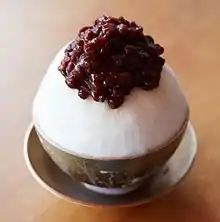 Pat-bingsu (red bean bingsu) | |
| Alternative names | Bingsoo |
|---|---|
| Type | Shaved ice |
| Course | Dessert |
| Place of origin | South Korea |
| Serving temperature | Cold |
| Main ingredients | Ice, toppings |
| Variations | Pat-bingsu (red bean bingsu), nokcha-bingsu (green tea bingsu), ttalgi-bingsu (strawberry bingsu), choko-bingsu (chocolate bingsu), etc |

| Korean shaved ice | |
| Hangul | 빙수 |
|---|---|
| Hanja | 氷水 |
| Revised Romanization | bingsu |
| McCune–Reischauer | pingsu |
| IPA | [piŋ.su] |
| Red bean shaved ice | |
| Hangul | 팥빙수 |
| Hanja | 팥氷水 |
| Revised Romanization | pat-bingsu |
| McCune–Reischauer | p'at-pingsu |
| IPA | [pʰat̚.p͈iŋ.su] |
The most common variety is pat-bingsu (Korean: 팥빙수), the red bean shaved ice. The main ingredient of ice was natural ice in the past, but later artificial ice was produced and high-quality sweeteners were developed, and now it has been improved into boiled red bean shaved ice or fruit shaved ice mixed with various fruits. At first, the ice-cutting machine was a simple tool in the shape of a plane, but now the electric power is widely used after a manual rotation by hand.
History
The early forms of patbingsu consisted of shaved ice and two or three ingredients, typically red bean paste, tteok, and ground nut powder.[4] The earliest forms of patbingsu existed during the Joseon dynasty (1392–1897). Government records show officials sharing crushed ice topped with various fruits.[5][6]
The modern version of the dessert usually is placed in the Korean bakery Tae Keuk Dang. However, elder people in Korea use to point out that the patbingsu became popular after the Korean war. The dish was made with ingredients from the USA surplus supplies and was sold as street food.[7]
Varieties
Patbingsu (팥빙수, 팥氷水, sometimes anglicized as patbingsoo, literally "red beans shaved ice") is a popular Korean shaved ice dessert with sweet toppings that may include chopped fruit, condensed milk, fruit syrup, and red beans.[2]
The food began as ice shavings with red beans (known as pat, 팥). Many varieties of patbingsu exist in contemporary culture.
There are a variety of bingsu types and flavors. Many bingsu do not necessarily follow tradition, and some do not include the red bean paste.[8] Some popular flavors are: green tea, coffee, and yogurt.[9]
In various countries
Korea
In addition to the existing patbingsu, several Korean franchises have made shaved ice made from various ingredients such as Injeolmi shaved ice, melon shaved ice, coffee shaved ice, and green tea shaved ice. Since the Joseon Dynasty, it was the first time to mix honey and fruit with ice taken from bingo, and after the Korean War, condensed milk, syrup, and chocolate were introduced from the United States and modern "Korean shaved ice" began to be made. Now, bingsu can be found at almost every dessert shop in Korea.[10]
Japan
In a tea shop in Kagoshima, Shirokuma (the white bear, 白熊) was made, and the shape of white condensed milk poured over shaved ice in a round bowl and fruits such as sweet red beans, cherries, and tangerines was named after what looked like a white bear's face.
Singapore
Due to the characteristics of mangoes, mango shaved ice with many mangoes is also famous, as served in a store in Singapore. The "Monster bingsu" is also famous for freezing various flavors of milk, grinding it into layers, and putting chocolate shaped like eyeballs. This variant has shaved ice grounded to show the grain of milk rather than ice with water.[11]
Gallery
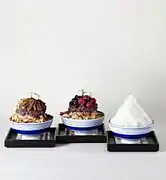 Various bingsu
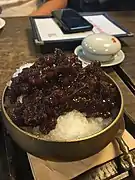 Patbingsu
 Persimmon bingsu
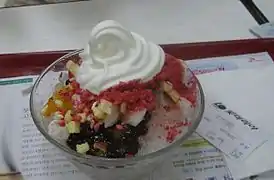 Bingsu with ice cream
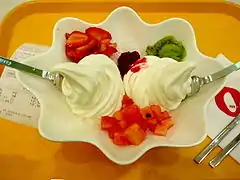 A yogurt bingsu
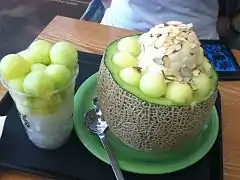 Melon bingsu
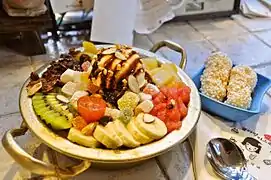 Patbingsu topped with fruits
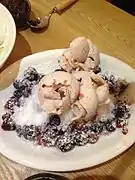 Berry bingsu
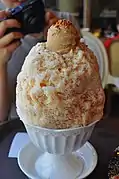 Milk tea bingsu
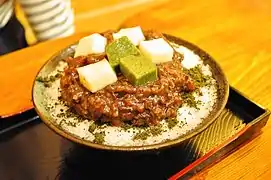 Black sesame bingsu
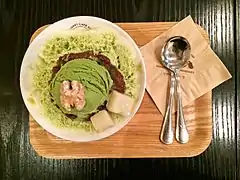 Green tea bingsu
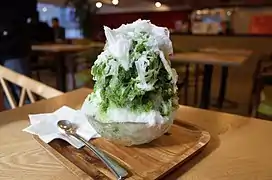 Green tea bingsu
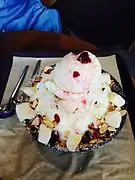 Cheese bingsu
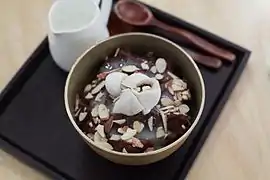 Patbingsu
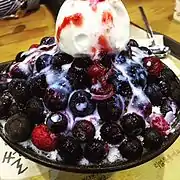 Mixed-berry bingsu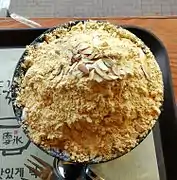
References
- Hoo, Winyan Soo (July 16, 2014). "Plate Lab: A guide to Asian shaved ice desserts halo-halo, bao-bing and bingsoo". The Washington Post. ISSN 0190-8286. Retrieved May 5, 2016.
- Lee, Robyn (June 5, 2009). "Snapshots from South Korea: Patbingsu, a Popular Shaved Ice Dessert". Serious Eats. Retrieved January 5, 2013.
- Kyoung Woo Jun, for. "Seoul hotels at war over dessert - CNN.com". CNN. Retrieved May 5, 2016.
- Min, Ines (June 3, 2010). "Ice cream explorations and a peek into the past". The Korea Times. Retrieved January 5, 2014.
- Dang, Tae Keuk (September 13, 2010). "Snowy delights and variations on bingsu". Herald Corporation. Retrieved January 6, 2014.
- 팥빙수[氷水] [Patbingsu]. Doopedia (in Korean). Doosan Corporation. Retrieved January 6, 2014.
- "Seoul Eats: The Origin of Patbingsu". Seoul Eats. Retrieved August 9, 2020.
- "Bingsu, an unbeatable summer treat!". KOREA TOURISM ORGANIZATION. Retrieved January 6, 2014.
- Lee, Ji-yoon (July 7, 2008). "Korea's cold summer taste - naengmyeon and patbingsu". Korea.net. The Korean Culture and Information Service. Retrieved January 6, 2013.
- Linda (October 12, 2019). "15 of the Best Bingsu in Seoul". Linda Goes East. Retrieved June 11, 2021.
- Ang, Daniel. "Roji Monster Ice Cream". Retrieved June 11, 2021.
External links
 |
Wikimedia Commons has media related to Bingsu. |