René Marcil
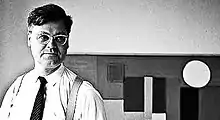
René Marcil (1917-1993) was a Canadian Québécois artist, painter and fashion illustrator[1] from Montréal, Québec. He spent most of his professional life in New York, Paris, London and the French Riviera. Marcil played a central role in the successful post-war launch of Christian Dior’s New Look (style of clothing) collection in the United States.
René Marcil | |
|---|---|
 | |
| Born | May 29, 1917 |
| Died | September 25, 1993 (aged 76) |
| Nationality | Canadian Québécois |
| Education | École des beaux-arts de Montréal, Académie de la Grande-Chaumière |
| Known for | Painting, Fashion illustration |
Notable work | Rider, Dévoile-moi tes charmes, Voulez-vous jouer avec moi? |
| Movement | Neoplasticism, Abstract painting, Neo-expressionism |
Early life
As a youngster, while recovering from major surgery, he collected and copied religious pictures, reproductions of Raphael and Piero della Francesca. At 14, he was admitted to the École des Beaux-Arts de Montréal.
Fashion illustration period
Marcil’s fashion drawings are expressive and refined according to Olivier Gabet,[2] director of the Musée des Arts Décoratifs, Paris at the Louvre.[3] He was the "perfect choice to reinterpret[4] Dior's vision.‘’
In 1947, Marcil's illustrations of models wearing what became known as Dior's "New Look (style of clothing)" outfits contributed to the collection's appeal to American women. The expression "New Look" is believed to have been coined by Carmel Snow editor-in-chief of the American edition of Harper's Bazaar.
Writer and curator Alexander Fury wrote that by 1956, the house of Dior was responsible for generating half the total French haute couture exports to the USA. Time magazine reported: ‘’[Dior] is the Atlas, holding up the entire French fashion industry.‘’[5]
Neoplasticism & Abstract painting period
Marcil moved to Paris in the 50’s and joined the Académie de la Grande Chaumière. He lived in a high ceiling artist's studio on rue Séguier near the Quai des Grands-Augustins. He socialized in the Montparnasse bistros with the Sonia Delaunay and other artists living nearby at the time.
Le Delarge notes that Marcil moved to Paris which
" introduced him to a taste for neoplasticism, for which he used bright colors...."[6]
Marcil's talent as a colorist became evident along with his idealization of visual perception of an abstract concept in a perfectly harmonious balance. His work is described by his contemporaries as:
"intense, luminous and has the quality of combining graphic design, great draftmanship, extraordinary color, fascinating surfaces ... [and] delicate poetic feeling"[7][8]
"He [Marcil] communicates the pleasure he discovers in putting down his ideas, his facility with paint and his almost epicurean device in making his luminous surfaces come together without conflict... his glowing sensuous colours of his abstract paintings are bright, unmuddied, and they come movingly together, cleared of all inessentials."[9][8]
During this period, Marcil commuted between Paris and New York. His work was exhibited in a number of galleries including a solo show in 1964 at the van Diemen-Lilienfeld Galleries on 57th St., New York. He also worked as a fashion illustrator for Stanley Marcus and in 1957, as a consultant in establishing the ‘’International Fortnight’’ which became a Nieman-Marcus tradition.
In 1977, Marcil’s The Abstract Couple dated 1954 entered the permanent collections of the Metropolitan Museum of Art, New York. Curator Elizabeth Flinn refers to this work as ‘’poetic in color and composition’’ and subsequently, artworks by Marcil were included in a Modern Art group exhibition alongside works by Pollock and Magritte.[10]
Neo-expressionism period
He later evolved towards Neo-expressionism sometimes called the ‘’New Fauves’’ to better meet the meaning of the term. The style is characterized by intense subjectivity and rough handling of materials.[11] During his Neo-expressionist period, Marcil was influenced by the Naturalism literary movement.
In one of his letters in 1986, Marcil writes:
" If I am talking to you about Dubuffet, Combas and Haring, it is because my work has been oriented in this direction for a long time....
A contemporary artist does not paint a picture for aesthetic reasons or for the sake of beauty if you prefer. Dubuffet was the first to place social thought above the artistic work and the latter only serves to define his thought ... even here in France, left-wing and right-wing politicians rejected his work, and his only supporters were writers and intellectuals. Fortunately, in Paris, there are always men (and women) who can express themselves freely because freedom of expression is something the French will never give up ....
Keith Haring's approach is excellent. In his good-natured style, he says very serious things."
As echoed in the following excerpt from Cornette de Saint-Cyr, Paris, Art Contemporain catalogue, 2012:
" The subject, form and flamboyant colors in Marcil’s work represent an artistic language totally in tune with the new generation’s aspirations of his time. This language was meant as a challenge to his peers .... In the hybrid repertoire so typical of Marcil, a common thread is his casual painting style inspired by daily life that it unmasks. "[12]
In another letter in 1989, Marcil writes:
" ... we are now moving out of a millennium of liberation and freeing, of energies, and into a period of implosion, going from a sort of maximum radiance and into a phase of social reversion – a gigantic reversion of a field once its saturation point has been reached. Stellar systems do not cease to exist either, once their radiating energy has dissipated – they implode according to a process which is slow at the outset and then progressively accelerates – they contract at an extraordinary rhythm and become involutive systems.
Large metropolises have perhaps become sites for implosion to occur, places for absorption, where society itself is reabsorbed including the golden era, contemporaneous to this twin concept of capital and revolution, is without a doubt ended.
The social is slowly and brutally involuting into an inert field which already envelops politics."
Important Public Collections
Marcil's artwork is present in the Collections Nationales de France, Ministère de la Culture de France[10] and in the permanent collections of the Musée des Arts Décoratifs, Paris at the Louvre[13] and the Metropolitan Museum of Art,[10] New York.
Marcil Estate
The U.S. copyright representative for the Marcil Estate (Patrimoine Marcil) is the Artists Rights Society.[14]
Bibliography
References
- Benezit (2010). Benezit Dictionary of Artists. Oxford University Press. doi:10.1093/benz/9780199773787.article.B00116362. ISBN 978-0199773787.
- Gabet. Gabet.
- MAD. Rapport d'activité (PDF). p. 32.
- MAD. Rapport d'activité 2018 p.93.
- Alexander Fury (2017). DIOR Catwalk. Yale University Press. ISBN 978-0-300-22584-6.
- Le Delarge. Le Delarge.
- Jean-Pierre Valentin, Galerie l'Art Français. René MARCIL.
- Waddington's. Waddington's.
- Kay Kritzwiser, art critic The Globe and Mail. René MARCIL.
- Waddington's. Waddington's.
- Chilvers, Ian and John Glaves-Smith. A Dictionary of Modern and Contemporary Art. Oxford University Press (2009), p. 503.
- Cornette de Saint Cyr. Cornette de Saint-Cyr , Art Contemporain, Lundi 17 décembre 2012. Drouot Richelieu, p. 221.
- Ministry of Culture (September 2019). "Bulletin Officiel n. 296" (PDF) (in French). p. 127.
- Artists Rights Society. Artists Rights Society.
- amazon.com. Amazon.com. ISBN 098104980X.
External links
- Émile Zola
- https://www.renemarcil.org/
- https://www.renemarcil.com
- https://www.wikiart.org/en/rene-marcil
- https://www.youtube.com/watch?v=olhas36m9ho
- https://www.youtube.com/results?search_query=rene+marcil
Authority control  | |
|---|---|
| General | |
| National libraries | |
| Art research institutes | |
| Other | |