Reymerston Hall, Norfolk
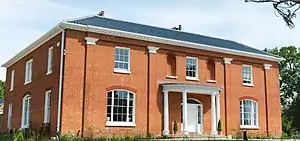
Reymerston Hall in Norfolk is a Georgian building of historical significance and is listed on the English Heritage Register.[1] It was built in the 1700s by a wealthy landowning family and was the home to many notable residents over the next two centuries. Today it is a wedding venue which has recently undergone extensive renovations.
Early owners
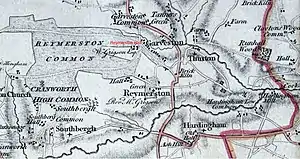
Faden’s Map of 1797 reveals that the house was owned at this time by William Grigson (1755-1807) who was a cleric. He came from a wealthy family which had owned land in Reymerston for many years. His father was Thomas Grigson (1715-1784) who in 1754 had married Catherine Branch (1732-1760). She was the daughter of Henry Branch of South Lopham. The couple had two sons William and Robert. William was the elder and Robert died aged 19 in 1776. All four members of this family are buried in St Peter’s Churchyard, Reymerston. Their tombstones or memorial plaques can be seen at this reference.[2]
When Thomas died in 1784 William inherited his property including Reymerston Hall. William had been educated at the University of Cambridge and was ordained in 1778. He was the rector at Peterborough and later at Ely.[3] He did not marry and had no direct heirs so when he died in 1807 he left some of his property, which included Reymerston Hall, to the Reverend Thomas Mann.
Reverend Thomas Mann (1761-1847) was educated at the University of Cambridge and ordained in 1786. He was rector for many years at Norwich.[4] He did not live at the house and for much of the time it was rented to wealthy tenants. One of these was John Turner Graver Browne who was there from 1830 until 1840. John later inherited Morley Hall Norwich (now Lambert Civil Engineering building). He is recorded in the 1838 Tithe Maps as the tenant and Reverend Thomas Mann is the owner. Thomas Mann was a bachelor and when he died in 1847 he left Reymerston Hall to George Latham Press.[5]
George Latham Press (1808-1884) was a landed proprietor and magistrate. He did not marry and the 1851 Census records him living at Reymerston Hall with his widowed sister Mary Robberds who occasionally stayed with him. Mary died in 1872 and George in 1884. There is an elaborate tombstone for both of them in St Peter’s Churchyard which can be seen at this reference.[6]
The house was rented for some time and the next notable resident was Captain Algernon Basil Feilden (1865-1926) who was there from about 1893 until 1902. He was a captain in the Royal Lancaster Regiment. At this stage he was single but he did marry later. He turned the property into a horse stud. The 1894 Hackney Stud Book lists two of his thoroughbred horses at Reymerston Hall.[7]
The Hare family bought the house in 1903 and were the owners for the next thirty years. Colonel Richard Charles Hare (1844-1917) joined the 22nd Cheshire Regiment and was later appointed A.D.C to General Sir Charles Ashe Windham who was then Commander in Chief in Canada.[8] He later married the General’s daughter Mary Windham (1857-1932) in 1875. The couple had six children. The 1911 Census records Richard and Mary at Reymerston Hall with two of their daughters, a cook, four servants and two footmen. When Richard died in 1917 his wife Mary continued to live there with her two unmarried daughters. She died in 1932 and some of her children continued to live there. By 1959 the property had been sold to Ken Wallis.
Ken Wallis
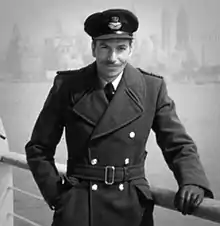
Wing Commander Kenneth Horatio Wallis (1916-2013) was an inventor, a record breaking pilot, a war hero and a stunt double for Sean Connery in a James Bond movie. Ken was born in 1916 in Ely. His father had a business which specialised in building motorcycles. Even in his teens he designed, built and raced powerboats and sports cars. He joined the RAF when the War started and then moved to Bomber Command in 1941. He completed 24 missions over Europe as a pilot of Wellington bombers with 103 Squadron. Later he then served in Italy with 37 Squadron. He had several narrow escapes when his aircraft suffered severe damage but because he was a very skilful pilot he survived.[9] In 1942 he married Peggy Mary Stapley (1916-2003) who was a WAAF officer.
After the War he continued his career in the RAF and retired in 1964. By this time he had already purchased Reymerston Hall. He and his cousin formed the company Wallis Autogyros Limited and became very successful. Between 1968 and 2002 he set 17 World Records in two Classes of autogyro and many are still held by him, including the speed record of 129 mph.
Ken appeared in several major feature films and many television documentaries but his most famous was when doubling as James Bond in “You Only Live Twice”. He was offered this role in 1966 and the autogyro he flew was called “Little Nellie”. A recent article outlined the whole story of this escapade including the footage of James Bond flying the aeroplane. It can be read at this reference.[10]
The article mentions that:
"Bond’s double, Ken Wallis, would take off from a Japanese mountainside 85 times and be airborne for a total of 46 hours. Filming started most days at 6 a.m. with most of the action filmed at 6,000 feet above the volcanic landscape. Most filming occurred around Mount Shinmoe, which doubled for Blofeld’s volcano base. The scene where Bond first spots the SPECTRE helicopters via their shadows on a mountainside was shot at Sakurajima, an active volcano."[11]
Ken had about 20 aircraft at Reymerston Hall and over the years they were employed for many different investigative roles. Some of these included aerial surveillance and photography, detecting coastal erosion and damaged underground pipelines, Police duties such as searching for buried bodies and photographing archaeological sites.
Ken died in 2013 and the Hall was sold. It has recently been extensively renovated to become a wedding venue.
References
- English Heritage Register. Online reference
- Find a Grave website. Online reference
- Biographical history of Gonville and Caius college, 1349-1897”, p. 92. Online reference
- Biographical history of Gonville and Caius college, 1349-1897”, p 105. Online reference
- Post Office Directory of Norfolk, 1879, p. 451. Online reference
- Find a Grave website. Online reference
- The Hackney Stud Book, 1894, p. 199 and 438. Online reference
- “The Near East”, 17 August 1917, p. 449. Online reference
- Norfolk and Suffolk Aviation Museum website. Online reference
- Bold Entrance website. Online reference
- Bold Entrance website. Online reference