Richmond–San Rafael Ferry Company
The Richmond–San Rafael Ferry Company began as the Richmond–San Rafael Ferry and Transportation Company, and is a defunct ferry service that provided a water transport link between Castro Point in Richmond, California in Contra Costa County and San Quentin in Marin County across the San Pablo Bay before the construction of the Richmond–San Rafael Bridge.[2][3]
| Class overview | |
|---|---|
| Builders | Bethlehem Steel, San Francisco |
| Operators |
|
| Built | 1924 |
| In service | 1924–1956 |
| Building | 3 |
| Completed | 3 |
| Retired | 3 |
| General characteristics | |
| Type | auto/automobile ferry[1] |
| Tonnage |
|
| Length | 234 ft (71.3 m) |
| Beam | 45 ft (13.7 m) |
| Depth | 17 ft (5.2 m) |
| Installed power | Total 1,300 hp (970 kW) from 3 water tube boilers |
| Propulsion | 3-cylinder triple-expansion engine powering a single screw |
| Capacity | 78 vehicles |
| Crew | 13 |
History
Richmond–San Francisco Transportation Company was formed to establish a ferry route between those two cities and ordered three ferries for that purpose. Southern Pacific Transportation Company purchased the new company before it began operations and integrated the route into its San Francisco Bay transportation system. The three new ferries were among the most modern on the bay, and saw use on many routes during the peak and declining years of San Francisco Bay ferry service. Richmond–San Rafael Ferry Company purchased the ferries in 1938, and Southern Pacific discontinued ferry service to Richmond in 1939. A fourth ferry, Sierra Nevada, was purchased from Southern Pacific in 1947.[4]
The ferry terminal in Richmond was located on Castro Point with a toll plaza and street car line connection from the Eastshore and Suburban Railway. The ferry also carried inmates to San Quentin Prison.[2]
The Ferries
El Paso
El Paso (documentation number 224327) was launched on 27 October 1924 and delivered to Southern Pacific on 8 December. She was put into service on Southern Pacific's route between San Francisco and Oakland, California. El Paso collided with the Southern Pacific ferry Berkeley on the foggy morning of 30 November 1936, but neither ferry was seriously damaged. El Paso was dismantled for scrap after the Richmond–San Rafael Bridge opened in 1956.[5]
New Orleans
New Orleans (documentation number 224347) was launched on 10 December 1924 and delivered to Southern Pacific on 2 January 1925. The new ferry inaugurated service between Richmond and San Francisco on 15 January 1925 with fares of $1.20 for a car and driver and 20 cents per rider or pedestrian. This ferry was renamed Russian River when purchased from Southern Pacific for service across San Pablo Bay, and was dismantled for scrap after the Richmond–San Rafael Bridge opened in 1956.[6]
Klamath
A steamship ferry named for Klamath County, Oregon, it carried as many as 1,000 people and 78 cars. It was powered by a 1,400-horsepower, triple-expansion steam engine that drove two cast iron propellers, 10 feet in diameter, one on each end.
Southern Pacific Railroad (1925 – 1938)
The Klamath (documentation number 224401) was launched on 27 December 1924 and delivered to Southern Pacific Railroad on 26 January 1925.[7] The ferry ran auto routes between Oakland and the San Francisco Ferry Building until 1929, and later between Sausalito and San Francisco’s Hyde Street Pier from 1929 to 1938.
Richmond-San Rafael Ferry Company (1938 – 1956)
With the construction of the Golden Gate and Bay bridges, ferry traffic plummeted. The boat was sold to the Richmond-San Rafael Ferry Company and carried prison inmates between Point Molate and San Quentin for 18 years (1938-1956), until the arrival of the Richmond-San Rafael Bridge which put an end to its role as a passenger vessel in 1956.
Landor, and Associates (1964)
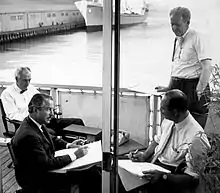
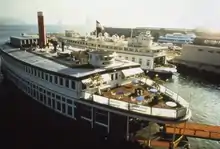
After nearly a decade, vacant in the Oakland Estuary, the Klamath was acquired at auction in 1964 by Landor, and Associates. Walter Landor had the boat refurbished and moored it at the old San Francisco Pier 5, where it served as the design firm's headquarters through the remaining 1960s, 1970s, and 1980s. During this time, it was a cultural hub for artists, musicians, actors and writers, among them Andy Warhol, Tom Wolfe and Marshall McLuhan.
Duraflame (1992)
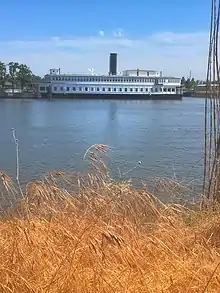
In 1992, the firelog creator Duraflame, INC bought the ferryboat and relocated to Ferry Harbor, a deep-water port of the Port of Stockton, docked for corporate meetings and private events.
Bay Area Council (2021)
The Bay Area Council paid $1.85 million for the vessel, plus tax, and signed a 15-year lease on July 13, 2021 with the Port of San Francisco, to serve as its floating headquarters. With renovations, it will provide approximately 20,000 square feet of office space totaling about 40,000 square feet along with other improvements accommodating corporate meetings and events. As the last major steamboat of its kind to operate on the bay, the vessel will also serve as a conference center and be open to the public.
References
- Ford, Robert S. Red Trains in the East Bay (1977). Interurban Press. ISBN 0-916374-27-0. pp. 166, 343–346.
- Changes in the Richmond Waterfront, access date 25-02-2009
- Point Molate Casino EIR, Volume I, 2009, accessed May 25, 2010 Archived July 15, 2011, at the Wayback Machine
- Ford, Robert S. Red Trains in the East Bay (1977). Interurban Press. ISBN 0-916374-27-0. p. 166–169, 342
- Ford, Robert S. Red Trains in the East Bay (1977). Interurban Press. ISBN 0-916374-27-0. pp. 166, 199, 342–343.
- Ford, Robert S. Red Trains in the East Bay (1977). Interurban Press. ISBN 0-916374-27-0. pp.166–167, 342, 344.
- Ford, Robert S. Red Trains in the East Bay (1977). Interurban Press. ISBN 0-916374-27-0 pp.166–167, 344.