Rishton, Uzbekistan
Rishton (Uzbek: Rishton, Tajik: Рештон, Russian: Риштан, alternative spellings Rishtan, Rishdan, Roshidon, previously called also Kyubishev by Russians) is a town (pop est 22,580) in Fergana Region, in Uzbekistan, about halfway between Kokand and Fergana. It is located at latitude 40°21'24N longitude 71°17'5E, and at an elevation of 471 meters.
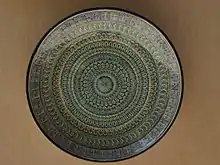
Rishton
Rishton / Риштан | |
|---|---|
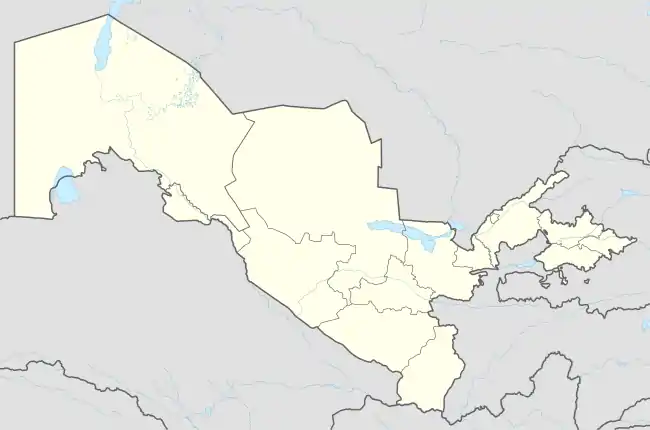  Rishton Location in Uzbekistan | |
| Coordinates: 40°21′24″N 71°17′05″E | |
| Country |  Uzbekistan Uzbekistan |
| Region | Fergana Region |
| Elevation | 471 m (1,545 ft) |
| Population (2019) | |
| • Total | 201,200 [1] |
| Website | www.rishton.uz |
Rishton is the most famous, and one of the oldest centers of ceramics in Uzbekistan. A fine quality reddish-yellow clay deposit 1-1.5 meters deep and 0.5-1.5 meters thick underlies almost the whole Rishton area. The clay can be used without refinement or addition of other types of clay from other regions. Besides clay, the potters of Rishton extracted various dyes, quartz sand, and fire clay from the surrounding the mountains. The special "ishkor" blue glaze is manufactured by natural mineral pigments and mountain ash plants.[2]
Hanafi scholar Burhan al-Din al-Marghinani, the author of the book al-Hidayah, was born in this small town and grew up in neighbouring Margilan.[3]
Main languages spoken in this area are Tajik and Uzbek.
References
- World Gazetteer.
- "rishton".
- "Rishton travel guide". Caravanistan. Retrieved 2021-04-23.
External links
- http://rishton.uz/
- http://www.euronews.com/2016/02/01/postcards-from-uzbekistan-the-historic-beauty-of-rishtan-ceramics/
Capital: Fergana | ||
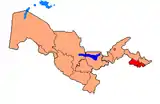
| Districts and seats |
|  |
| Other towns and villages | ||
Authority control  | |
|---|---|
| General | |
| National libraries | |