Robert Coates (critic)
Robert Myron Coates (April 6, 1897 – February 8, 1973) was an American novelist, short story writer and art critic. He published five novels; one classic historical work, The Outlaw Years (1930) which deals with the history of the land pirates of the Natchez Trace; a book of memoirs, The View from Here (1960), and two travel books, Beyond the Alps (1962) and South of Rome (1965). During his unusually varied career, Coates explored many different genres and styles of writing and produced three highly remarkable experimental novels, The Eater of Darkness (1926), Yesterday’s Burdens (1933) and The Bitter Season (1946). Highly original and experimental, these novels draw upon expressionism, Dadaism and surrealism. His last two novels—Wisteria Cottage (1948) and The Farther Shore (1955)—are examples of crime fiction. Simultaneously to working as a novelist, Coates maintained a life-long career at the New Yorker, whose staff he joined in 1927. The magazine printed more than a hundred of his short stories many of which were collected in three anthologies; All the Year Round (1943), The Hour after Westerly (1957) and The Man Just ahead of You (1964). Also, from 1937 to 1967, Coates was the New Yorker’s art critic and coined the term “abstract expressionism” in 1946 in reference to the works of Hans Hofmann, Arshile Gorky, Jackson Pollock and Willem de Kooning and others.[1][2][3][4] He was elected to the National Institute of Arts and Letters in 1958. Coates was married to sculptor Elsa Kirpal from 1927 to 1946. Their first and only child, Anthony Robertson Coates, was born on March 4, 1934. In 1946, they divorced and Coates married short story writer Astrid Meighan-Peters. He died of cancer of the throat in New York City on February 8, 1973.[5]
Robert M. Coates | |
|---|---|
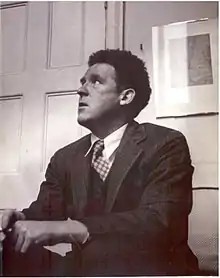 Coates, 1930s | |
| Born | Robert Myron Coates April 6, 1897 New Haven, Connecticut, U.S. |
| Died | February 8, 1973 (aged 75) New York City, U.S. |
| Occupation | Writer, art critic |
| Education | Yale University |
| Literary movement | Lost Generation |
Anthony Boucher praised Coates as "one of the most persuasive recorders of the unaccountable and disturbing moment," singling out his fantasy stories for their "haunting tone of uncertainty and dislocation."[6] Floyd C. Gale said that The Eater of Darkness "has been called the first surrealist novel in English".[7]
Maxim Lieber was Coates' literary agent from 1935 to 1938 and in 1941 and 1945.
Life
Early life
Coates was born in New Haven, Connecticut in 1897. He was the second but only living child of Harriet Coates, a Victorian with feminist sympathies and Frederick Coates, a toolmaker-cum-inventor who became a professional designer of special machinery. In 1905, the Coates family embarked on a 10-year tour of the United States. They moved so often that Malcolm Cowley wrote that the young Coates “grew up in more places than laid claim to Homer.”[8] Before he had turned eighteen, Coates had lived in various gold-mining camps in Colorado;[9][10] in Seattle, Washington; Portland, Oregon; Cincinnati, Ohio; Springfield, Massachusetts; Buffalo, New York; New York City; and Rochester, New York. As a result, as Coates recalls in his book of memoirs, “everywhere we went, I was, for a period at least, the new boy, the outsider.”[11] Even during the three years that the family stayed in Cripple Creek (1905-1908), they were far from stationary. They moved from the fairly large town of Victor to Independence, then moved on to Goldfield, and finally settled down in the tiny settlement of Christmas Crossing, a “mere clump of log huts and tar-papered shanties” [12] at an altitude of close to eleven thousand feet.
Yale University and Woodstock
In 1915, Coates enrolled at Yale University (class of 1919). He published several short stories in the Yale Literary Magazine, and joined its editorial board in the spring of 1918. His early stories took their inspiration from realist writers like O.Henry on the one hand and naturalist writers like Du Maupassant and Theodore Dreiser on the other. Coates also was a member of the literary fraternity “Chi Delta Theta” where he found himself in the company of poet Stephen Vincent Benét, playwrights Thornton Wilder and Philip Barry, and future founder and editor of Time, Henry Luce. When the US became involved in World War I, Coates became a private in the Yale R.O.T.C. in November 1917 and joined the air service (naval aviation) in June 1918. The war was over, however, before he had obtained his wings.
After graduation, Coates moved to New York and worked as an advertising man for the United States Rubber Company. In the spring of 1921 he exchanged New York City for the rural surroundings of Woodstock, in upstate New York, and devoted himself to writing poetry[13] (VFH, 199). The following unpublished poem, inspired by metaphysical poetry, is called “The Noose:”[14]
I hold my whole life like a noose,
Following you everywhere.
I hold it light and very loose
To make the better snare.
Still like the frightened butterfly
You would elude the net;
And like a gentle hunter, I
Shall fling it round you yet.
And though you flee across the field
And flutter in the heather.
Know that when captive you shall yield
We'll both be bound together.
Bibliography
Novels
- The Eater of Darkness (Contact Editions, Paris 1926; Macaulay, New York, 1929; republished by Putnam, 1959)
- Yesterday's Burdens (1933; rpt. 1975, 2020)
- The Bitter Season (1946)
- Wisteria Cottage (1948) (also known as The Night Before Dying)
- The Farther Shore (1955)
Short fiction
- Collections
- All the Year Round (1943)
- The Hour After Westerly (1957)
- The Man Just Ahead of You (1965)
- Stories[15]
| Title | Year | First published | Reprinted/collected | Notes |
|---|---|---|---|---|
| The law | 1947 | Coates, Robert (November 29, 1947). "The law". The New Yorker. Vol. 23 no. 41. pp. 41–43. | ||
Non-fiction
- The Outlaw Years (1930)
- Coates, Robert (January 15, 1949). "The Art Galleries: Blume, Delaunay, Glackens". The New Yorker. Vol. 24 no. 47. pp. 48–49. Reviews Peter Blume at the Durlacher Gallery, Robert Delaunay at the Sidney Janis Gallery, and William Glackens at the Kraushaar Galleries.
- Coates, Robert (January 28, 1950). "The Art Galleries: Rembrandt and Juan Gris". The New Yorker. Vol. 25 no. 49. pp. 60, 62. Reviews Rembrandt at the Wildenstein Gallery; Gris at the Buchholz Gallery.
- The View from Here (1960). Memoir
- Beyond the Alps (1961)
- South of Rome (1965)
References
Notes
- New Yorker, Peter Schjeldahl, Big Bang
- BBC The Power to Amaze, Abstract Expressionism
- Abstract Expressionism, NY, MoMA
- Clement Greenberg, Art and Culture Critical essays, ("American-Type Painting"), Beacon Press, 1961 p.:209, ISBN 978-0807066812
- Wagle, Greta (2003). "Coates, Robert M[yron]". In Serafin, Steven R. (ed.). The Continuum Encyclopedia of American Literature. Bendixen, Alfred. London: Continuum Publishing. p. 207. ISBN 0-8264-1517-2. Retrieved May 30, 2010.
- "Recommended Reading," F&SF, May 1957, p.77.
- Gale, Floyd C. (August 1960). "Galaxy's 5 Star Shelf". Galaxy Science Fiction. pp. 117–121.
- Cowley, Malcolm (1978). "Figure in a Crowd". And I Worked at the Writer's Trade Chapters of Literary History 1918-1978. Viking Press. p. 83.
- Coates, Robert M. (1960). The View from Here. New York: Harcourt, Brace. pp. 21–22.
- Coates, Robert M. (July 1951). "You'll still find gold in Cripple Creek". Holiday. 10.
- Coates. The View from Here. pp. 3–4.
- Coates. "You'll still find gold in Cripple Creek". Holiday: 93.
- Coates. The View from Here. p. 199.
- Robert M. Coates Collection, American Heritage Center, Laramie, WY
- Short stories unless otherwise noted.
Further reading
- Pierce, Constance. "Gertrude Stein and her Thoroughly Modern Protege." Modern Fiction Studies 42.3 (Autumn 1996): 607–25.
- Pierce, Constance. "Language • Silence • Laughter: The Silent Film and the 'Eccentric' Modernist Writer." SubStance 16.1 (1987): 59–75.
- Roza, Mathilde. Following Strangers: The Life and Literary Works of Robert M. Coates. Columbia, SC: University of South Carolina Press, 2011.
- Roza, Mathilde, & Mearns, Jack. "Collecting Robert M. Coates". Firsts, 17.8 (2007): 18–27.
Authority control  | |
|---|---|
| General | |
| National libraries | |
| Other | |